
Publication Date: June 25, 2026
Author: Hu Yanwei, Cymber Metal Technical Expert
For busbar projects, oxygen-free copper rod should be inspected before bulk order confirmation, not after delivery. Buyers should verify copper grade, chemical composition, conductivity, diameter tolerance, surface quality, internal defects, straightness, batch traceability and export packaging.
For high-current busbars, switchgear, transformers, electrical panels and power distribution systems, raw copper quality directly affects fabrication accuracy, electrical conductivity, heat rise and long-term connection reliability.
CYMBER Metal supplies pure copper products, including copper rod, copper bar, copper plate, copper tube and pure copper busbar for electrical and industrial applications. For busbar cutting, drilling, bending and production flow support, buyers can also review the CYMBER Busbar Fabrication Workshop.
Why Oxygen-Free Copper Rod Matters in Busbar Projects
A busbar project does not fail only because of fabrication mistakes. Sometimes the problem starts earlier, from raw copper rod quality.
If the oxygen-free copper rod has unstable conductivity, internal porosity, inclusions, surface cracks or poor dimensional consistency, downstream processing may become difficult. These issues can affect extrusion, rolling, cutting, drilling, bending, plating and final busbar assembly.
For bulk power distribution projects, the cost of poor copper rod quality is not only material loss. It may cause delayed production, rejected busbars, unstable electrical performance and project delivery risk.
C10100 vs C10200 vs C11000: Which Copper Grade Should Buyers Consider?
For busbar and electrical applications, buyers often compare oxygen-free copper and standard ETP copper.
| Copper Grade | Common Description | Typical Buyer Concern | Suitable Use |
|---|---|---|---|
| C10100 | Oxygen-free electronic copper | Very high purity and low oxygen content | High-reliability electrical systems |
| C10200 | Oxygen-free copper | Stable conductivity and good forming performance | Busbar, electrical connection and power equipment |
| C11000 | Electrolytic tough pitch copper | High conductivity and strong availability | Standard busbars, panels and switchgear |
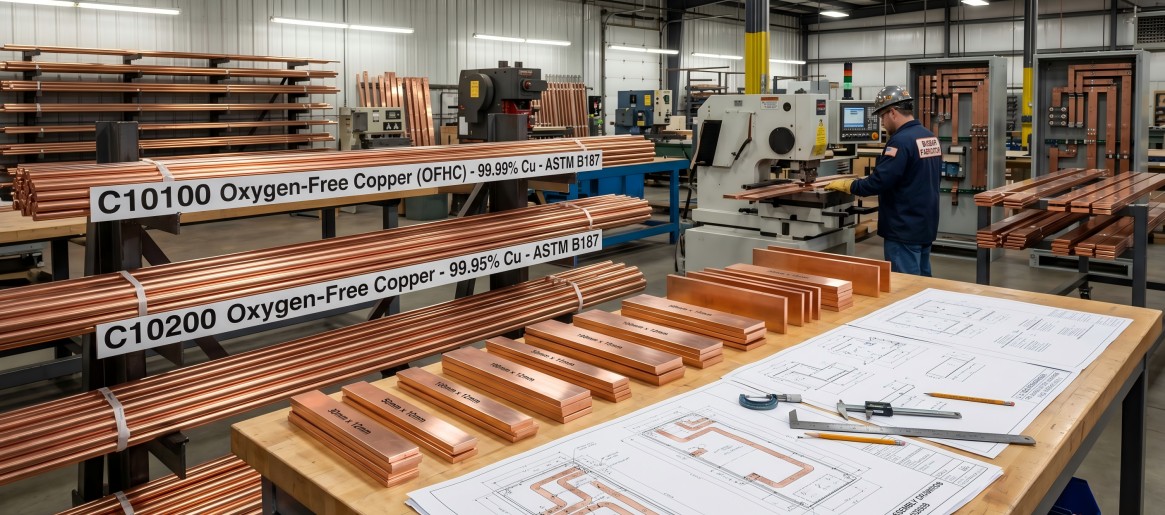
C11000 is widely used for electrical copper busbars. C10100 and C10200 are often selected when buyers need lower oxygen content, better purity control and stable performance in demanding electrical systems.
For finished power distribution components, buyers can compare oxygen-free copper rod with pure copper busbar, high-conductivity tinned copper busbar and related pure copper materials. If the project requires tin plating, nickel plating or surface protection, buyers can also review CYMBER’s electroplating workshop process.
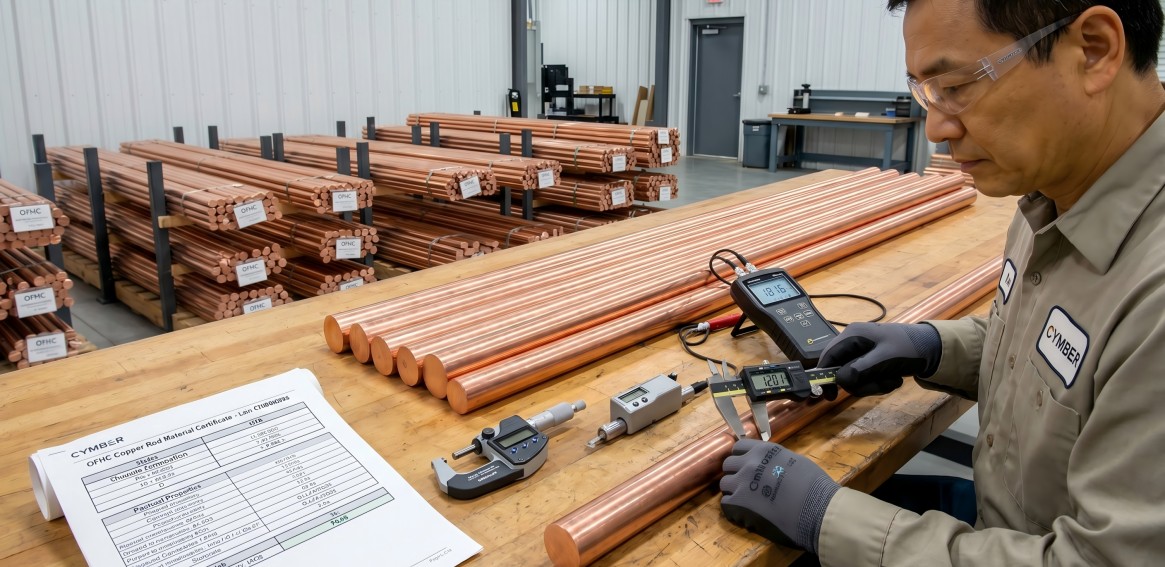
Inspection Items Before Bulk Ordering Oxygen-Free Copper Rod
Before confirming a bulk order, buyers should ask the supplier to define the inspection scope clearly.
| Inspection Item | What to Check | Why It Matters |
|---|---|---|
| Chemical composition | C10100, C10200 or agreed grade | Confirms material identity |
| Oxygen content | Low oxygen level according to grade requirement | Reduces risk of internal defects and performance instability |
| Conductivity | %IACS or agreed conductivity value | Supports busbar electrical performance |
| Diameter tolerance | Actual diameter across the batch | Affects rolling, machining and busbar fabrication |
| Surface quality | Cracks, scratches, oxidation, stains | Reduces downstream processing defects |
| Internal soundness | Porosity, inclusions, internal cracks | Prevents hidden failure during fabrication |
| Straightness | Rod alignment and handling quality | Helps cutting and machining consistency |
| Mechanical properties | Hardness, tensile or elongation when required | Supports forming and processing reliability |
| Batch traceability | Heat number, lot number, certificate | Supports project documentation |
| Packaging inspection | Protection against moisture and impact | Reduces export transportation damage |
For large-volume red copper rod, copper bar and busbar-related procurement, CYMBER’s red copper bar and busbar core warehouse can support stock checking, batch preparation and export packing coordination.
Common Defects Found in Oxygen-Free Copper Rod
Oxygen-free copper rod looks simple from the outside, but several defects may be hidden inside the material.
| Defect | Possible Cause | Risk in Busbar Projects |
|---|---|---|
| Internal cracks | Casting, extrusion or rolling stress | Cracking during machining or bending |
| Porosity | Gas or process control issues | Lower mechanical integrity and unstable processing |
| Inclusions | Contamination during production | Poor conductivity or surface defects after machining |
| Segregation | Uneven material structure | Inconsistent conductivity or forming behavior |
| Surface scratches | Handling or transport damage | Plating defects or rejection after inspection |
| Oxidation | Poor storage or packaging | Surface cleaning cost and contact reliability risk |
| Diameter variation | Process control issue | Poor fit during cutting, rolling or machining |
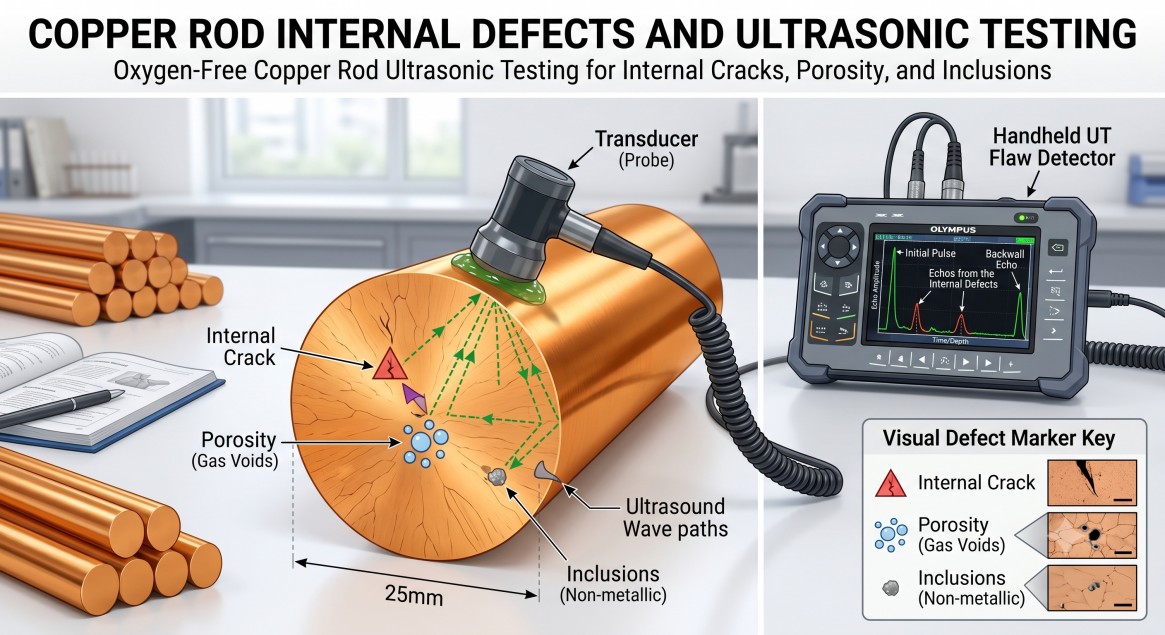
For busbar projects, internal defects are more serious than cosmetic surface marks. A small hidden defect can become a major problem after cutting, machining, bending or plating.
Why Ultrasonic Testing and Conductivity Testing Matter
For high-value busbar projects, buyers should not rely only on visual inspection.
Ultrasonic testing can help identify internal cracks, porosity and discontinuities that may not be visible on the surface. Conductivity testing helps confirm whether the copper rod can support the intended electrical performance.
A practical inspection package may include:
- Material certificate
- Chemical composition report
- Conductivity test report
- Dimensional inspection report
- Surface inspection photos
- Ultrasonic testing report when required
- Packaging photos before shipment
- Batch traceability record
This kind of documentation is especially useful for switchgear, transformer, energy storage and power distribution projects where buyers need quality records before production.
How Oxygen-Free Copper Rod Connects to Busbar Fabrication
Oxygen-free copper rod is often used as upstream raw material before further processing into copper bar, plate, strip or busbar components. The final busbar quality depends on both raw material and fabrication control.
Buyers should confirm whether the supplier can support:
- Raw copper rod supply
- Copper bar or plate preparation
- Cutting and sizing
- CNC drilling and slotting
- Deburring and chamfering
- Bending and forming
- Tin, nickel or silver plating
- Export packing and labeling
For finished parts, CYMBER can support copper material supply and busbar processing coordination through our Busbar Fabrication Workshop. If the project requires tin plating, nickel plating or other surface protection, buyers can also review our electroplating workshop process.
Buyers evaluating complete busbar sourcing can also read our guide on how to choose a reliable custom copper busbar supplier.
Bulk Order Quotation: Do Not Compare Price Alone
For oxygen-free copper rod, price comparison should not be limited to one number per kilogram.
A transparent quotation should separate:
Final Cost =
Copper Reference Price
+ Grade Premium
+ Processing Fee
+ Inspection Requirement
+ Cutting or Preparation
+ Packaging
+ Freight or Export Handling
For large copper orders, buyers may ask whether the quotation is linked to SMM or LME copper reference pricing, plus a transparent processing fee. This helps reduce confusion when copper prices fluctuate.
A very low quote may exclude conductivity testing, ultrasonic testing, export packing or required documentation. For busbar projects, that saving can disappear quickly if the material fails inspection after delivery.
Buyer Checklist Before Confirming Oxygen-Free Copper Rod
Before confirming a bulk order, buyers should ask these questions:
| Question | Why It Matters |
|---|---|
| Is the grade C10100, C10200 or another agreed copper grade? | Prevents material mismatch |
| Is conductivity clearly specified? | Supports electrical performance |
| Is oxygen content controlled and documented? | Confirms oxygen-free copper quality |
| Are diameter and length tolerances defined? | Reduces downstream processing risk |
| Is ultrasonic testing required? | Helps detect hidden internal defects |
| Are surface defects clearly controlled? | Protects plating and machining quality |
| Is batch traceability available? | Supports project documentation |
| Are packaging photos provided before shipment? | Reduces transport damage risk |
| Is the quotation structure transparent? | Makes supplier comparison easier |
| Can the supplier support related copper busbar processing? | Simplifies procurement and project coordination |
Why Buyers Work With CYMBER Metal
CYMBER Metal supports overseas buyers who need pure copper materials and custom processing for electrical, power distribution, machinery and industrial manufacturing projects.
Our support includes:
- Oxygen-free copper rod, pure copper rod, copper bar, copper plate and copper tube supply
- Pure copper product coverage for electrical and industrial applications
- Copper busbar and tinned busbar sourcing support
- Busbar cutting, drilling, bending and fabrication coordination through our busbar fabrication workshop
- Tin plating, nickel plating and surface treatment support through our electroplating workshop process
- Batch checking and stock preparation through our red copper bar and busbar core warehouse
- Export packing and international shipment support
- Quotation based on material grade, inspection requirement, processing and delivery needs
If your project requires oxygen-free copper rod, copper busbar, copper plate, copper bar or related electrical copper components, send your grade, diameter, quantity, tolerance and inspection requirements through the CYMBER Metal contact page.
Conclusion
Oxygen-free copper rod inspection should be completed before bulk order confirmation, especially for busbar and power distribution projects. Buyers should verify grade, conductivity, oxygen content, surface quality, internal soundness, dimensional tolerance, traceability and packaging.
A reliable supplier helps buyers control risk before production starts. For large electrical projects, this can be the difference between stable busbar fabrication and costly project delay.
FAQ
What is oxygen-free copper rod used for?
Oxygen-free copper rod is used in electrical, busbar, transformer, power distribution, electronic and high-conductivity applications where low oxygen content and stable electrical performance are required.
Is C10200 suitable for copper busbar projects?
Yes. C10200 oxygen-free copper is often selected for electrical applications that require stable conductivity, low oxygen content and good processing performance.
What should buyers inspect before ordering oxygen-free copper rod?
Buyers should inspect copper grade, chemical composition, conductivity, diameter tolerance, surface quality, internal defects, straightness, traceability and packaging.
Is ultrasonic testing necessary for copper rod?
For standard orders, it may not always be required. For bulk busbar projects or high-reliability electrical applications, ultrasonic testing can help detect internal defects before shipment.
Can CYMBER supply copper rod and custom busbar processing?
Yes. CYMBER supports pure copper material supply, oxygen-free copper rod sourcing, copper busbar material support, busbar fabrication coordination, electroplating process support, inspection documentation and export packing.
Post time: Jun-25-2026