
Quick Answer
A reliable custom copper busbar supplier should do more than offer a low copper price. For power distribution projects, buyers should evaluate material grade, conductivity, dimensional tolerance, hole accuracy, bending capability, surface treatment, inspection documents, export packing and delivery control.
For switchgear, transformers, electrical cabinets, energy storage systems and industrial power equipment, the best supplier is usually the one that can understand drawings, control machining accuracy, document inspection results and deliver repeatable batch quality.
CYMBER Metal supports custom copper busbar supply, copper material selection, cutting, CNC machining coordination, inspection documentation and export-ready quotation. Buyers can review our pure copper products, CYMBER CNC Machining Workshop and large-scale copper and aluminum warehouse to understand our material and processing support.
Why Copper Busbar Supplier Selection Matters
A copper busbar is not just a conductive metal strip. It is part of the electrical path that affects current stability, heat rise, assembly accuracy and long-term power distribution reliability.
When the supplier does not control quality properly, the problem may appear later during production or installation:
- Hole positions do not match the switchgear or cabinet assembly.
- Burrs or sharp edges damage insulation sleeves.
- Surface oxidation affects plating or connection quality.
- Conductivity does not meet the required electrical load.
- Bending angles are inconsistent across the batch.
- Packaging damage creates scratches before installation.
- Inspection reports or batch traceability are missing.
For small orders, these issues may only cause rework. For power distribution projects, they can delay electrical panel assembly, transformer connection, substation installation or export delivery.
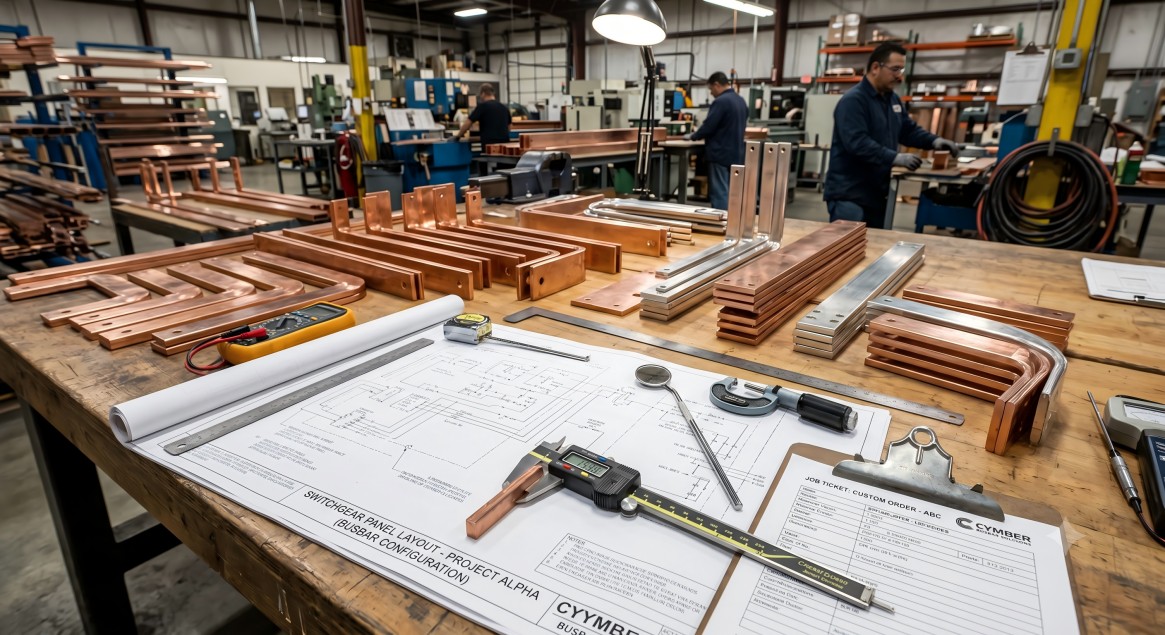
Common Applications for Custom Copper Busbars
Custom copper busbars are widely used in electrical and industrial power systems where conductivity, dimensional accuracy and stable assembly are required.
| Application | Buyer Concern | Busbar Requirement |
|---|---|---|
| Switchgear | Assembly accuracy and heat rise | Accurate holes, stable conductivity, clean surface |
| Electrical panels | Fast installation | Consistent dimensions and burr-free edges |
| Transformers | Reliable current connection | Proper copper grade and surface finish |
| Energy storage systems | Compact high-current transfer | Custom shape, plating and insulation support |
| EV charging systems | Thermal and electrical stability | High conductivity and repeatable machining |
| Industrial machinery | Durable power connection | Strong mechanical fit and corrosion control |
| Power distribution cabinets | Batch consistency | Traceability, packaging and inspection records |
This is why international buyers often need a supplier that understands both copper materials and custom fabrication.
Start With the Right Copper Grade
The first question should not be only “How much per kilogram?” A better first question is: “Which copper grade matches the electrical, machining and project requirements?”
Common copper options include:
| Material | Typical Use | Buyer Notes |
|---|---|---|
| C11000 ETP Copper | Standard electrical busbar, switchgear and panels | High conductivity, widely used, cost-effective |
| C10100 Oxygen-Free Copper | High-purity electrical applications | Very low oxygen content and strong conductivity stability |
| C10200 Oxygen-Free Copper | Busbar, vacuum, electrical and high-reliability systems | Good choice when low oxygen and stable quality are required |
| Tin-Plated Copper | Electrical panels and corrosion-sensitive connections | Improves surface protection and solderability |
| Nickel-Plated Copper | Harsh environments or higher corrosion demand | Useful when surface durability matters |
| Silver-Plated Copper | High-performance electrical contact areas | Higher cost, used for demanding contact applications |
For most power distribution projects, C11000, C10100 or C10200 copper is the starting point. If the busbar will be used in a humid, corrosive or high-contact environment, surface treatment should be discussed before production.
For buyers comparing different high-conductivity copper materials, CYMBER also supplies chromium zirconium copper, which is often considered for welding electrodes, high-temperature conductive parts and applications that require better strength than pure copper.
Drawing Review Is Where Good Suppliers Prove Themselves
A serious custom copper busbar supplier should review your drawing before giving a final production quotation.
A complete drawing review should check:
- Copper grade and conductivity requirement
- Thickness, width, length and tolerance
- Hole diameter and hole position tolerance
- Slot, chamfer, radius and edge requirements
- Bending direction, bend angle and bend radius
- Surface finish, plating or insulation requirement
- Quantity, batch split and delivery schedule
- Packing method for export or project-site delivery
If a supplier quotes only by weight without asking about holes, bends, plating or tolerance, the quotation may look low at first but become expensive later.
Fabrication Capabilities Buyers Should Confirm
For custom copper busbar projects, buyers should confirm whether the supplier can support the full process or coordinate it reliably.
| Process | Why It Matters |
|---|---|
| Cutting | Controls final length and edge quality |
| Punching or drilling | Determines assembly accuracy |
| CNC machining | Supports slots, complex holes, steps and precision features |
| Deburring | Prevents insulation damage and improves safety |
| Bending | Critical for switchgear, cabinet and transformer assembly |
| Surface cleaning | Reduces oxidation and improves plating quality |
| Tin, nickel or silver plating | Improves corrosion resistance or contact performance |
| Insulation coating or sleeve support | Required in many electrical assemblies |
| Marking and packaging | Helps traceability and project-site installation |
Custom busbar projects often involve more than simple cutting. Slots, countersunk holes, chamfers, threaded holes and complex shapes may require CNC machining. Buyers can review the CYMBER CNC Machining Workshop to understand our machining support for copper and aluminum alloy components.
For heavier or more complex metal processing requirements, our heavy forging and precision processing workshop also shows CYMBER’s broader manufacturing coordination capability.
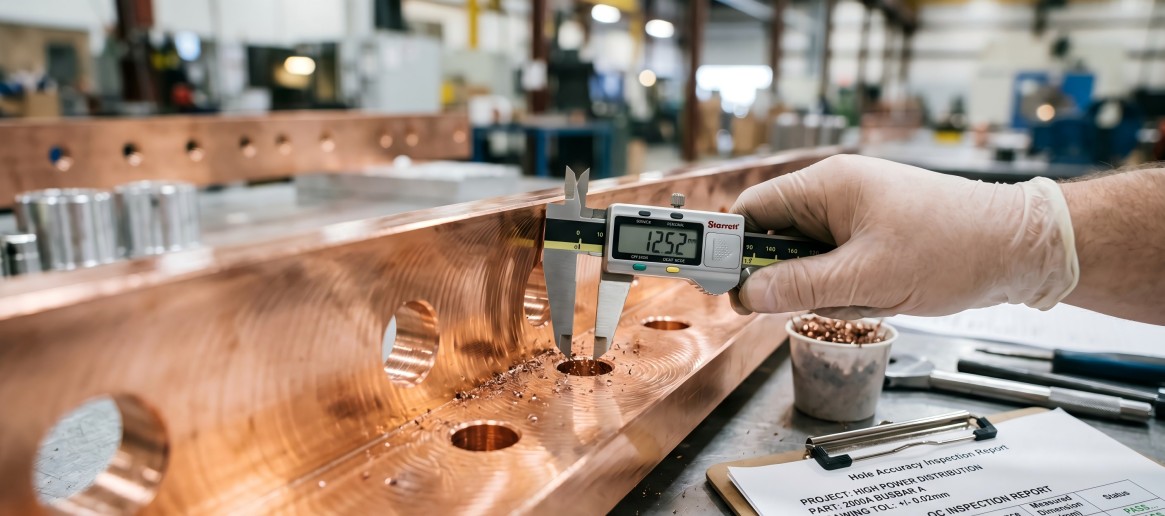
Inspection Standards Buyers Should Ask For
A reliable supplier should not treat inspection as a final formality. For custom copper busbars, inspection should be connected directly to the drawing.
Important inspection items include:
| Inspection Item | Why It Matters |
|---|---|
| Material grade verification | Confirms the copper grade matches the order |
| Conductivity check | Supports electrical performance |
| Dimensional inspection | Confirms length, width, thickness and hole position |
| Flatness and straightness | Important for assembly and contact quality |
| Burr and edge inspection | Prevents insulation damage and safety risk |
| Surface inspection | Checks oxidation, scratches, stains or plating defects |
| Plating thickness | Important for tin, nickel or silver-plated busbars |
| Bend angle inspection | Ensures repeatable installation |
| Batch traceability | Helps future maintenance and reorder control |
| Packaging inspection | Reduces transit damage for export orders |
For large busbar projects, raw copper quality is also important before fabrication. Buyers can also read our guide on oxygen-free copper rod defects, SMM pricing and factory inspection standards for more details about bulk copper procurement risk control.
How to Compare Copper Busbar Quotations
Copper busbar quotations can vary because suppliers may include different cost items.
A transparent quotation should separate:
Final Cost =
Copper Material Cost
+ Cutting / Machining Cost
+ Bending Cost
+ Plating or Surface Treatment
+ Inspection and Documentation
+ Packaging
+ Freight or Export Handling
For large copper orders, buyers may ask whether the quotation can be linked to SMM or LME copper reference pricing, plus a clearly listed processing fee. This makes price comparison more transparent, especially when copper prices fluctuate.
The cheapest quote may become risky if it excludes plating, inspection, packaging or tolerance control.
Red Flags When Choosing a Custom Copper Busbar Supplier
Be careful if a supplier shows these signs:
- They do not ask for drawings or technical requirements.
- They quote only by material weight.
- They cannot explain copper grade differences.
- They cannot provide inspection reports.
- They ignore hole tolerance and bend direction.
- They cannot confirm plating thickness or surface requirements.
- They have no clear export packaging method.
- They cannot support repeat orders with batch consistency.
- Their delivery time sounds fast but has no process explanation.
In power distribution projects, unclear communication before production often becomes rework after delivery.
What Buyers Should Send for a Fast Quotation
To get a practical quotation, buyers should prepare:
- Copper grade, such as C11000, C10100 or C10200
- Drawing in PDF, DWG, DXF or STEP format
- Thickness, width, length and tolerance
- Hole diameter and hole position requirements
- Bend angle and bend direction
- Surface treatment, such as bare copper, tin plating, nickel plating or silver plating
- Quantity and annual demand if available
- Inspection document requirements
- Packaging and destination country
- Target delivery schedule
The more complete the drawing package, the faster the supplier can provide a realistic quote.
Why Buyers Work With CYMBER Metal
CYMBER Metal supports overseas buyers who need copper materials and custom processing for electrical, machinery, power distribution and industrial manufacturing projects.
Our support includes:
- Pure copper, copper plate, copper bar, copper rod, copper tube and custom busbar supply
- Material coverage across pure copper, brass, bronze, chromium zirconium copper and aluminum alloy
- Custom cutting, machining and fabrication coordination
- Drawing review before quotation
- Support for copper busbar, copper plate, copper bar, copper rod and copper tube requirements
- Stock checking and batch preparation through our large-scale copper and aluminum warehouse
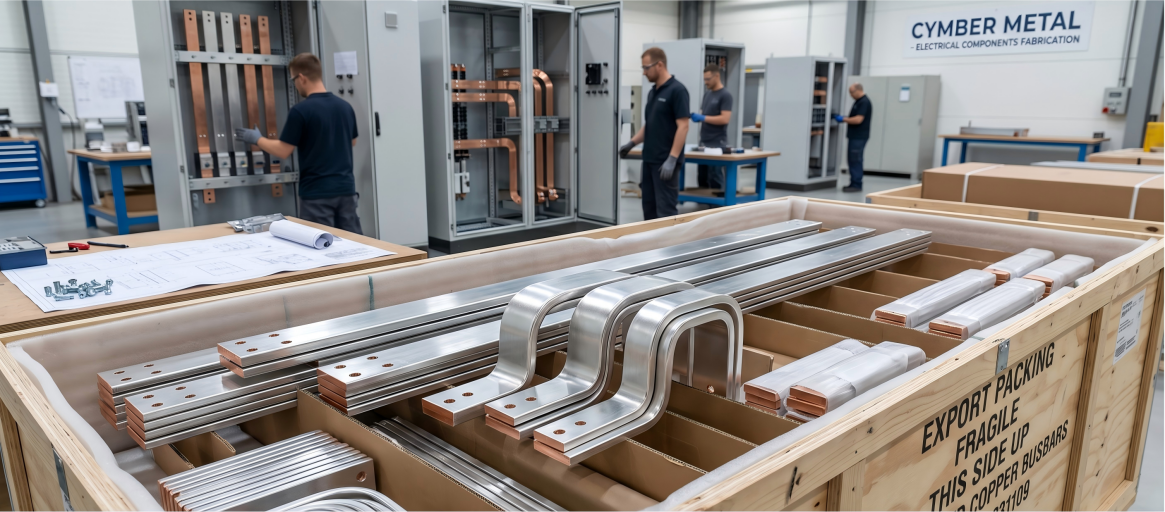
- Export packing and international shipment support
- Practical quotation based on material, processing, surface treatment and delivery needs
If you are sourcing copper busbars for switchgear, electrical panels, transformers, power distribution systems or energy storage projects, CYMBER can review your drawings and help prepare a practical quotation.
Buyer Checklist Before Confirming an Order
Before placing a custom copper busbar order, confirm these points:
| Question | Why It Matters |
|---|---|
| Is the copper grade confirmed? | Avoids conductivity or material mismatch |
| Are drawings complete? | Reduces production misunderstanding |
| Are hole tolerances defined? | Protects assembly accuracy |
| Is plating required? | Affects corrosion resistance and contact performance |
| Is deburring included? | Improves safety and insulation reliability |
| Are inspection reports available? | Supports project documentation |
| Is packaging suitable for export? | Reduces transit damage |
| Is the lead time realistic? | Helps project scheduling |
| Is the quotation transparent? | Makes supplier comparison easier |
Conclusion
Choosing a custom copper busbar supplier for power distribution projects requires more than comparing copper prices. Buyers should evaluate material grade, drawing review ability, processing accuracy, surface treatment, inspection control, packaging and delivery reliability.
A strong supplier helps reduce project risk before production starts. For large orders, this can be the difference between smooth assembly and costly rework.
Send your copper busbar drawing, copper grade, dimensions, quantity, surface treatment and delivery schedule through the CYMBER Metal contact page. Our team can review your requirements and provide quotation support for custom copper busbar, copper plate, copper bar and related electrical copper components.
FAQ
What is the best copper grade for custom copper busbars?
C11000 ETP copper is widely used for electrical busbars because of its high conductivity and availability. For applications requiring lower oxygen content or higher stability, C10100 or C10200 oxygen-free copper may be selected.
What information is needed to quote a custom copper busbar?
A supplier usually needs the copper grade, drawing, dimensions, thickness, hole details, bend requirements, surface treatment, quantity, tolerance and delivery schedule.
Should copper busbars be tin plated?
Tin plating is often used when buyers need better surface protection, solderability or corrosion resistance. The decision depends on the working environment and electrical connection requirements.
Why is hole accuracy important in copper busbar fabrication?
Hole accuracy affects installation, cabinet assembly and electrical connection stability. Poor hole positioning can cause assembly delays or rework.
Can CYMBER support custom copper busbar machining?
Yes. CYMBER supports copper material supply, drawing review, cutting, CNC machining coordination, surface treatment support, inspection documentation and export packaging for custom copper busbar projects.
Post time: Jun-22-2026