
Published: June 20, 2026
By: Yanwei Hu, Technical Expert at Cymber Metal
For a 200-ton copper busbar project, the biggest risk is not always the copper price.
The real risk is discovering material defects after cutting, extrusion, drawing, machining or busbar fabrication has already started.
A small internal crack, oxide inclusion, shrinkage cavity or conductivity inconsistency may not look serious at the raw material stage. But when the order volume reaches hundreds of tons, even a small defect rate can create serious delays in production scheduling, shipment planning and customer delivery.
This is why oxygen-free copper rod procurement should never be treated as a simple “price per ton” comparison.
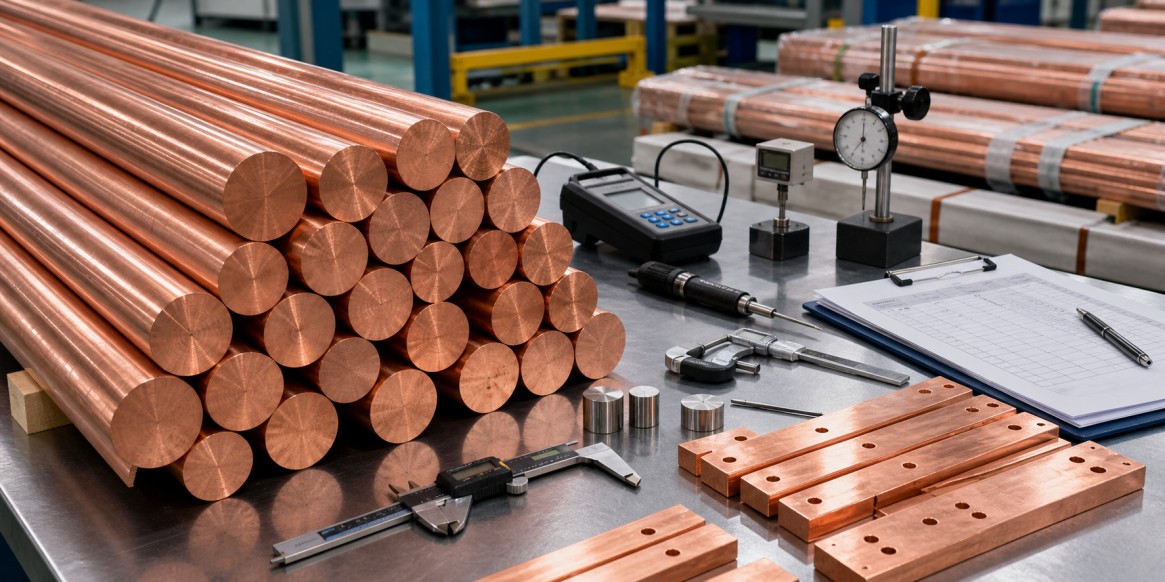
At Cymber Metal, we support buyers with pure copper materials, copper rods, copper busbars, cutting, machining and large-volume project coordination. For high-conductivity busbar and electrical projects, we focus on three things before shipment:
- Transparent copper price basis
- Stable processing and fabrication cost
- Strict outgoing inspection before bulk delivery
-
Quick Answer: What Should Buyers Check Before Ordering Oxygen-Free Copper Rod in Bulk?
For 100-ton, 200-ton or larger copper busbar projects, buyers should check:
- Copper grade, such as C10100, C10200, TU1, TU2 or C11000
- Conductivity requirement, usually expressed as %IACS
- Oxygen content and impurity control
- Rod diameter, length, straightness and surface condition
- Internal defects such as porosity, cracks, oxide inclusions and centerline looseness
- Ultrasonic testing or other flaw detection requirements
- Price basis, preferably linked to a transparent copper market index such as SMM
- Processing fee, cutting fee, packaging and shipment terms
- Certificate, inspection report and traceability documents
For a 200-ton busbar program, these checks help avoid project delays before the material enters machining or fabrication.
Why Oxygen-Free Copper Rod Matters in Busbar Manufacturing
Oxygen-free copper rod is commonly used when high electrical conductivity, stable thermal performance and clean material structure are required.
Compared with ordinary copper materials, oxygen-free copper is valued for:
- High conductivity
- Lower oxygen content
- Better performance in vacuum or controlled environments
- Better resistance to hydrogen embrittlement risk
- Improved stability for electrical and electronic applications
- Cleaner structure for precision machining and forming
For copper busbar projects, the copper rod may be used to produce bars, strips, machined conductors, connector blanks or custom high-current parts. In this process, material consistency matters as much as the nominal grade.
Cymber’s pure copper product range includes Premium Pure Copper Busbar, Premium Large Diameter Pure Copper Round Bar, Forged Pure Copper Rod and High-Conductivity Tinned Copper Busbar for different electrical and industrial applications.
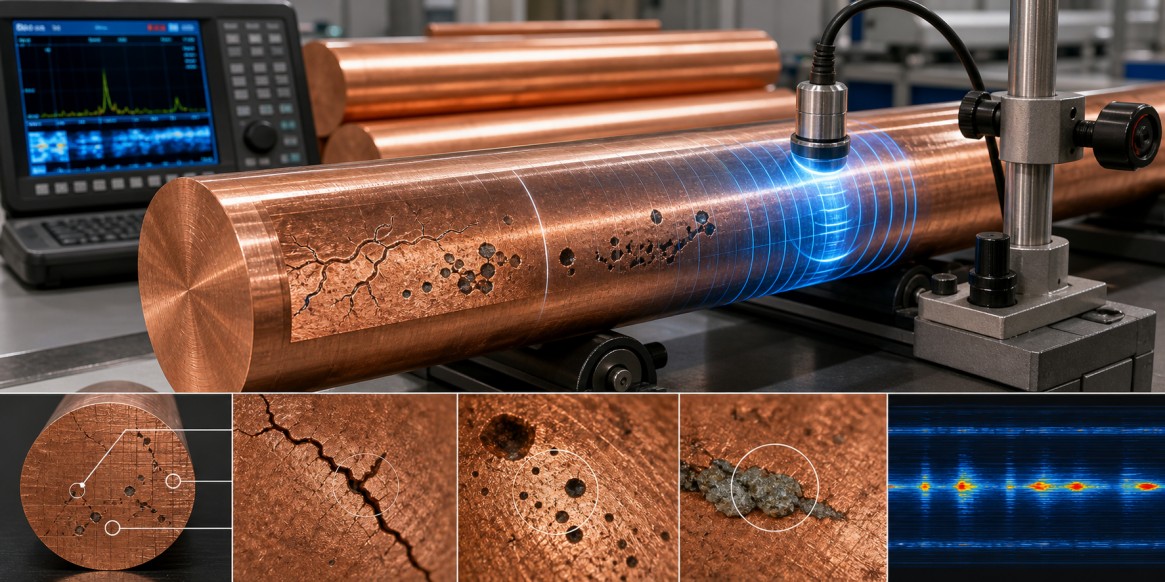
The Hidden Problem: Micro Defects That Delay Bulk Copper Projects
In large copper rod and busbar projects, the most dangerous defects are not always visible from the surface.
A buyer may receive material that looks acceptable, but problems appear later during cutting, bending, drilling, milling, tin plating or high-current assembly.
1. Oxide Inclusions
Oxygen-free copper is selected partly to reduce oxide-related problems. However, poor melt control, contamination or improper handling may still create inclusions.
Oxide inclusions can cause:
- Local conductivity variation
- Weak points during deformation
- Poor surface after machining
- Risk of cracking during forming
- Unstable performance in high-current busbar systems
For electrical buyers, the issue is not only mechanical. Local defects may also affect current distribution and heat generation under load.
2. Shrinkage Porosity and Internal Voids
Shrinkage porosity can form during casting or solidification if temperature control and feeding are not stable.
In small orders, one or two defective sections may be manageable. In a 200-ton project, repeated internal voids can cause serious production waste.
Typical risks include:
- Machining exposure of internal holes
- Rejection after cutting or drilling
- Reduced mechanical reliability
- Unstable plating or surface finishing
- Delayed busbar fabrication schedule
3. Centerline Looseness
Centerline looseness is especially important for large-diameter copper rods. It may not be visible externally, but it can appear during machining or section cutting.
If a buyer needs long busbars or large machined copper conductors, centerline quality should be confirmed before shipment.
4. Surface Seams, Laps and Folding
Surface defects can come from rolling, extrusion, drawing or handling.
For copper busbar projects, surface quality is important because busbars may require:
- Low contact resistance
- Smooth plating surface
- Stable insulation bonding
- Accurate bending and drilling
- Reliable bolted connection
A surface seam may become a crack after bending or machining.
5. Grain Coarsening and Inconsistent Structure
Improper thermal processing may lead to grain size inconsistency. For high-conductivity copper rods, structure consistency affects forming behavior, machining stability and mechanical performance.
A large project should not only check chemical composition. It should also confirm that the material condition is suitable for the required downstream process.
-
Why SMM-Based Pricing Reduces Copper Procurement Risk
Copper price volatility is one of the biggest concerns for bulk buyers.
For a 200-ton order, even a small price movement can change the total project cost significantly. This is why many overseas buyers prefer a transparent pricing formula instead of a fixed quotation that hides risk premium inside the unit price.
A practical quotation model is:
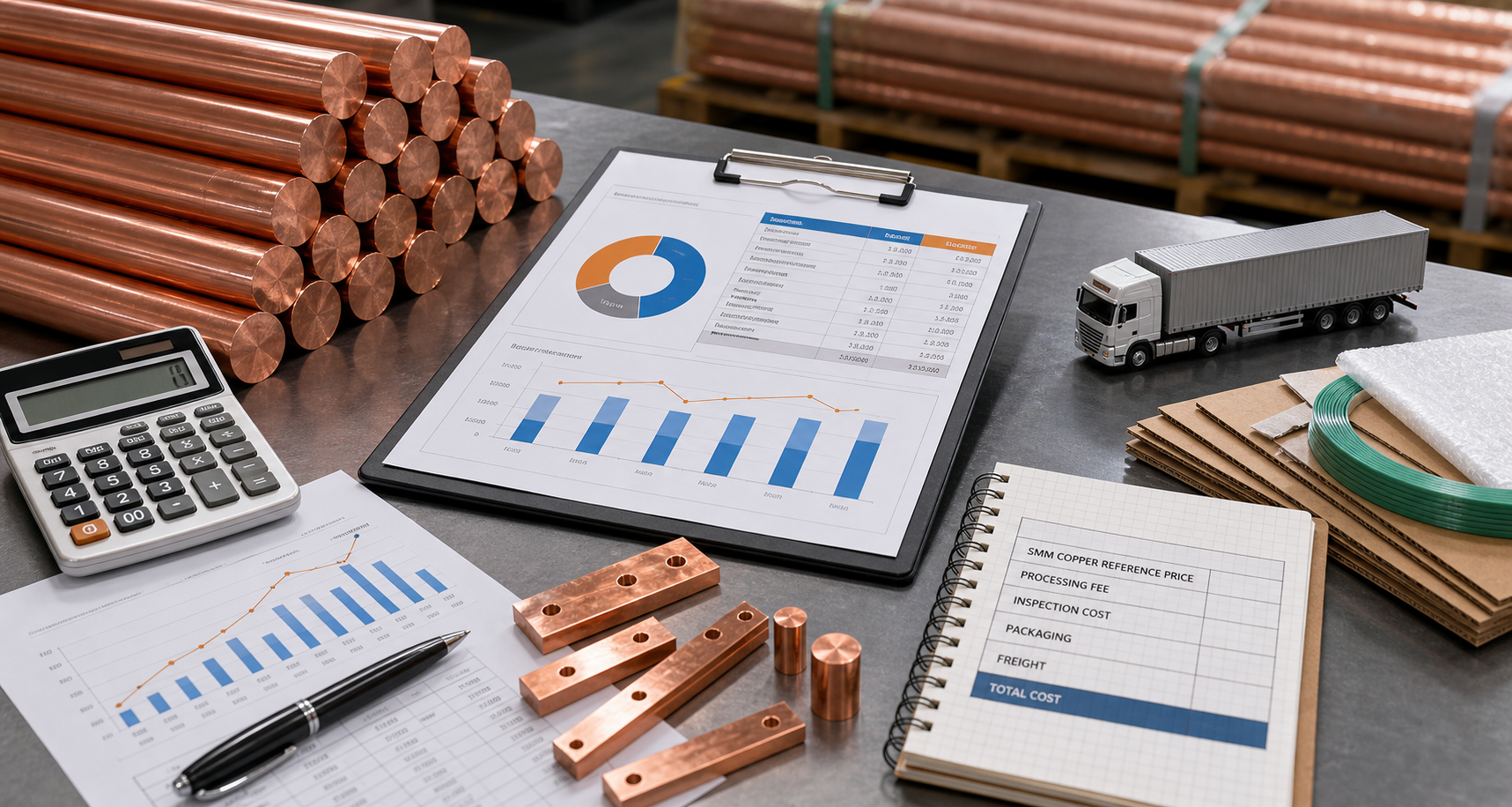
Final Copper Price = SMM Copper Reference Price + Processing Fee + Cutting / Machining Fee + Packaging + Freight
This model helps both buyer and supplier.
For the buyer, it reduces the risk of paying an inflated price when the market is volatile.
For the supplier, it keeps the quotation fair because raw material cost is linked to a recognized market reference.
For large busbar and copper rod projects, Cymber can support quotation structures based on transparent copper price references, with processing fees, cutting fees and export costs listed clearly.
Why Transparent Processing Fee Matters
In regional manufacturing and processing, buyers often compare quotations from multiple suppliers. But if the price structure is not transparent, the lowest quote may not be the safest quote.
A complete copper rod or busbar quotation should separate:
Cost Item Why It Matters Copper market price Reflects raw material cost basis Processing fee Covers extrusion, drawing, rolling, cutting or fabrication Machining fee Applies when drilling, milling, bending or custom cutting is required Surface treatment Tin plating, nickel plating, polishing or anti-oxidation treatment Inspection cost Ultrasonic testing, conductivity testing, dimensional inspection Export packing Wooden cases, moisture protection, anti-bending support Freight FOB, CIF, DAP or other shipping terms This structure helps procurement teams calculate landed cost more accurately.
It also makes supplier comparison more meaningful.
Factory Inspection Standards for Oxygen-Free Copper Rod Before Shipment
For high-volume copper projects, inspection should happen before shipment, not after arrival.
Cymber recommends a multi-layer inspection approach for bulk oxygen-free copper rod and copper busbar orders.
1. Chemical Composition and Oxygen Content
The first step is confirming the material grade.
Typical checks may include:
- Copper purity
- Oxygen content
- Phosphorus or residual element control
- Impurity elements
- Grade consistency across batches
For oxygen-free copper such as C10100 or C10200, oxygen control is central to performance.
2. Electrical Conductivity Test
Conductivity is a key property for busbar projects.
For electrical applications, the buyer should confirm:
- %IACS value
- Test method
- Batch consistency
- Whether results match the contract requirement
High conductivity is not just a marketing claim. It should be measured and documented.
3. Ultrasonic Testing for Internal Defects
Ultrasonic testing can help detect internal discontinuities in large copper rods, including voids, cracks and looseness.
For large-diameter rods or bulk busbar production materials, ultrasonic inspection can reduce the risk of discovering internal defects after cutting.
A practical inspection plan should define:
- Testing scope
- Rod diameter range
- Acceptance criteria
- Sampling rate or full inspection requirement
- Report format
For critical 200-ton projects, buyers may request stricter inspection requirements before shipment.
4. Surface Inspection
Surface inspection should check:
- Cracks
- Seams
- Folding
- Heavy scratches
- Oxidation
- Oil contamination
- Handling damage
For busbar production, surface defects may affect plating, insulation, bending and contact performance.
5. Dimensional Inspection
Dimensional checks should include:
- Diameter or width/thickness
- Length
- Straightness
- Ovality
- Cut-end condition
- Tolerance consistency
If the copper rod will be cut into busbar blanks or machined into electrical conductors, tolerance consistency can directly affect production efficiency.
6. Mechanical and Hardness Checks
Depending on application, buyers may also request:
- Tensile strength
- Elongation
- Hardness
- Temper condition
- Bending performance
Not every busbar project needs all mechanical tests, but the requirements should be clear before production.
-
How Inspection Prevents 200-Ton Project Delays
A large busbar project has many connected steps:
Material production → Cutting → Straightening → Machining → Drilling → Bending → Surface treatment → Inspection → Packing → Shipment → Customer assembly
If defects are found late, the delay is multiplied across the whole schedule.
For example:
- Internal voids may be discovered after cutting
- Surface seams may open during bending
- Conductivity inconsistency may appear during final testing
- Poor straightness may slow down machining
- Packaging weakness may cause bending during ocean transport
This is why outgoing inspection is not a formality. It is a project risk-control tool.
Cymber Support for Bulk Oxygen-Free Copper Rod and Busbar Projects
Cymber Metal supports large-volume copper projects with material supply, cutting, machining coordination and export preparation.
For buyers working on 100-ton or 200-ton projects, we can support:
- Copper grade selection
- SMM-based copper price reference
- Transparent processing fee quotation
- Copper rod, busbar, strip and plate supply
- Cut-to-length preparation
- CNC machining support through the CYMBER CNC Machining Workshop
- Stock and project coordination through the large-scale copper and aluminum warehouse
- Conductivity and dimensional inspection
- Ultrasonic testing coordination when required
- Export packing and shipping documentation
For electrical buyers, Cymber can support copper busbar projects including Pure Copper Busbar, Nickel-Coated Copper Busbar and High-Conductivity Tinned Copper Busbar depending on corrosion resistance, contact surface and installation requirements.
What Buyers Should Send for a 24-Hour Bulk Order Review
To evaluate a copper rod or busbar project properly, send us:
- Copper grade requirement: C10100, C10200, C11000, TU1, TU2 or equivalent
- Rod diameter or busbar size
- Total quantity
- Required length
- Conductivity requirement
- Surface condition
- Machining or cutting requirement
- Inspection requirement, including ultrasonic testing if needed
- Delivery terms: FOB, CIF, DAP or others
- Destination port or country
- Required shipment schedule
With these details, Cymber can provide a structured quotation including copper price basis, processing fee, cutting or machining cost, inspection plan and export packing recommendation.
Final Takeaway
For a 200-ton oxygen-free copper rod or busbar project, price matters, but inspection matters just as much.
A transparent SMM-based pricing model helps buyers reduce market volatility risk. A clearly separated processing fee helps procurement teams compare suppliers fairly. Strict outgoing inspection, including conductivity testing, dimensional inspection and ultrasonic testing when required, helps avoid production delays after shipment.
If you are planning a bulk oxygen-free copper rod or copper busbar project, send your specification to Cymber Metal. We can review your material requirement and provide a transparent quotation structure within 24 hours.
Learn more about Cymber pure copper materials: https://www.cymbermetal.com/pure-copper/
FAQ
Why is oxygen-free copper rod used for busbar projects?
-
Oxygen-free copper rod is used for busbar projects because it offers high electrical conductivity, low oxygen content and stable performance for high-current electrical applications.
What defects should buyers check in oxygen-free copper rod?
-
Buyers should check for oxide inclusions, shrinkage porosity, internal voids, centerline looseness, surface seams, cracks, grain inconsistency and conductivity variation.
Is ultrasonic testing necessary for copper rods?
-
For small or standard orders, ultrasonic testing may not always be required. For large-diameter rods, critical busbar projects or 100-ton to 200-ton bulk orders, ultrasonic testing can help reduce the risk of internal defects.
Why use SMM pricing for copper bulk orders?
-
SMM-based pricing provides a transparent copper price reference. It helps buyers reduce the risk of hidden premium when copper prices fluctuate sharply.
What should be included in a copper rod quotation?
-
A clear quotation should include copper price basis, processing fee, cutting or machining cost, inspection requirement, packaging, freight terms and delivery schedule.
Can Cymber support large copper busbar projects?
-
Yes. Cymber can support pure copper materials, copper rods, copper busbars, cutting, CNC machining coordination, inspection and export packing for large-volume electrical and industrial projects.
Ready to secure your 200-ton oxygen-free copper rod or busbar project?
Send us your specifications and quantity. We will provide a transparent SMM-based quotation with clear processing fees and inspection plan within 24 hours.
- Download 2026 Oxygen-Free Copper Rod Bulk Order & Inspection Guide (PDF)
Post time: Jun-20-2026