
Publication Date: July 15, 2026
Author: Hu Yanwei, Cymber Metal Technical Expert
Quick Answer
SMM copper pricing can reduce procurement risk by separating the changing copper value from fixed conversion and service charges. Instead of relying on a metal price that may become outdated before the purchase order is confirmed, the buyer and supplier agree on an exact SMM assessment, pricing date or averaging window, settlement weight, premium, processing fee and currency basis. This creates a more traceable quotation and makes invoice reconciliation easier. However, SMM-based pricing does not remove every risk. Buyers must still confirm copper grade, dimensions, yield, inspection, delivery terms, exchange-rate treatment and whether taxes are included.
Why Fixed Copper Quotations Can Become Unreliable
Copper prices can move between the RFQ, quotation, purchase order, production and shipment dates. This becomes important when an order involves several tons or hundreds of tons of copper rod, plate, tube, busbar or machined components.
A supplier may issue a quotation using the copper price available on Monday, while the buyer confirms the order two weeks later. If the quotation does not define how the metal portion will be updated, one of three things commonly happens:
- The supplier shortens the quotation validity to one or two days.
- The supplier adds a larger risk margin to protect against price movement.
- The parties renegotiate the price after the purchase order, creating delay and distrust.
SMM-based copper pricing addresses this problem by agreeing on a transparent reference for the raw copper portion of the order.
It does not guarantee that copper prices will fall. Its purpose is to make the pricing mechanism clearer and reduce disagreement about which market price should apply.
What Is SMM Copper Pricing?
SMM refers to Shanghai Metals Market, a provider of price assessments and market information for metals traded in China.
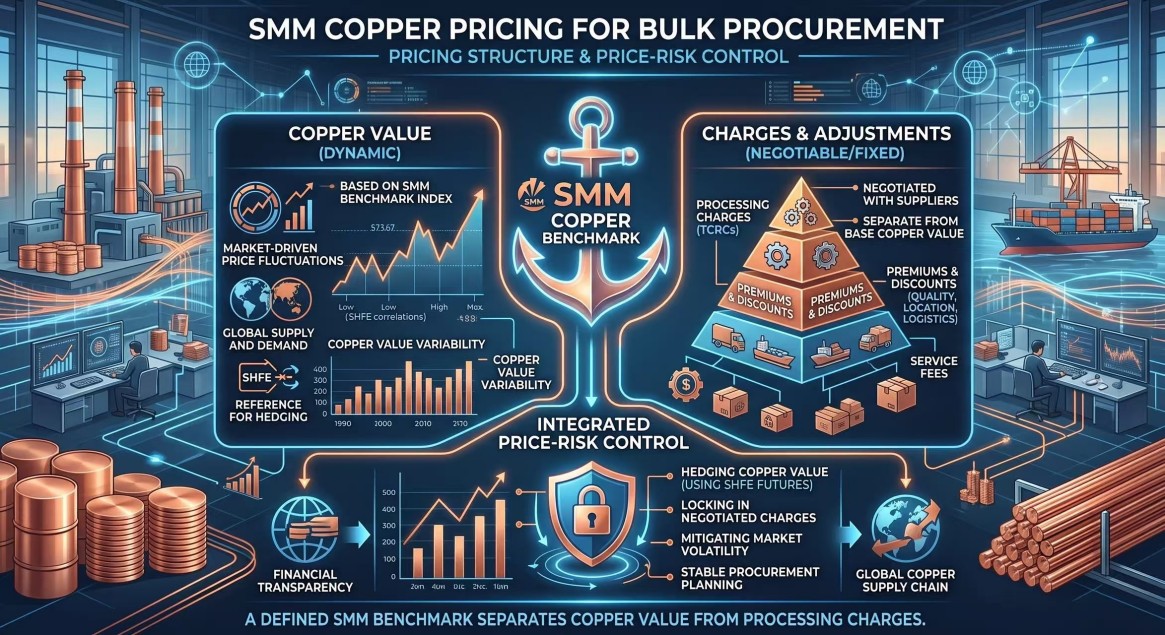
In a copper supply contract, the parties may use a specified SMM copper assessment as the reference for the raw material portion of the quotation. The final product price is then built by adding the agreed commercial and manufacturing charges.
A simplified structure is:
Final order value
=
agreed SMM copper basis × confirmed settlement weight
+ premium or discount
+ extrusion, rolling, drawing or forging cost
+ cutting and CNC machining
+ surface treatment
+ inspection and documentation
+ packing and logistics
+ applicable tax or currency adjustment
The exact formula varies by product. A quotation for raw copper rod will not have the same conversion cost as a quotation for drilled, plated and formed busbars.
Buyers sourcing pure copper materials should therefore ask for a cost breakdown instead of treating the published copper benchmark as the finished product price.
SMM Is a Benchmark, Not the Final Selling Price
This distinction is important.
An SMM assessment represents an agreed reference point for the copper value. It does not automatically include every cost required to turn copper into an export-ready product.
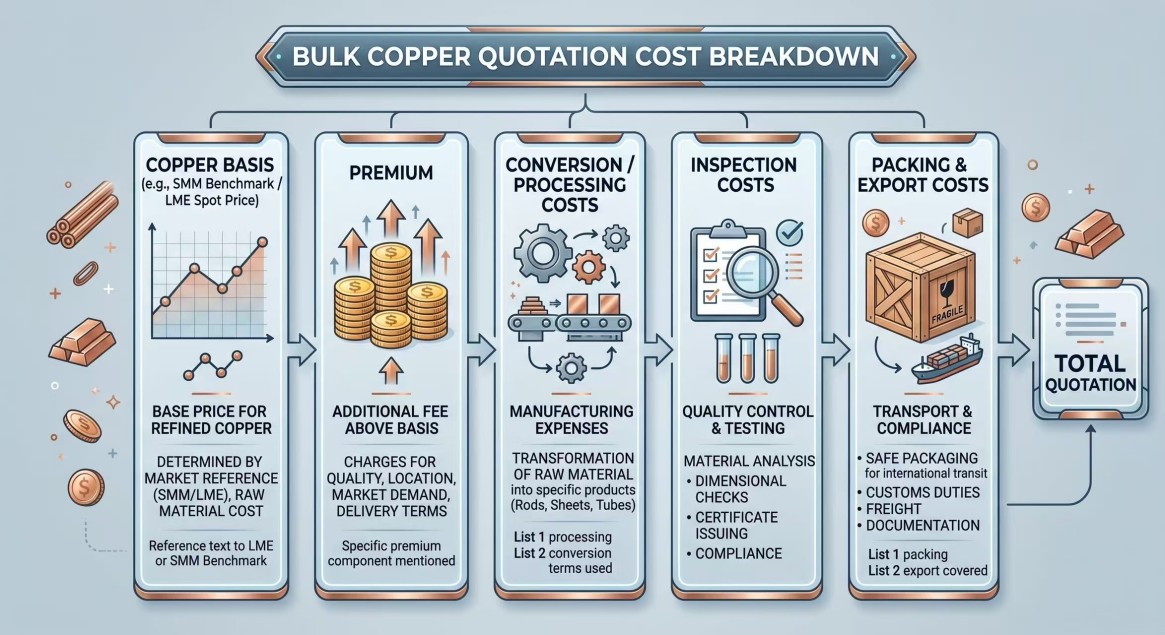
Depending on the order, the final quotation may include:
| Cost element | What it covers | Can it change? |
|---|---|---|
| SMM copper basis | Reference value of the copper content | Changes with the agreed pricing date or window |
| Premium or discount | Grade, availability, physical market or commercial adjustment | Defined by contract or quotation |
| Conversion charge | Rolling, extrusion, drawing, forging or casting | Usually fixed for the quotation period |
| Machining charge | Cutting, drilling, milling, bending or tapping | Based on drawings and quantity |
| Surface treatment | Tin, silver or nickel plating and other finishes | Based on specification |
| Inspection | Dimensions, chemistry, conductivity or third-party checks | Based on the agreed inspection scope |
| Packing | Bundles, protection, wooden cases and labels | Based on product and shipping method |
| Logistics | Inland transport and international freight | Depends on Incoterm and destination |
| Tax and currency | VAT basis, duties or foreign-exchange treatment | Must be defined before order confirmation |
A buyer comparing two suppliers should first confirm whether both quotations include the same cost elements.
How SMM-Based Pricing Reduces Procurement Risk
It Creates a Defined Copper Price Reference
Without a named benchmark, a quotation may simply state “current copper price.” That wording is too vague for a large order.
A proper SMM-linked agreement should identify:
- The exact SMM price assessment
- Copper grade or product basis
- Quoted unit, such as RMB per metric ton
- Whether the assessment includes or excludes tax
- Pricing date or averaging period
- Source and publication time used for verification
Writing only “based on SMM” is not enough. Different SMM assessments, regions and product definitions may not be interchangeable.
It Separates Metal Volatility from Manufacturing Cost
Copper value changes with the market. Die setup, rolling, cutting, CNC machining and inspection costs behave differently.
Separating these parts allows buyers to see whether a price increase comes from the copper benchmark or from a change in manufacturing scope.
For example, a quotation for custom tin-plated copper busbars may contain:
Copper basis
+ busbar fabrication
+ hole and tolerance control
+ tin plating
+ inspection
+ export packing
If the SMM benchmark changes but the drawing remains unchanged, the copper portion can be updated without renegotiating every processing charge.
It Reduces Hidden Market Margins
A supplier offering a long fixed-price quotation during a volatile period may include an additional market-risk margin. The buyer cannot always see how much of the quotation is copper value and how much is protection against future price movement.
An agreed benchmark and fixing rule make this more visible. The supplier still needs a reasonable premium and conversion fee, but these charges can be reviewed separately.
It Makes Invoice Reconciliation Easier
When the purchase order records the benchmark, fixing date, weight basis and additional charges, the buyer can reconstruct the final invoice.
A useful reconciliation file should show:
Agreed SMM assessment:
Pricing date or average:
Published benchmark value:
Settlement weight:
Premium or discount:
Processing charges:
Inspection and packing:
Tax and currency basis:
Final payable amount:
This is especially useful for repeat orders and annual supply programs.
Four Common Copper Price-Fixing Methods
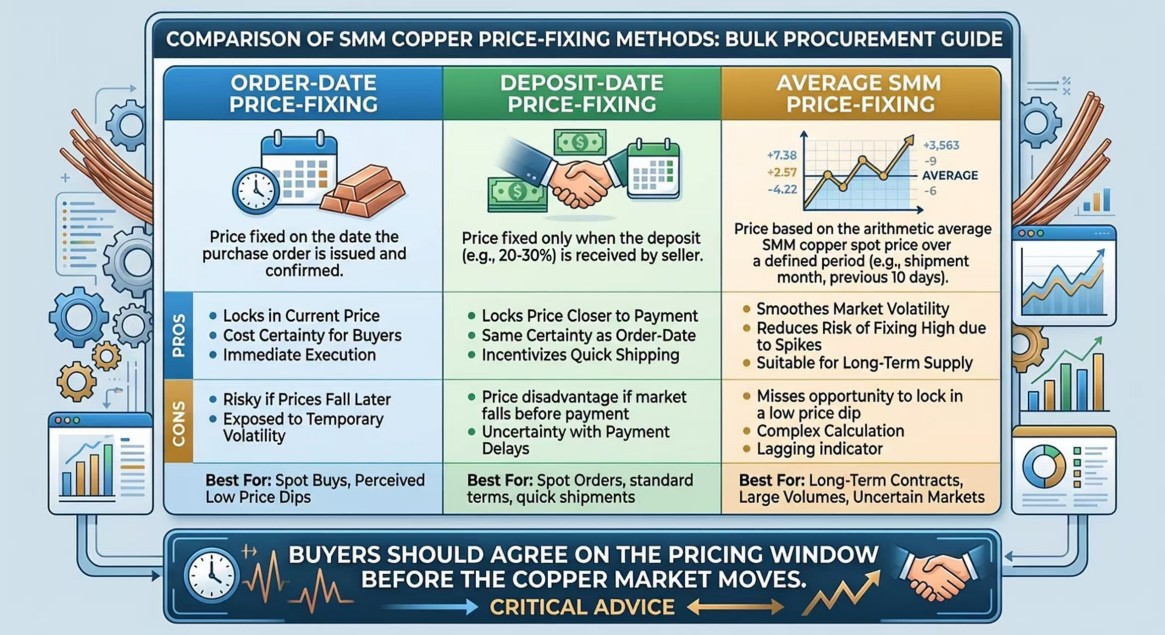
The buyer and supplier should agree on the fixing method before production. Choosing the method after the copper price has moved creates an obvious conflict of interest.
| Fixing method | How it works | Main advantage | Main caution |
|---|---|---|---|
| Order-date fixing | Uses the agreed assessment on the purchase-order date | Simple and easy to verify | Buyer accepts the market level on that date |
| Deposit-date fixing | Price is fixed when the agreed deposit is received | Connects price commitment with payment | Payment timing must be recorded clearly |
| Period average | Uses the arithmetic average over agreed trading days | Reduces dependence on one unusually high or low day | Exact dates and missing publication days must be defined |
| Buyer nomination window | Buyer selects a fixing date within an agreed period | Gives the buyer limited timing flexibility | Requires clear deadlines and written confirmation |
None of these methods is always best. The suitable method depends on production lead time, order value, payment terms and the buyer’s internal procurement policy.
For a one-time spot order, order-date fixing may be sufficient. For repeated monthly purchases, an agreed monthly average may provide more stable budgeting.
A Contract-Ready SMM Pricing Formula
A stronger purchase order does not merely say “price follows SMM.” It records how the calculation will work.
The following structure can be adapted to the order:
Copper benchmark:
The arithmetic average of [exact SMM assessment name]
published on [defined dates].
Metal value:
Agreed benchmark × confirmed net settlement weight.
Additional charges:
Agreed premium or discount
+ processing fee
+ secondary machining
+ inspection
+ packing
+ logistics.
Currency:
Benchmark converted from RMB to [currency]
using [agreed exchange-rate source and date].
Tax basis:
[VAT included / VAT excluded / export basis].
Price confirmation:
Both parties confirm the fixing result in writing before production.
This is not a universal contract clause. It is a checklist showing which details should be agreed with the supplier and reviewed by the buyer’s commercial or legal team.
Which Weight Should Be Used for Settlement?
Weight is one of the most overlooked parts of a copper pricing formula.
The parties may calculate the copper portion from:
- Theoretical drawing weight
- Actual finished net weight
- Input material weight
- Shipped gross weight
- Shipped net weight
- An agreed weight per meter
These figures can differ because cutting, machining and fabrication create scrap or yield loss.
For a raw copper plate order, actual net weight may be straightforward. For a finished busbar with holes and machined edges, the supplier also needs to account for processing loss. The quotation should explain whether scrap is included in the conversion charge, metal premium or settlement weight.
Buyers should never use gross shipping weight as the metal settlement basis unless packaging weight is clearly excluded.
Grade and Form Still Affect the Price
An SMM copper benchmark does not mean every copper product should have the same final price.
C11000, C10200 and other grades have different production routes, availability and application requirements. Oxygen-free material may require different controls from general commercial copper.
For example, C10200 oxygen-free copper may be selected for applications requiring high conductivity and controlled oxygen content. Dense forged material, such as oxygen-free copper sheets, also includes forging, dimensional and inspection costs beyond the basic copper benchmark.
Product form affects conversion cost as well:
- Rod requires casting, extrusion, drawing or finishing.
- Plate may require rolling, forging, sawing and surface preparation.
- Tube requires control of OD, wall thickness and surface condition.
- Busbar may require slitting, straightening, drilling, bending and plating.
- Custom components require additional machining and inspection.
SMM-based pricing makes the raw copper reference clearer; it does not erase these manufacturing differences.
SMM vs LME: Which Benchmark Should Buyers Use?
SMM and LME serve different market contexts.
SMM assessments are closely connected to China’s physical metals market. LME prices are widely used as international exchange references. They should not be substituted for each other without agreement.
| Consideration | SMM-linked approach | LME-linked approach |
|---|---|---|
| Market context | China physical market | International exchange market |
| Common currency | Usually RMB-based assessments | Usually USD-based reference |
| Relevance | Can reflect Chinese raw-material procurement conditions | Familiar to many international procurement teams |
| Additional terms | Tax basis, local premium and exchange rate need clarification | Regional physical premium and conversion still need clarification |
| Best use | When supplier input pricing is closely tied to China’s market | When buyer policy or contract is structured around LME |
For Chinese-origin processed copper products, an SMM-linked structure may align closely with the supplier’s raw-material cost. An international buyer may still prefer LME because it matches internal budgeting or hedging policies.
The important point is consistency. The buyer should not compare an SMM-based quotation with an LME-based quotation without normalizing currency, tax, premium, fixing period and processing scope.
Currency Risk Must Be Defined Separately
SMM pricing can make the copper benchmark transparent while still leaving the buyer exposed to currency movement.
If the SMM benchmark is quoted in RMB and the sales contract is settled in USD or EUR, the agreement should identify:
- Exchange-rate source
- Exchange-rate date
- Whether a fixed rate or actual conversion is used
- Whether the rate is fixed with the copper price
- What happens if payment is delayed
- Rounding method
Otherwise, two parties may agree on the SMM copper price but still disagree on the final foreign-currency invoice.
SMM-based pricing is a purchasing formula, not a currency hedge.
Quote Validity and Price Locking
A quotation should distinguish between three statuses:
| Status | Meaning |
|---|---|
| Indicative quotation | Used for budgeting; copper price is not fixed |
| Price formula agreed | Calculation method is confirmed, but the benchmark has not yet been fixed |
| Price fixed | Benchmark value, date, weight basis and currency conversion are confirmed |
This wording prevents a budgetary quotation from being mistaken for a firm metal-price commitment.
Once the price is fixed, both parties should retain the confirmation email, purchase order amendment or signed fixing notice.
What SMM Pricing Does Not Protect Against
A transparent copper benchmark does not solve every procurement problem.
It does not protect the buyer from:
- Incorrect copper grade
- Dimensional nonconformity
- Poor surface quality
- Unapproved scrap or recycled-content practices
- Delayed production
- Weak export packing
- Incorrect shipment weight
- Currency movement
- Freight increases
- Supplier default
Price management must therefore be combined with material certification, dimensional inspection, sample approval and shipment control.
For oxygen-free copper projects, buyers should also review the inspection requirements for oxygen-free copper rod before confirming bulk production.
Bulk Copper Procurement Workflow
A practical procurement process can follow these steps:
1. Define the Technical Scope
Confirm grade, standard, form, dimensions, tolerance, surface, conductivity and quantity.
2. Separate the Quotation Components
Ask the supplier to identify the copper basis, premium, conversion, machining, inspection, packing and logistics.
3. Agree on the Benchmark
Record the exact SMM assessment, unit and tax basis.
4. Choose the Fixing Method
Select the order date, deposit date, averaging period or buyer nomination window.
5. Confirm Weight and Currency Rules
Define settlement weight, exchange-rate source and applicable date.
6. Approve the Price in Writing
Do this before raw-material purchase or production begins.
7. Inspect and Reconcile
Compare the material certificate, inspection report, shipment weight and final invoice with the purchase order.
Where stock preparation is relevant, buyers can also review CYMBER Metal’s ready-stock warehouse capabilities. Stock availability may influence lead time and the point at which raw-material pricing must be fixed.
RFQ Checklist for an SMM-Linked Copper Quotation
Include the following information in the RFQ:
Copper grade:
Product form:
Applicable standard:
Dimensions and tolerances:
Order quantity:
Estimated net weight:
Trial or bulk order:
Required delivery date:
Destination:
Incoterm:
Preferred SMM assessment:
Preferred pricing date or averaging window:
Currency:
Tax basis:
Processing requirements:
Inspection requirements:
Packing requirements:
Payment terms:
The following sentence can be added to an RFQ:
Please separate the copper benchmark, premium, processing, inspection, packing and logistics in the quotation. Also state the exact SMM assessment, price-fixing method, quotation validity, settlement weight and exchange-rate basis.
That single request makes supplier quotations considerably easier to compare.
How CYMBER Metal Handles Pricing Discussions
CYMBER Metal supplies copper, brass, bronze, CuCrZr and custom-machined metal products for international industrial projects.
Where an SMM-referenced quotation is suitable and commercially agreed, the quotation can be discussed around:
- Exact copper grade and product form
- SMM reference and price-fixing method
- Material premium or discount
- Processing requirements
- Drawing-based machining
- Inspection documentation
- Export packing
- Delivery and currency terms
The final calculation still depends on the product specification and order conditions. CYMBER Metal does not treat a published copper benchmark as the complete finished-product price.
For orders involving cutting, drilling or finished components, the CNC precision machining workshop can be considered as part of the complete manufacturing route.
Conclusion
SMM-based copper pricing reduces risk by giving buyers and suppliers a shared reference for the changing copper portion of a bulk order. It improves transparency, shortens price negotiations and provides a clearer basis for invoice reconciliation.
Its value depends on the details. The contract must identify the exact assessment, pricing date, weight basis, premium, processing charges, tax treatment, exchange rate and confirmation process.
A vague statement such as “price based on SMM” is not enough.
For a bulk copper quotation, submit the complete specification and request a separated cost structure through the CYMBER Metal contact page.
FAQ
What does SMM copper pricing mean?
It means that an agreed SMM copper price assessment is used as the reference for the raw copper portion of a quotation. Processing, premiums, inspection, packing, freight, tax and currency adjustments may still be added separately.
Does SMM pricing guarantee a lower copper price?
No. It does not predict or reduce the market price. It reduces ambiguity by defining which benchmark and pricing period will be used.
Is the SMM price the final price of copper busbar or plate?
Usually not. Finished products may include rolling, extrusion, forging, cutting, machining, plating, inspection and packing costs.
Which SMM pricing date should a buyer use?
Common options include the purchase-order date, deposit date, an agreed average period or a buyer-selected date within a fixing window. The method must be agreed before the market moves.
Can international buyers use SMM pricing in USD orders?
Yes, if both parties agree on the RMB-to-USD exchange-rate source and conversion date. Currency treatment should be recorded separately from the copper benchmark.
Is SMM better than LME for purchasing copper from China?
Not universally. SMM may align more closely with Chinese physical market conditions, while LME may align better with an international buyer’s budgeting policy. Currency, tax, premium and fixing terms must be normalized before comparing them.
What should buyers request with the final invoice?
Buyers should request the agreed benchmark value, fixing date or average, settlement weight, premiums, processing charges, exchange-rate calculation and supporting inspection or shipment documents.
Post time: Jul-15-2026