
Publication Date: June 27, 2026
Author: Hu Yanwei, Cymber Metal Technical Expert
Quick Answer
For high-power electronics, CuCrZr Plate usually performs better than pure copper when the application requires a balance of electrical conductivity, thermal conductivity, heat resistance, mechanical strength and dimensional stability.
Pure copper still offers higher conductivity, but in real industrial use, it softens faster, wears more easily and may lose dimensional stability under repeated thermal cycling. In contrast, C18150 CuCrZr plate provides high conductivity together with better hardness, softening resistance and service life, which makes it a strong choice for resistance welding components, semiconductor cooling plates, power module base plates and high-current electrical contacts.
CYMBER Metal supplies both Chromium Zirconium Copper and Pure Copper products for industrial buyers who need material selection support, stock preparation and custom machining coordination.
Why This Comparison Matters in High-Power Electronics
In high-power electronics, material choice affects much more than conductivity on paper.
Buyers often compare pure copper and CuCrZr plate in applications such as:
- Semiconductor cooling plates
- Power module heat sinks
- Resistance welding parts
- High-current electrical contacts
- Busbar-linked heat dissipation structures
- EV power electronics
- Industrial inverter cooling components
At first glance, pure copper seems like the obvious choice because of its very high electrical and thermal conductivity. But many real projects require more than conductivity. They also require:
- Stable strength under heat
- Better wear resistance
- Reliable machining performance
- Lower deformation risk
- Longer service life under repeated load cycles
This is where C18150 CuCrZr plate becomes a more practical engineering material.
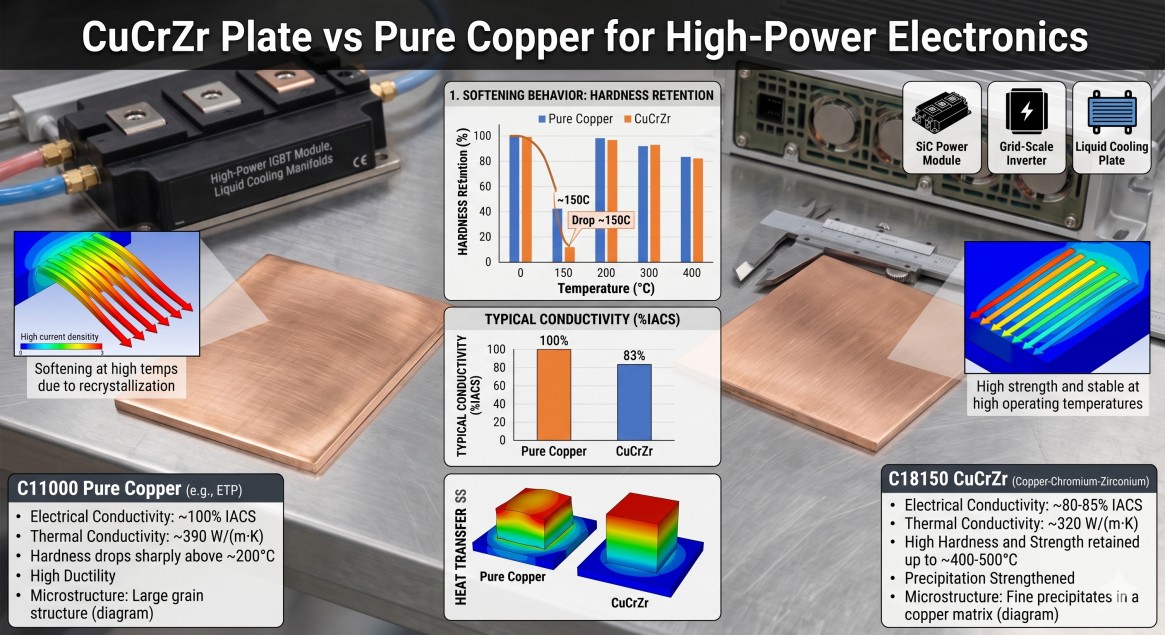
CuCrZr Plate vs Pure Copper: Core Material Comparison
| Property | CuCrZr Plate | Pure Copper |
|---|---|---|
| Electrical conductivity | High, usually around 75-85% IACS depending on condition | Very high, typically above 95% IACS |
| Thermal conductivity | High | Very high |
| Mechanical strength | Much higher than pure copper | Lower |
| Softening resistance | Excellent | Weaker under elevated temperature |
| Wear resistance | Better | Lower |
| Fatigue resistance | Better for cyclic thermal/mechanical load | Less stable |
| Machining stability | Better dimensional retention | Softer, easier to deform |
| Service life in demanding use | Usually longer | Shorter in high-stress environments |
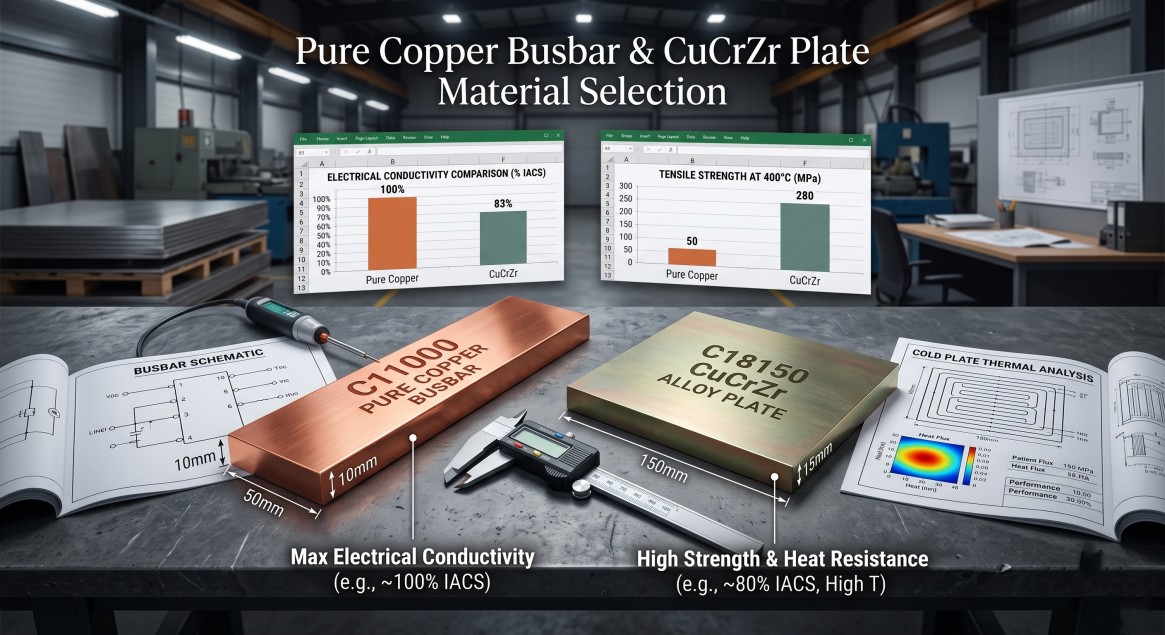
If the part is mainly designed for maximum conductivity with minimal mechanical stress, pure copper can still be the right choice. But if the component operates under heat, repeated load, friction or structural pressure, CuCrZr often becomes the better long-term material.
Where CuCrZr Plate Performs Better Than Pure Copper
1. Semiconductor Cooling and Power Module Base Plates
In semiconductor cooling systems, the material must transfer heat well while staying dimensionally stable under long-term thermal cycling.
Pure copper has strong thermal conductivity, but it is softer and more likely to deform when the part is clamped, machined or repeatedly heated and cooled.
CuCrZr plate offers a better balance between thermal transfer and mechanical reliability. That is why buyers often choose CuCrZr sheet and plate for cooling plates, heat spreaders and power module structural parts.
2. Resistance Welding and High-Current Contact Parts
High-current contact parts need more than conductivity. They also need strength, wear resistance and resistance to softening.
This is one of the classic areas where Chromium Zirconium Copper performs better than pure copper. In welding electrodes, contact arms and conductive tooling, CuCrZr can maintain performance longer under repeated heating and pressure.
3. Precision Machined Components in High-Heat Environments
For machined parts with tight tolerances, pure copper can create difficulties because it is soft, sticky during machining and more vulnerable to deformation.
CuCrZr plate and CuCrZr rod usually offer better machining behavior and better dimensional stability after processing.
Where Pure Copper Still Has an Advantage
Pure copper is still highly useful in high-power electronics when maximum conductivity is the main priority and the mechanical load is limited.
Typical examples include:
- Standard electrical busbars
- Flexible or less mechanically stressed conductive parts
- Power distribution connections
- Large-volume conductive strips and plates
- Applications where the part is easy to replace and low cost matters
For these uses, pure copper products and pure copper busbars remain very important.
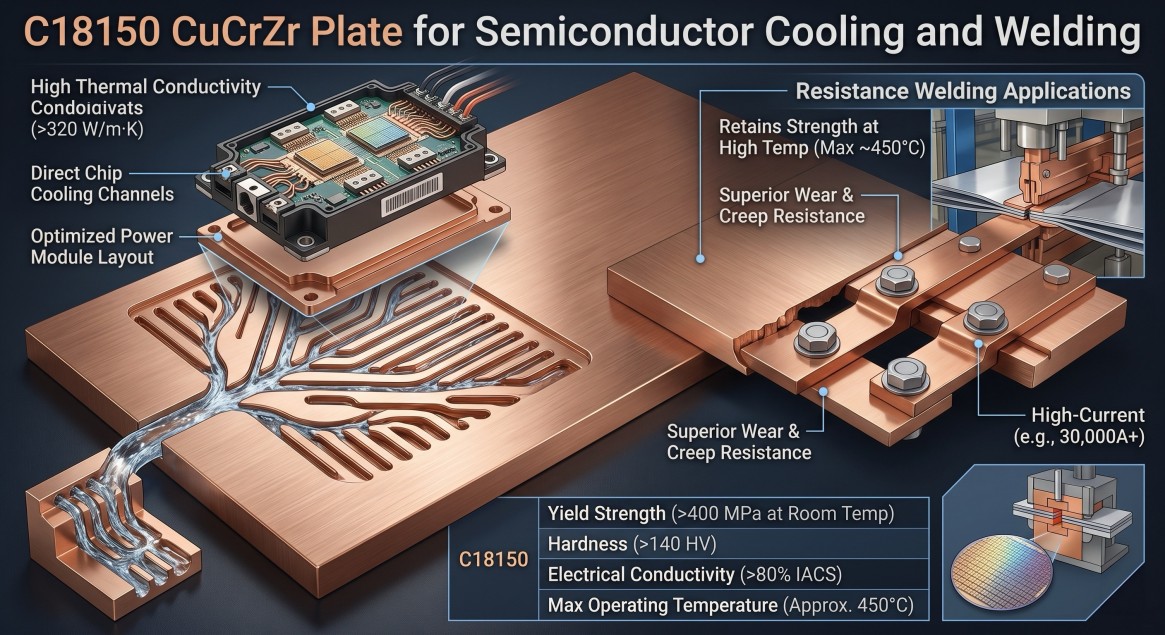
Thermal Conductivity vs Real Performance
One of the most common mistakes in material selection is choosing only by conductivity value.
A buyer may see that pure copper offers better conductivity than CuCrZr and assume it is automatically the better material. But in many real high-power electronics projects, the final decision should include:
- Heat load
- Mechanical load
- Clamping stress
- Repeated heating and cooling cycles
- Surface wear
- Expected service life
- Machining complexity
- Replacement cost
If a component is exposed to both thermal and structural stress, real performance may favor CuCrZr even if pure copper has higher theoretical conductivity.
Machining Considerations: CuCrZr Plate vs Pure Copper
Buyers who need finished parts should also compare machining behavior.
| Machining Factor | CuCrZr Plate | Pure Copper |
|---|---|---|
| Dimensional stability | Better | Lower |
| Edge retention | Better | Softer edges |
| Tool wear | Moderate | Copper adhesion can be challenging |
| Surface consistency | Good with proper setup | Can smear more easily |
| Deformation risk | Lower | Higher |
| Suitability for complex parts | Better for stable precision | Good for simpler conductive parts |
For projects that require drilled holes, milled channels, cooling paths, slots or close tolerances, CuCrZr is often easier to manage as a finished precision part.
CYMBER can support custom machining coordination through the CNC Machining Workshop for buyers who need CuCrZr plate or pure copper converted into finished industrial components.
Typical Buyer Decision Logic
A practical sourcing decision often looks like this:
Choose pure copper when:
- Conductivity is the top priority
- Mechanical stress is low
- The part is mainly a conductor
- Cost sensitivity is high
- Replacement is easy
Choose CuCrZr plate when:
- The part also carries thermal or mechanical load
- Heat resistance matters
- Wear resistance matters
- Machining precision matters
- Service life under repeated use matters
- Downtime cost is high
What Buyers Should Ask Before Ordering CuCrZr Plate
Before placing an order, buyers should confirm:
- Material grade: C18150 or equivalent
- Plate thickness, width and length
- Conductivity target
- Hardness or strength requirement
- Surface condition: mill finish, milled or polished
- Flatness and dimensional tolerance
- Application environment
- Machining requirement
- Inspection report requirement
- Export packing requirement
For structural and precision applications, buyers can also compare different CuCrZr plate formats and welding-grade CuCrZr sheets depending on size, machining route and end use.
Why Buyers Work With CYMBER Metal
CYMBER Metal supports industrial buyers who need both material supply and application-oriented selection support.
Our capabilities include:
- Chromium Zirconium Copper supply
- CuCrZr sheet and plate support
- CuCrZr rod and custom component support
- Pure copper and pure copper busbar supply
- Drawing-based review for electronics, welding and cooling applications
- CNC machining coordination for finished copper alloy parts
- Export-ready quotation and industrial packing support
If you are comparing CuCrZr plate and pure copper for high-power electronics, send your application, dimensions, conductivity target and machining requirements through the CYMBER Metal contact page.
Conclusion
CuCrZr plate does not replace pure copper in every application, but it often performs better in high-power electronics where conductivity must be combined with heat resistance, mechanical strength, wear resistance and dimensional stability.
Pure copper remains the right choice for many standard conductive applications. CuCrZr becomes the better choice when performance under heat and stress matters more than conductivity alone.
For buyers working on semiconductor cooling, welding systems, power modules, electrical contacts or high-current precision components, the best material choice should be based on the real operating environment, not conductivity value alone.
FAQ
Is CuCrZr plate better than pure copper?
For high-power electronics under heat and mechanical stress, CuCrZr plate is often better because it provides high conductivity together with stronger heat resistance and better mechanical stability. Pure copper is still better when maximum conductivity is the main requirement.
What grade is commonly used for CuCrZr plate?
C18150 is one of the most common grades used for chromium zirconium copper plate in industrial applications.
Is pure copper better for busbars?
For standard electrical busbars, pure copper is often preferred because of its very high conductivity. For more demanding conductive structural parts, CuCrZr may be more suitable.
What applications use CuCrZr plate?
Common applications include resistance welding components, semiconductor cooling plates, high-current contacts, power module base plates, mold components and heat-resistant conductive parts.
Can CYMBER supply both CuCrZr plate and pure copper?
Yes. CYMBER supplies both CuCrZr products and pure copper materials for industrial buyers.
Post time: Jun-27-2026