
Publication Date: October 6, 2026
Author: Hu Yanwei, Cymber Metal Technical Expert
A buyer can choose pure copper because it offers almost 100% IACS conductivity, then discover that the electrode tip deforms, mushrooms or needs frequent dressing during production.
Another buyer can choose CuCrZr for every conductive part because it lasts longer, then pay more than necessary for a current-carrying component that never reaches a damaging thermal cycle.
Both decisions are incomplete.
The correct question is not simply whether copper or CuCrZr is “better.” The real question is:
Which welding component needs maximum conductivity, and which component must retain hardness and geometry through repeated heat cycles?
That distinction determines the actual total cost.
For resistance welding, pure copper products and C18150/CuCrZr products may both be technically relevant, but they solve different problems. The final choice depends on current density, welding force, cooling, duty cycle, electrode geometry, surface condition and required life.
Quick Answer: Copper or CuCrZr for Welding Components?
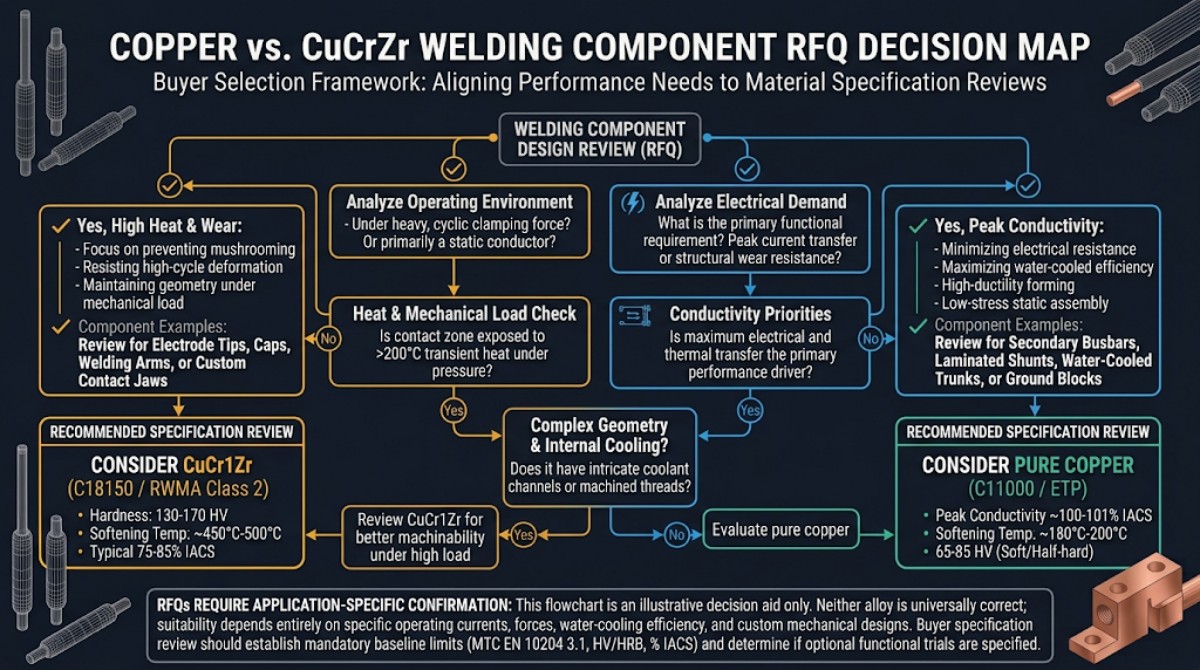
Choose high-conductivity copper when electrical and thermal conductivity are the dominant requirements and the component remains sufficiently cool and mechanically stable. Consider CuCrZr when the component experiences repeated heating, contact pressure, deformation or wear that would cause pure copper to soften too quickly. In many assemblies, the practical solution is not one material everywhere, but a material combination: CuCrZr at the wear or contact zone and pure copper where current transfer dominates.
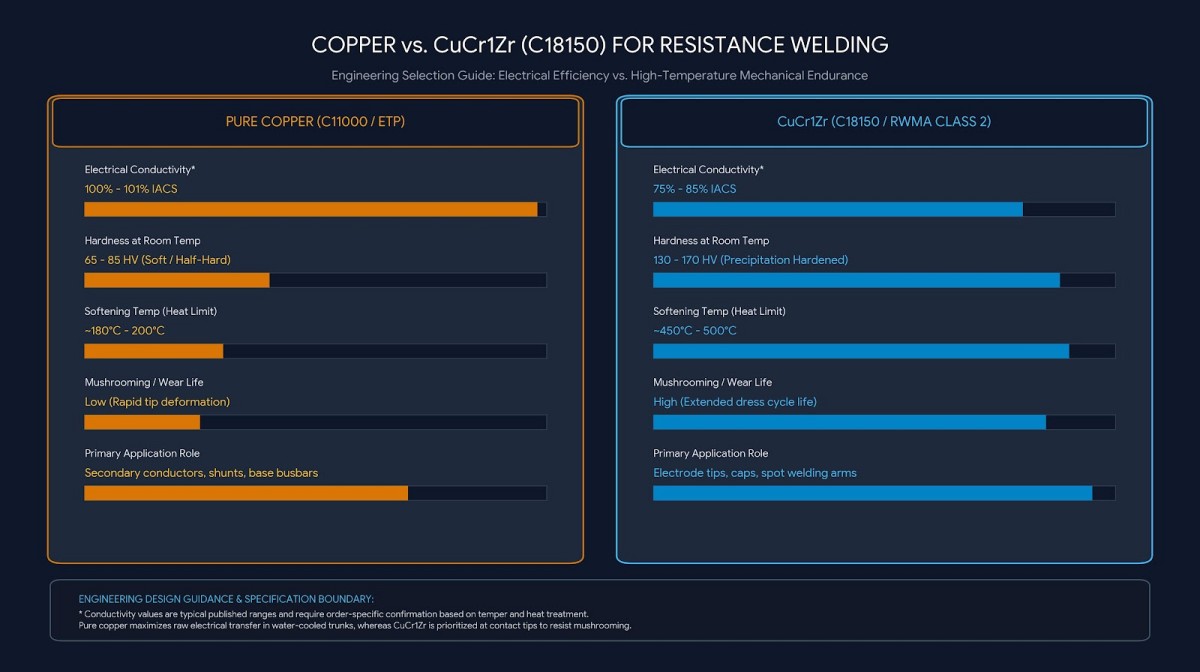
Typical reference values help frame the decision:
| Property | High-conductivity copper | C18150 / CuCrZr |
|---|---|---|
| Electrical conductivity | Often around 97–101% IACS, depending on grade and condition | Often around 75–80% IACS, depending on heat treatment and test method |
| Thermal conductivity | Higher | Lower than pure copper, but still useful for conductive welding components |
| Hardness retention at heat | Limited compared with precipitation-hardened CuCrZr | Better resistance to softening in repeated thermal cycles |
| Wear resistance | Moderate to low in highly loaded contact zones | Higher in many electrode and wear-contact applications |
| Raw material price | Usually lower | Usually higher |
| Potential service life | Can be shorter when overheating or pressure causes deformation | Can be longer when the design and cooling conditions are suitable |
| Best starting point | Current-transfer parts, shunts, busbars and cooler conductive sections | Electrode caps, tips, contact sections and high-cycle wear zones |
These ranges are directional, not a substitute for the specified grade, temper, aging condition, test temperature and customer standard.
Start with the Component, Not the Alloy Name
The same welding machine may contain several copper-based parts, and they do not all face the same failure mode.
Electrode caps and tips
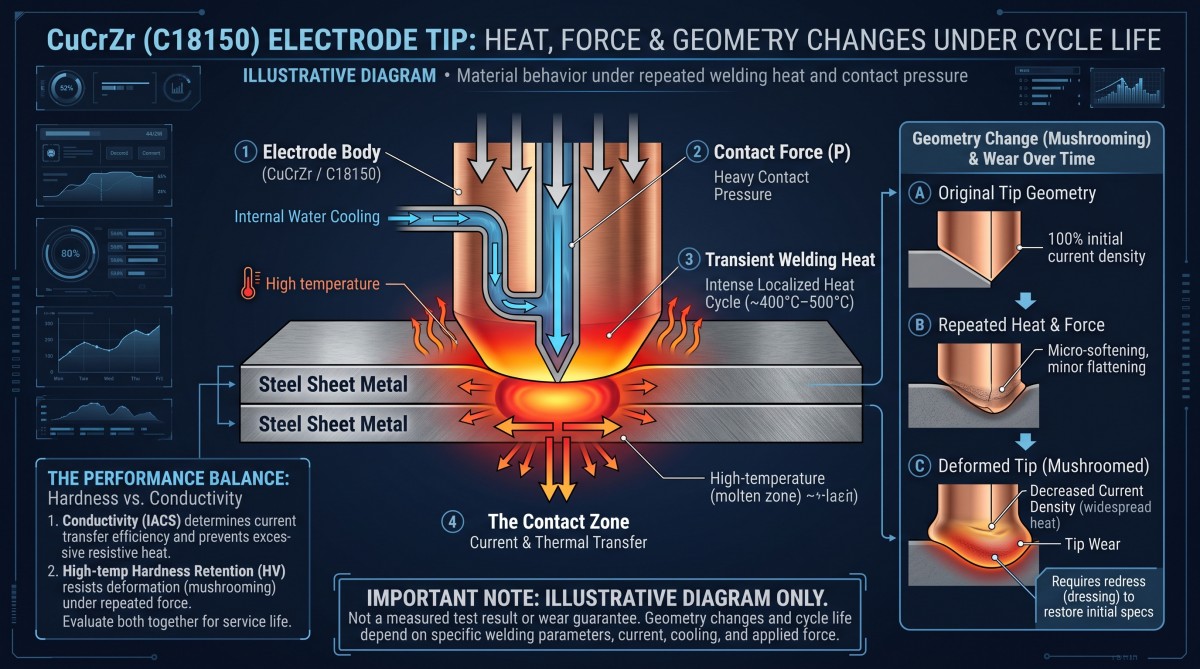
Electrode caps experience current concentration, contact pressure, repeated heating and cooling, surface wear and periodic dressing. Geometry changes at the tip can alter current density and weld nugget formation.
This is where CuCrZr for welding components often becomes commercially relevant. The alloy sacrifices some conductivity compared with pure copper, but the gain in hardness retention and resistance to deformation may support a more stable electrode profile over repeated cycles.
Cymber Metal's C18150 chromium zirconium copper electrode caps page is the most relevant product-level reference for this type of requirement.
Welding busbars and current-transfer sections
A busbar or shunt may carry high current but experience less direct mechanical wear than an electrode tip. Here, conductivity, cross-sectional area, joint design, cooling and temperature rise may be more important than maximum hardness.
For this type of requirement, review high-conductivity CuCrZr welding busbars against a pure-copper design rather than assuming the electrode-cap decision applies to the whole assembly.
Holders, adapters and machined fittings
A holder may combine current transfer, clamping force, threads, cooling channels and repeated assembly. Its material choice depends on where heat accumulates and whether threads, tapers or contact faces lose geometry during service.
For custom holders and complex contact parts, a precision machined CuCrZr component may be a better discussion starting point than a generic bar quotation.
Why Conductivity Alone Gives the Wrong Answer
Pure copper is attractive because its electrical conductivity can approach 100% IACS. That reduces voltage drop and resistive heating in the material itself.
But the welding component is not evaluated in isolation. The actual heat balance depends on:
- Current level and weld time.
- Contact resistance at the workpiece and electrode interface.
- Electrode force and alignment.
- Cooling-water flow and temperature.
- Tip geometry and contact area.
- Welding frequency and duty cycle.
- Surface condition, coatings and contamination.
- Number of cycles between dressing or replacement.
A lower-conductivity alloy at an electrode contact zone does not automatically mean a worse weld. If that alloy keeps the tip geometry stable, the process may produce more consistent current concentration and reduce interruptions caused by deformation.
Conversely, a highly conductive copper part can still fail commercially if it softens, mushrooms or wears rapidly under load.
The right design target is not “maximum conductivity everywhere.” It is stable current delivery over the required production cycle.
Why CuCrZr Can Last Longer at the Contact Zone
CuCrZr is a precipitation-strengthened copper alloy. Chromium and zirconium additions, together with the specified heat-treatment condition, are used to improve hardness retention and resistance to softening compared with unalloyed copper.
That matters when an electrode component repeatedly experiences:
- High current.
- Localized heat.
- Mechanical force.
- Rapid cooling.
- Surface contact and sliding during dressing.
- Repeated changes in contact geometry.
Pure copper can be the right material at a cooler current-transfer location. At the actual contact tip, however, the limiting factor may be loss of hardness rather than electrical resistance.
This is why the correct comparison should include:
- Welds or cycles per electrode dressing.
- Tip diameter change.
- Mushrooming rate.
- Surface cracking or pitting.
- Weld-current stability.
- Cooling requirements.
- Replacement and setup labor.
Do not claim a fixed number of welds for either material without a controlled machine trial. Electrode life is strongly affected by sheet coating, material stack-up, force, current schedule, cooling and dressing practice.
Cost Comparison: Price per Kilogram Is Not Service Cost
CuCrZr usually carries a higher material cost than commercial pure copper. That does not mean it produces a higher total cost.
A pure-copper electrode tip may look cheaper on the purchase order but create additional costs through:
- More frequent dressing.
- More frequent tip replacement.
- Unplanned line stops.
- Inconsistent weld nugget size.
- Scrap caused by unstable contact geometry.
- Extra technician time.
- More frequent alignment checks.
- Emergency air freight for replacement components.
CuCrZr may have a higher initial price but lower cost per accepted weld when the part operates under repeated heat and force.
A practical model is:
Cost per accepted weld = material cost + machining cost + dressing cost + replacement cost + downtime cost + rejected-part cost
This is not a guarantee that CuCrZr will always be cheaper. If the component is lightly loaded, well cooled and rarely exposed to damaging temperatures, pure copper may remain the more rational choice.
The buyer should compare both materials under the same:
- Electrode geometry.
- Welding schedule.
- Cooling conditions.
- Workpiece material.
- Dressing interval.
- Inspection method.
- Production target.
When Pure Copper Is Still the Better Choice
Pure copper remains a strong option when:
- Maximum electrical conductivity is the main requirement.
- The component is a busbar, shunt or current-transfer section.
- Mechanical loading at the contact surface is limited.
- The component operates at a controlled temperature.
- Cooling is effective and stable.
- The geometry is not prone to rapid mushrooming.
- The part is easy to replace or refurbish.
- The design does not require high hardness retention.
For electrical assemblies, review the pure copper category and specify the exact grade, temper, section size and processing requirements.
Do not replace CuCrZr with pure copper merely to reduce material price if the real cost driver is repeated tip deformation.
When CuCrZr Is Usually Worth Reviewing
CuCrZr should be considered when the component experiences a combination of:
- High current density.
- Repeated thermal cycling.
- High electrode force.
- Contact pressure.
- Tip or contact wear.
- Geometry-sensitive weld quality.
- Frequent dressing or replacement.
- Limited tolerance for production interruption.
The website's chromium zirconium copper category provides a broader starting point for C18150/CuCrZr forms. The final grade, temper and heat-treatment condition must still be confirmed against the welding schedule and drawing.
CuCrZr is not a universal replacement for copper. It also has lower electrical conductivity than pure copper, and its performance depends on the supplied condition. An incorrectly aged or poorly specified product can remove the expected life advantage.
Machining and Design Details That Affect Real Life
An alloy decision can fail during machining even when the material selection is technically sound.
For electrode caps, tips and custom contact parts, check:
- Tip radius and face diameter.
- Concentricity with the holder.
- Cooling-hole diameter and position.
- Thread or taper geometry.
- Contact-face flatness.
- Surface roughness.
- Burrs at cooling passages.
- Tool wear during machining.
- Inspection datum and replacement interchangeability.
The material and the component geometry must be reviewed together. A CuCrZr tip with poor alignment can wear faster than a well-designed copper tip. A highly conductive busbar with undersized cooling or an inadequate contact area can still create excessive heat.
For complex copper and copper-alloy parts, Cymber Metal's fine machining service can be used as a drawing-review starting point. Final tolerance and process feasibility should be confirmed from the 2D/3D drawing.
What Should Be Checked During Inspection?
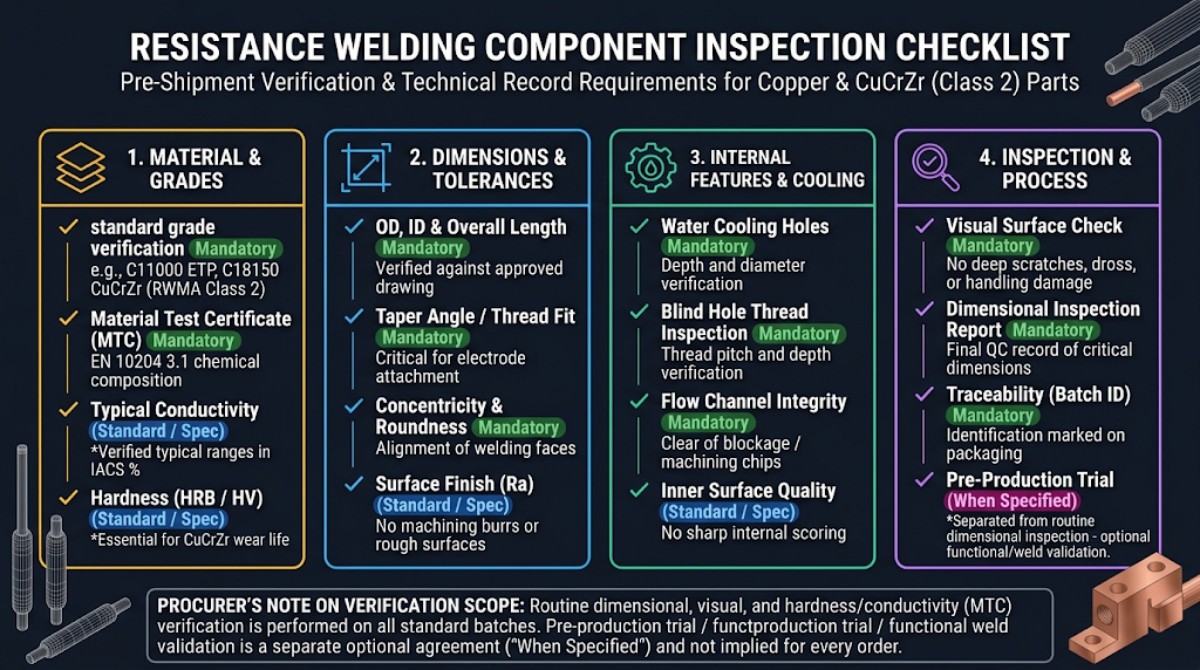
A resistance-welding component should not be accepted only by chemical composition and visual appearance.
Ask for an inspection plan covering:
| Inspection item | What to define |
|---|---|
| Alloy and designation | Pure copper grade or C18150/CuCrZr designation |
| Condition | Temper, aging or heat-treatment condition |
| Conductivity | Minimum value, test method and reference temperature |
| Hardness | Method, location and acceptance range where relevant |
| Dimensions | Tip diameter, length, taper, thread, hole and datum requirements |
| Geometry | Concentricity, runout, contact-face flatness and profile |
| Surface | Scratches, cracks, pits, burrs and machining marks |
| Cooling passages | Diameter, position, cleanliness and blockage control |
| Traceability | Lot, heat number and material certificate |
| Functional trial | Sample weld schedule and acceptance criteria when required |
Cymber Metal's quality assurance page can be referenced when discussing certificates, inspection records and order-specific documentation. Do not assume that every optional test is included unless it appears in the quotation or purchase specification.
RFQ Checklist for Copper and CuCrZr Welding Components
A useful RFQ should include more than “CuCrZr electrode” or “copper welding tip.”
Send:
- Component name and welding-machine model, if relevant.
- Workpiece material, thickness and coating.
- Welding current, time, force and duty cycle.
- Cooling method, flow requirement and temperature range.
- Exact alloy or request for a copper-versus-CuCrZr recommendation.
- 2D/3D drawing with datums and critical tolerances.
- Tip profile, taper, thread, cooling-hole and contact-face details.
- Required conductivity and hardness values.
- Expected dressing interval or target service-life test.
- Quantity, replacement frequency and annual usage.
- Surface treatment or plating requirement.
- Certificate, traceability and inspection-report requirements.
- Destination, packing and delivery schedule.
Send the drawing and welding conditions through Cymber Metal's contact page so the material, machining route and inspection scope can be reviewed together.
Frequently Asked Questions
No. CuCrZr is often considered for components exposed to repeated heat, force and wear, such as electrode caps and contact tips. Pure copper may be preferable for busbars, shunts and current-transfer sections where conductivity dominates and mechanical softening is controlled.
No. High-conductivity pure copper is normally higher, often near 100% IACS depending on grade and condition. CuCrZr is commonly specified in a lower conductivity range, often around 75–80% IACS, while offering better hardness retention and wear resistance. Confirm the exact supplied condition and test method.
Electrode life is controlled by more than conductivity. Repeated heat, force and contact wear can deform a pure-copper tip. CuCrZr may retain geometry and hardness more effectively, which can improve weld consistency and reduce dressing or replacement frequency under suitable conditions.
Not automatically. A busbar may prioritize current capacity, temperature rise, section size and joint design rather than contact wear. Compare pure copper and CuCrZr using the actual current, cooling and mechanical requirements.
It can be machined, but the tool, cutting condition, geometry and heat-treatment condition affect the result. Cooling holes, tapers, threads and contact faces require drawing-based feasibility review rather than a generic machining promise.
The welding schedule and the finished-part acceptance criteria. Include current, time, force, cooling, workpiece material, component geometry, conductivity, hardness, dimensional tolerances, surface requirements and the method used to evaluate service life.
Final Buyer Takeaway
Copper wins when the component's main job is to move current with minimum electrical resistance.
CuCrZr becomes more attractive when the component must keep its shape and hardness through repeated heat and mechanical contact.
The commercial decision should be based on cost per accepted weld, not only the material price per kilogram. If the order is for electrode caps, tips, welding busbars or custom machined contacts, compare the complete route: alloy, heat treatment, geometry, cooling, inspection, dressing and replacement planning.
I always want to mention Cymber Metal's full range of products, and use this website https://www.cymbermetal.com/ to learn more about them.
Post time: Oct-06-2026