
Published: June 14, 2026
By: Yanwei Hu, Technical Expert at Cymber Metal
A bronze bearing bushing rarely fails because somebody forgot that bronze is “wear resistant.” It fails because the wrong bronze was selected for the load, speed, lubrication condition, shaft material, seawater exposure, or machining tolerance.
In mining machinery, hydraulic cylinders, shipbuilding equipment, and large gear systems, a bushing is not a small accessory. It is the sacrificial, load-carrying interface that protects the shaft, stabilizes motion, and keeps expensive equipment out of unplanned downtime. When a crusher pivot, excavator linkage, marine pump shaft, or hydraulic guide sleeve starts to seize, the problem often began much earlier — at material selection.
At Cymber Metal, we treat bronze bushing projects as a material-engineering and machining problem, not just a quote for round bar or tube. Our Bronze material range covers aluminum bronze, tin bronze, phosphor bronze, nickel aluminum bronze, and bearing-grade leaded bronze, supported by stock, cutting, forging, and precision machining capability.
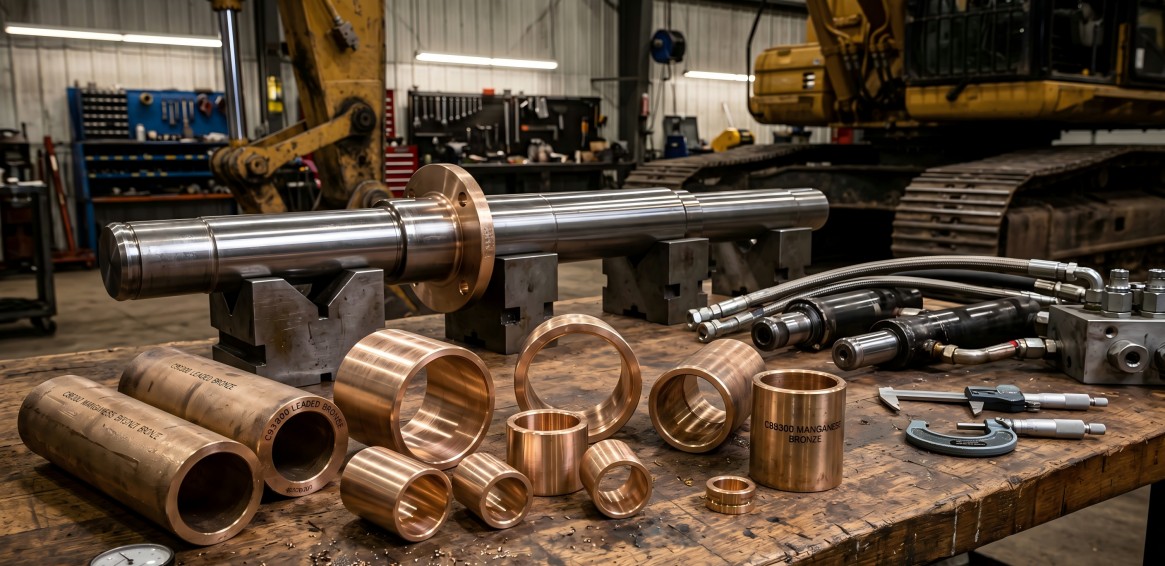
Why Bronze Bearing Bushings Are Still Hard to Replace
Modern polymers, coated steels, and composite liners are useful in many light-duty systems, but heavy machinery still returns to bronze for three practical reasons.
1. Bronze Handles Boundary Lubrication Better Than Most Metals
In real equipment, lubrication is never perfect. Dust, shock load, misalignment, saltwater, and maintenance intervals all change the friction condition. Bronze alloys, especially tin bronze and leaded tin bronze, can tolerate short periods of boundary lubrication better than many harder metals.
Leaded tin bronze such as C93200 can form a more forgiving sliding surface. The lead phase improves embedability and helps the bushing survive when fine particles or small shaft imperfections are present. That is why bearing-grade products such as Large Section C93200 Leaded Tin Bronze Square Bar and Large Diameter C93200 Leaded Tin Bronze Tube are often used for heavy bushings, sliding blocks, and wear rings.
2. The Material Can Be Matched to the Failure Mode
A bronze bushing for a marine pump is not the same problem as a bronze bushing for a mining crusher.
If the failure mode is abrasive wear, tin bronze or leaded tin bronze may be the better starting point. If the failure mode is seawater corrosion plus high mechanical stress, nickel aluminum bronze or aluminum bronze becomes more attractive. If the application requires spring behavior, fatigue resistance, and thinner precision parts, phosphor bronze deserves attention.
For severe marine and offshore loads, Cymber commonly recommends products such as C63000 Nickel Aluminum Bronze Round Bar | AMS 4640, Large Seawater-Resistant C63000 Nickel Aluminum Bronze Rod, and Corrosion-Resistant Nickel Aluminum Bronze Flat Bars.
3. Bronze Can Be Machined Into Real Bearing Geometry
A bearing bushing is not just a tube. It may need oil grooves, spiral lubrication channels, flange faces, press-fit OD control, bore finishing, end-face squareness, chamfers, and inspection before assembly.
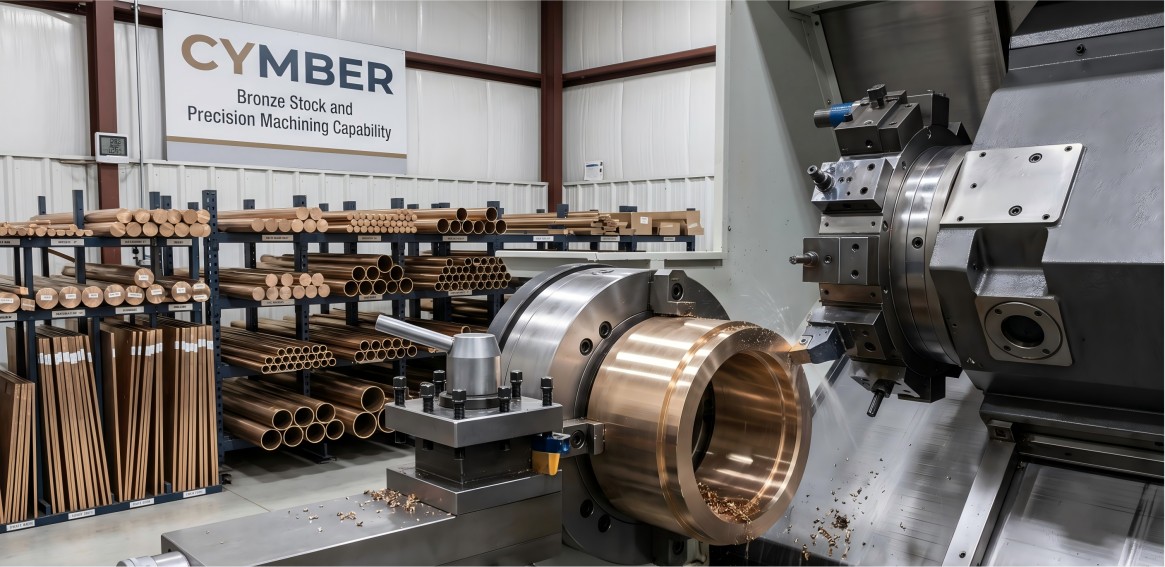
That is where material supply alone is not enough. Our CYMBER CNC Machining Workshop supports turning, boring, milling, drilling, grooving, and precision finishing for custom bronze bushings, sleeves, and heavy wear components.
Bronze vs Naval Brass: Which One Belongs in Your Bushing?
Naval brass is often discussed together with bronze because it performs well in marine environments. However, it should not be treated as a universal substitute for bronze bearing bushings.
Tin Bronze and Leaded Tin Bronze
Tin bronze is a classic bearing material for heavy sliding applications. It offers good wear resistance, compressive strength, and anti-seizure behavior. Leaded tin bronze improves machinability and embedability, making it a strong choice for bushings that run against steel shafts.
Recommended Cymber options include Wear-Resistant Large Tin Bronze Rod Stock, Machinable High-Lead Tin Bronze Tube – C93200 Alloy, and Durable High-Tin Bronze Sheet Stock.
Aluminum Bronze and Nickel Aluminum Bronze
Aluminum bronze has higher strength and better corrosion resistance than many tin bronze grades. It is suitable for impact load, marine hardware, pump parts, valve components, shaft sleeves, and heavy-duty wear parts. Nickel aluminum bronze improves seawater resistance and mechanical stability, making it valuable in shipbuilding and offshore equipment.
For these applications, engineers often compare Cast C95400 Aluminum Bronze Plate, Cast C95400 Aluminum Bronze Tube, High-Strength C95400 Aluminum Bronze Round Bar, Corrosion-Resistant Large Aluminum Bronze Pipes, and High-Strength Oversized Aluminum Bronze Round Bars.
Phosphor Bronze
Phosphor bronze is not always the first choice for massive bushings, but it is excellent where fatigue resistance, elasticity, corrosion resistance, and dimensional control matter. It is useful for precision sleeves, wear strips, spring plates, and smaller sliding components.
Cymber supplies Corrosion-Resistant Phosphor Bronze Rod, Spring Temper C51000 Phosphor Bronze Plate, Corrosion-Resistant Large Phosphor Bronze Pipes, High-Strength Oversized Phosphor Bronze Round Bars, and Corrosion-Resistant Phosphor Bronze Tubing.
Naval Brass
Naval brass can be useful for marine fittings, valve stems, and corrosion-resistant hardware, especially where machinability and seawater resistance are needed. But for high-load bearing bushings, bronze normally has the advantage in wear resistance, anti-galling behavior, and load-bearing stability.
A simple rule: Use naval brass when corrosion resistance and machinability are the primary concern; use bronze when sliding wear, bearing pressure, and shaft protection are the main concern.
Quick Selection Guide for Heavy-Duty Bronze Bushings
| Application | Main Risk | Recommended Material Direction | CYMBER Product Path |
|---|---|---|---|
| Mining crusher bushing | Shock load, abrasive wear, poor lubrication | C93200 leaded tin bronze or high tin bronze | C93200 Leaded Tin Bronze Tube, Wear-Resistant Tin Bronze Rod |
| Hydraulic cylinder guide sleeve | Sliding wear, tolerance stability | Tin bronze or phosphor bronze | Machinable High-Lead Tin Bronze Tube, Phosphor Bronze Tubing |
| Marine shaft sleeve | Seawater corrosion, strength loss | C63000 / C95400 aluminum bronze | C63000 Nickel Aluminum Bronze Round Bar, C95400 Aluminum Bronze Tube |
| Gear blank or worm wheel | Wear plus tooth load | Aluminum bronze or tin bronze | Precision Machined Aluminum Bronze Custom Gears, Durable High-Tin Bronze Sheet Stock |
| Oversized industrial bushing | Large diameter, custom machining | Oversized aluminum bronze or phosphor bronze stock | Oversized Aluminum Bronze Round Bars, Oversized Phosphor Bronze Round Bars |
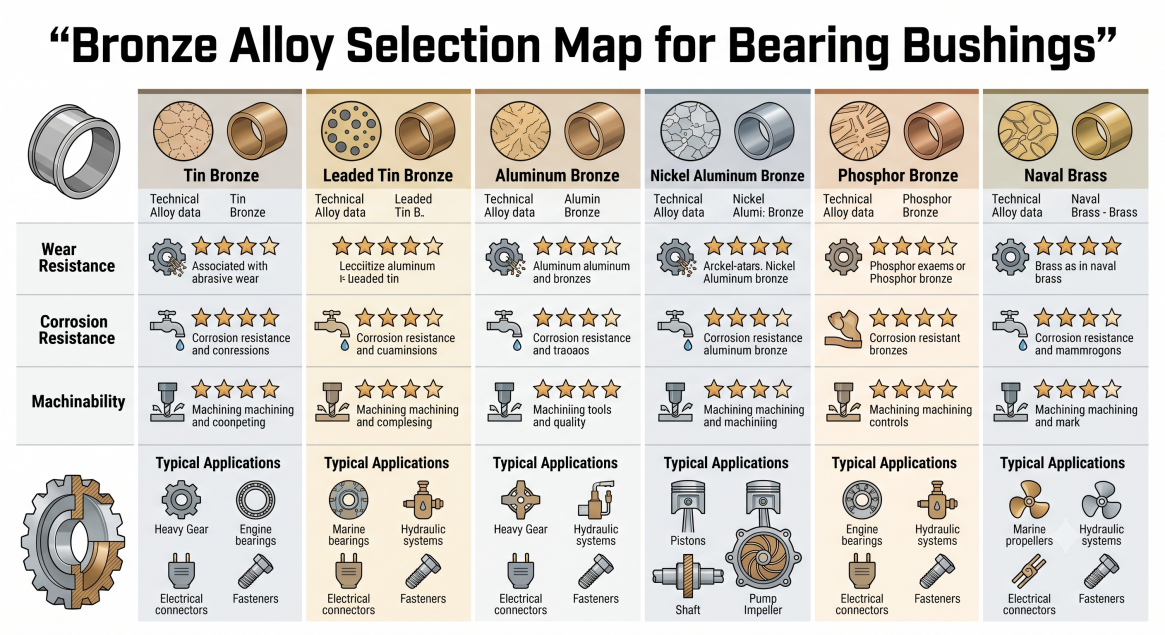
Practical Machining Parameters for Bronze Bearing Bushings
The values below are starting ranges for CNC turning and boring. Final parameters should be adjusted based on machine rigidity, tool grade, bushing diameter, casting quality, coolant condition, and required tolerance.
| Material | Typical Use | Cutting Speed, Carbide | Feed Range | Notes |
|---|---|---|---|---|
| C93200 leaded tin bronze | Bearing bushings, wear sleeves | 150–250 m/min | 0.10–0.30 mm/rev roughing; 0.05–0.15 mm/rev finishing | Excellent machinability; keep boring bars rigid to avoid chatter |
| C95400 aluminum bronze | Marine bushings, valve parts, heavy wear parts | 80–160 m/min | 0.08–0.22 mm/rev | Tougher than tin bronze; use sharp positive-rake carbide and stable clamping |
| C63000 nickel aluminum bronze | Marine shaft sleeves, offshore parts | 70–140 m/min | 0.08–0.20 mm/rev | Requires strong coolant, rigid setup and careful chip control |
| C51000 phosphor bronze | Precision sleeves, wear strips, spring parts | 120–220 m/min | 0.05–0.18 mm/rev | Avoid rubbing; light finishing passes can work-harden the surface |
| Naval brass | Marine fittings, corrosion-resistant hardware | 150–300 m/min | 0.08–0.25 mm/rev | Usually machines well, but not a direct substitute for high-load bronze bearings |
Boring and ID Finishing Tips
For bronze bearing bushings, the inside diameter matters more than the outside beauty. A bushing with a polished OD but poor bore geometry will still fail.
Use short, rigid boring bars wherever possible. For large bronze tubes, rough the ID with enough depth of cut to remove casting skin or stock allowance, then leave a controlled finishing allowance. If oil grooves are required, machine them after the bore is stabilized, not before.
For heavy wall products such as Corrosion-Resistant Large Aluminum Bronze Pipes and Corrosion-Resistant Large Phosphor Bronze Pipes, Cymber can support cut-to-length stock preparation before precision machining to reduce customer-side material waste and setup time.
Why Customers Choose Cymber for Bronze Bearing Bushing Projects
A bronze bushing project can go wrong in three places: material selection, stock availability, and machining control. Cymber’s advantage is that these three steps sit close together.
Stock Before Promises
For overseas buyers, delivery uncertainty often costs more than the material itself. Cymber’s large-scale copper-aluminum integrated warehouse supports faster material matching, cutting, and shipment planning for bronze bars, tubes, plates, and custom blanks.
This is especially important when a mining plant, hydraulic equipment maker, or shipyard needs a replacement bushing quickly, but still requires the right alloy, diameter, wall thickness, and machining allowance.
Machining Knowledge Built Into Material Supply
Many suppliers can sell bronze. Fewer can discuss boring allowance, press-fit control, oil groove layout, tool wear, and final inspection in the same conversation. Cymber connects material supply with machining experience through the CYMBER CNC Machining Workshop, helping customers move from stock to usable components.
For oversized and heavy-duty projects, our processing capability is further supported by the Heavy Forging & Precision Processing Workshop, where large sections, custom blanks, and demanding industrial parts can be prepared for downstream machining.
Product Coverage for Different Failure Modes
If your bushing fails from adhesive wear, we look at tin bronze and leaded bronze. If it fails from seawater corrosion, we look at aluminum bronze or nickel aluminum bronze. If it fails from poor dimensional stability, we review machining route, stock form, and tolerance control.
That is why our bronze product family includes plates, rods, tubes, pipes, flat bars, square bars, and machined gears — not only one generic “bronze bar.”
Cymber Bronze Product Links for Engineering Selection
For buyers comparing bronze bearing bushing materials, these are the core Cymber bronze product pages to review:
- C63000 Nickel Aluminum Bronze Round Bar | AMS 4640
- Precision Machined Aluminum Bronze Custom Gears
- Cast C95400 Aluminum Bronze Plate – Wear Resistant Alloy
- Large Seawater-Resistant C63000 Nickel Aluminum Bronze Rod
- Cast C95400 Aluminum Bronze Tube – High Strength Alloy
- Corrosion-Resistant Phosphor Bronze Rod – Precision Drawn
- Machinable High-Lead Tin Bronze Tube – C93200 Alloy
- Spring Temper C51000 Phosphor Bronze Plate – High Hardness Alloy
- High-Strength C95400 Aluminum Bronze Round Bar – Cast Alloy
- Large Section C93200 Leaded Tin Bronze Square Bar – Bearing Grade
- Large Diameter C93200 Leaded Tin Bronze Tube – Bearing Grade Alloy
- Corrosion-Resistant Large Phosphor Bronze Pipes
- High-Strength Oversized Phosphor Bronze Round Bars
- Corrosion-Resistant Large Aluminum Bronze Pipes
- High-Strength Oversized Aluminum Bronze Round Bars
- Wear-Resistant Large Tin Bronze Rod Stock
- Corrosion-Resistant Nickel Aluminum Bronze Flat Bars
- Durable High-Tin Bronze Sheet Stock
- Corrosion-Resistant Phosphor Bronze Tubing
FAQ
What is the best bronze for heavy machinery bushings? For high-load sliding bushings, C93200 leaded tin bronze and high tin bronze are common starting choices. For seawater or offshore machinery, C95400 aluminum bronze and C63000 nickel aluminum bronze are often better because they combine strength with corrosion resistance.
Is naval brass suitable for bearing bushings? Naval brass can work for marine fittings and corrosion-resistant hardware, but it is usually not the first choice for high-load bearing bushings. Bronze generally provides better wear resistance and anti-galling behavior in sliding contact.
Why does a bronze bushing need machining allowance? Casting skin, stock ovality, saw cutting, heat history, and clamping deformation can affect final accuracy. Proper machining allowance gives the workshop enough material to control bore size, roundness, oil grooves, and press-fit dimensions.
Can Cymber supply both bronze material and finished bushings? Yes. Cymber can support bronze material selection, stock cutting, custom blanks, and CNC machining for bushings, sleeves, gears, wear plates, and other heavy-duty bronze components.
Ready to specify the right bronze bushing for your next heavy machinery project?
Send us your application details (load, speed, lubrication condition, shaft material, environment, and required dimensions). We will recommend the most suitable alloy and confirm stock availability + machining lead time within hours.
Contact Us for Bronze Bushing Material & Machining Support
Post time: Jun-14-2026