
Publication Date: August 4, 2026
Author: Hu Yanwei, Cymber Metal Technical Expert
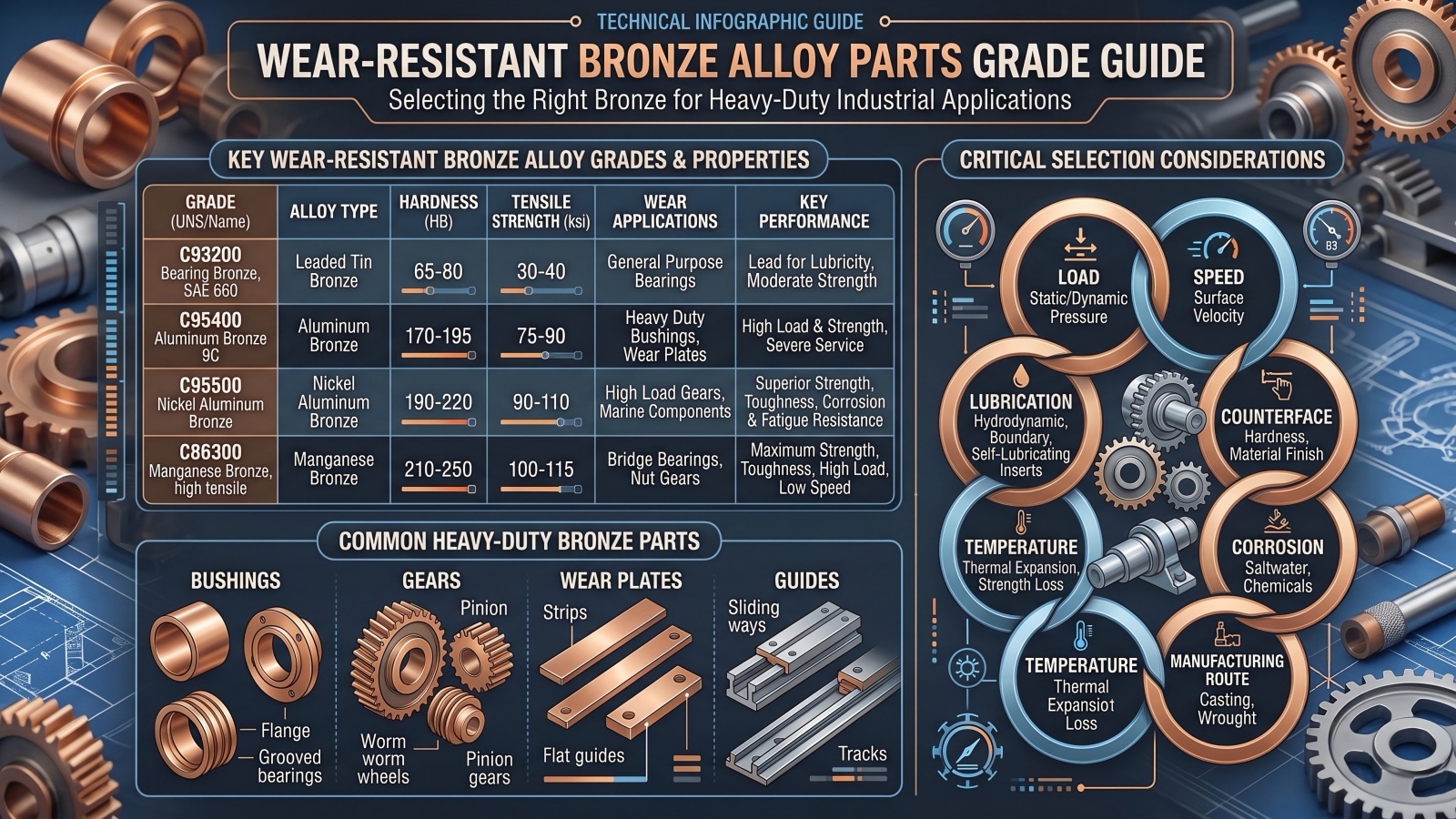
Stop choosing heavy-duty bronze by hardness alone.
A hard bronze bushing can still seize if the shaft finish, running clearance and lubrication system are wrong. A softer leaded bronze may tolerate contamination but deform under shock loading. A high-strength nickel aluminum bronze may survive the mechanical load yet make the finished part unnecessarily expensive if the application never needed its strength, seawater resistance or cavitation performance.
The wrong grade rarely fails on the quotation.
It fails after machining, assembly or several weeks of service.
Quick answer: There is no universally best grade for wear-resistant bronze alloy parts. C93200 is commonly selected for lubricated bearings that need conformability and embeddability. C95400 is a stronger starting point for heavily loaded bushings, gears and wear plates. C95500 or wrought C63000 may be justified when high strength, seawater corrosion and cavitation resistance must work together. C86300 is often considered for very high static loads and slow movement. C90700 may suit gears and selected low-lead bearing applications. Final selection must be based on load, surface speed, lubrication, impact, counterface, temperature, corrosion and manufacturing route.
Why “Wear-Resistant Bronze” Is Not a Specification
Wear is not a single material property.
- Bearing pressure
- Sliding or oscillating velocity
- Lubrication regime
- Start-stop frequency
- Shock loading
- Shaft hardness
- Shaft surface roughness
- Alignment
- Running clearance
- Operating temperature
- Contamination
- Corrosive exposure
- Required service life
A supplier cannot select the correct alloy from this RFQ:
Product: Wear-resistant bronze bushing
Quantity: 500 pieces
Please quote your best price.
“Wear-resistant bronze” does not define the grade, casting route, lubrication condition, finished dimensions or acceptance tests.
A usable RFQ must answer a harder question:
What will the part actually experience in service?
Which Bronze Grade Fits Which Heavy-Duty Condition?
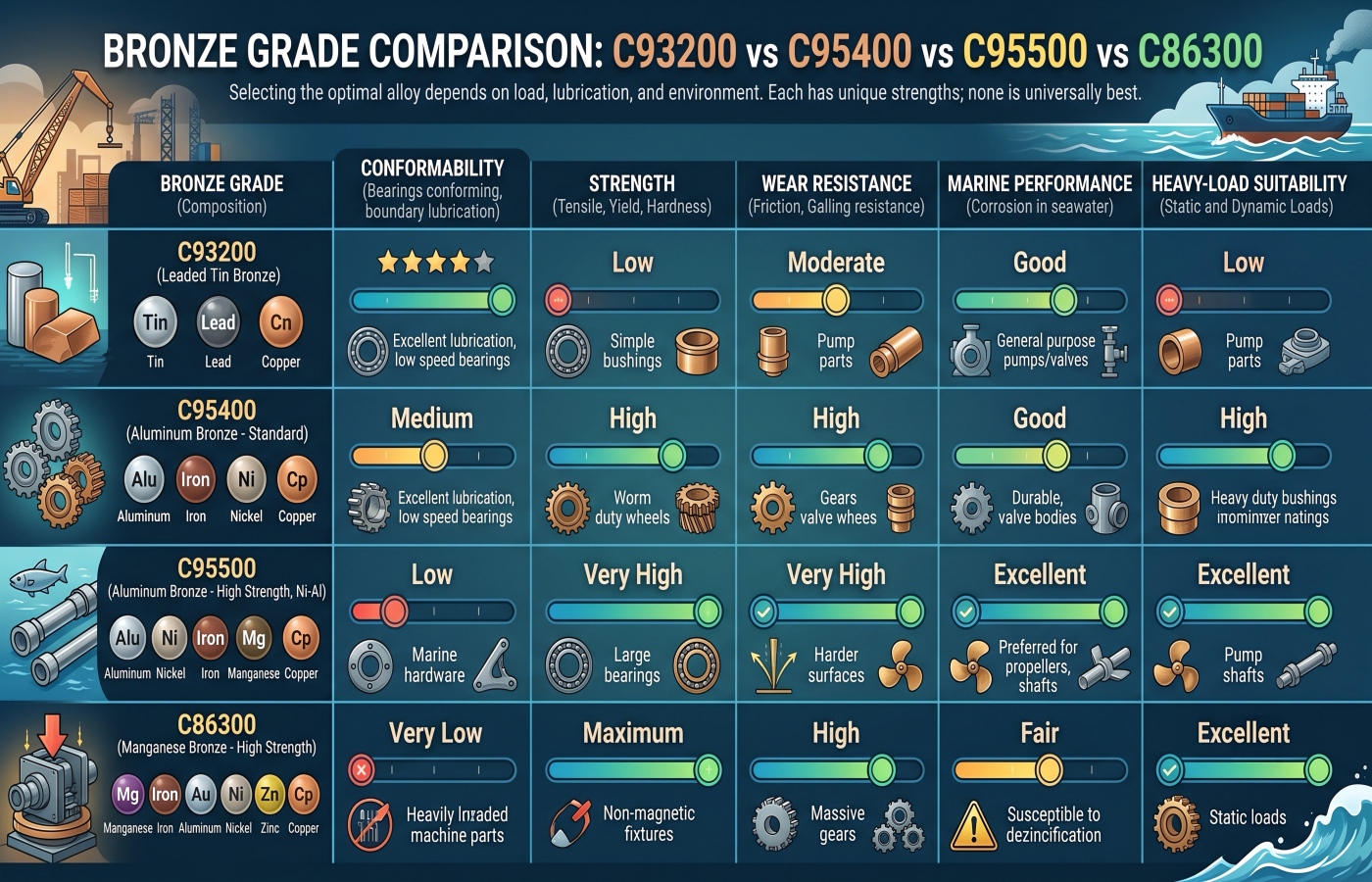
| Grade | Best starting point | Main advantage | Major purchasing risk |
|---|---|---|---|
| C93200 | Lubricated bushings under moderate loads and speeds | Conformability, embeddability and machinability | Lower strength; commonly contains approximately 6–8% lead |
| C95400 | Heavy-load bushings, gears, wear plates and guides | High strength, hardness and industrial corrosion resistance | More demanding machining; lubrication still matters |
| C95500 | Marine, cavitation and high-load components | Strength combined with seawater and cavitation resistance | Higher alloy and processing cost |
| C63000 | Wrought shafts, guides, bushings and marine hardware | Wrought strength, fatigue and corrosion performance | Product condition and manufacturing route must be controlled |
| C86300 | Slow-speed, very-high-load bushings and screw-down nuts | High strength and load-carrying potential | Not a universal marine alloy; lubrication and corrosion require review |
| C90700 | Gears, worms and selected low-lead wear parts | Tin-bronze wear and corrosion performance | Less embeddability than leaded bearing bronze |
| C51000/C52100 | Springs, contacts, shims and thin wear elements | Elastic performance and thin-section wear resistance | Not the default choice for massive heavy-load bearings |
The table is a screening tool. It does not replace application engineering.
Representative Alloy Data
The following values are useful for preliminary comparison. Composition limits and mechanical properties must be confirmed against the governing standard, product form, casting or wrought route and certified material condition.
| Grade | Common composition reference, wt.% | Representative mechanical reference | Practical positioning |
|---|---|---|---|
| C93200 | Sn 6.3–7.5, Pb 6.0–8.0, Zn 2.0–4.0 | UTS about 240 MPa; yield about 125 MPa; hardness about 60–70 HB | General bearing bronze with strong embeddability |
| C95400 | Al 10.0–11.5, Fe 3.0–5.0 | UTS about 585 MPa; yield about 220 MPa; hardness often 150–190 HB | High-strength aluminum bronze |
| C95500 | Al 10.0–11.5, Ni 3.0–5.5, Fe 3.0–5.0 | UTS about 620 MPa; yield about 260 MPa; hardness often 170–200 HB | Nickel aluminum bronze for higher-load and marine service |
| C86300 | Cu 60–66, Zn 22–28, Al 5.0–7.5, Mn 2.5–5.0, Fe 2.0–4.0 | UTS around 760 MPa; yield around 415 MPa; hardness often 200–230 HB | High-strength manganese bronze for slow, heavy loads |
| C90700 | Sn 10.0–12.0, Pb max. about 0.5, Zn max. about 0.5 | UTS around 275 MPa; yield around 140 MPa; hardness around 70–85 HB | Tin bronze for gears and selected bearing duties |
These are reference values—not contractual guarantees. A heat-treated, centrifugally cast, continuously cast or wrought product can differ substantially from another product carrying the same general alloy designation.
Do not combine the tensile strength from one manufacturing condition with the hardness from another and place both on a purchase order.
C93200 bearing bronze—often associated with SAE 660—is commonly used for:
- Sleeve bearings
- Bushings
- Thrust washers
- Pump components
- General machinery bearings
- Lubricated sliding parts
Its lead content supports conformability and embeddability. Small particles can become embedded in the softer bearing surface instead of immediately scoring the shaft.
That can be valuable when:
- Lubrication is imperfect
- Shaft alignment is not ideal
- Contamination cannot be eliminated completely
- The bearing must conform slightly during run-in
But that same softness limits its usefulness under severe impact or extremely high unit loading.
A buyer may select C93200 because it machines easily and costs less than nickel aluminum bronze. If the bushing is subjected to repeated hammering, edge loading or inadequate housing support, the apparent saving can turn into plastic deformation, loss of clearance and premature replacement.
C93200 Compliance Warning
C93200 commonly contains approximately 6–8% lead.
That creates a separate procurement decision. Buyers should check:
- Current RoHS requirements and applicable exemptions
- Customer-specific restricted-substance specifications
- Drinking-water requirements
- Food-contact restrictions
- Scrap-segregation requirements
- Destination-market regulations
- Required material declarations
Do not approve C93200 merely because the mechanical application looks suitable.
C95400 aluminum bronze is one of the most common starting points for heavy-duty bronze parts requiring substantially more strength than C93200.
Typical applications include:
- High-load bushings
- Gears and worm wheels
- Wear plates
- Guide blocks
- Slide components
- Valve parts
- Heavy-equipment components
- Steel-mill and forming-equipment parts
C95400 offers:
- Higher strength than traditional leaded bearing bronze
- Higher hardness
- Good wear performance under suitable lubrication
- Good corrosion resistance in many industrial environments
- Better resistance to shock and deformation
It is not self-lubricating.
Selecting C95400 and removing the lubricant because “aluminum bronze is wear resistant” is a poor engineering decision. Under dry sliding, a high-strength bronze can still generate frictional heat, transfer material or gall against an unsuitable shaft.
The mating surface, clearance and lubrication route remain part of the alloy selection.
C95400 can also require more machining effort than C93200. Buyers should account for:
- Higher tool loading
- More demanding chip control
- Greater deburring effort
- Workholding stability
- Surface-finish requirements
- Inspection time
- Potential finishing allowance
The correct comparison is finished-part cost, not raw casting price.
C95500 nickel aluminum bronze is commonly evaluated when the component needs a combination of:
- High strength
- Wear resistance
- Seawater corrosion resistance
- Cavitation resistance
- Resistance to shock loading
- Dimensional stability
Typical applications include:
- Marine bushings
- Pump and valve parts
- Propeller-related components
- Guide bearings
- Heavy-duty gears
- High-load wear components
- Hydraulic-equipment parts
Nickel is not added for decoration. It changes the alloy system, mechanical properties, phase stability and corrosion behavior.
That also raises cost.
If the component operates in a clean, lubricated indoor machine without corrosion or cavitation exposure, C95500 may be unnecessary. C95400 or another bearing bronze may meet the requirement at a lower total cost.
For critical marine components, buyers should review more than chemistry:
- Casting route
- Heat-treatment condition
- Microstructural control
- Repair-welding history
- Internal soundness
- Mechanical-property results
- Corrosion exposure
- Final machining and surface condition
A C95500 certificate does not automatically prove that every critical casting has the required internal quality.
C63000 nickel aluminum bronze is a wrought alloy commonly supplied as rod, bar, forgings or other worked forms.
It may be considered for:
- Shafts
- Valve stems
- Guides
- Wear rings
- Bushings
- Marine hardware
- High-strength machined components
Wrought processing can provide a different grain structure and mechanical response from a cast product.
C63000 should not be treated as a simple one-for-one substitute for C95500. Buyers must compare:
- Exact composition
- Product standard
- Wrought or cast route
- Heat treatment
- Directional properties
- Available dimensions
- Machining allowance
- Inspection requirements
A drawing that specifies “nickel aluminum bronze” without identifying the cast or wrought product form leaves too much room for commercial interpretation.
C86300 manganese bronze is frequently considered for components exposed to very high loads and relatively slow movement, including:
- Bridge and construction-equipment bushings
- Screw-down nuts
- Heavy-press components
- Crane and lifting-equipment parts
- Slow-moving bearings
- High-load guide parts
C86300 is often called manganese bronze, although metallurgically it belongs to a high-strength copper-zinc-aluminum-manganese family.
Its strength can be much higher than that of traditional tin bearing bronzes.
That does not mean it is the best material for high-speed rotation.
Higher strength cannot compensate for:
- Insufficient lubrication
- Poor shaft finish
- Excessive sliding speed
- Misalignment
- Edge loading
- Incorrect clearance
- Corrosive media not considered during selection
C86300 is best treated as a high-load engineering alloy, not as a universal replacement for every bronze bushing.
C90700 tin bronze is commonly considered for:
- Worm gears
- Gear wheels
- Bushings
- Bearings
- Pump parts
- Components requiring good corrosion performance
Its higher tin content supports strength, hardness and wear performance without the high lead content of C93200.
The tradeoff is reduced embeddability.
If hard contamination reaches the interface, a low-lead tin bronze may be less forgiving than C93200. Better sealing, lubricant cleanliness and shaft protection may therefore be required.
C90700 should also not be selected based on a “lead-free” label without confirming the exact chemical limits and destination-market requirements.
Thin spring contacts, clips, shims and flexible wear elements are a different problem from thick heavy-duty bushings.
C51000 and C52100 from Cymber Metal’s phosphor bronze range may be suitable when a component requires:
- Elastic recovery
- Spring force
- Thin-section fatigue resistance
- Moderate sliding wear
- Electrical-contact performance
- Precision stamping
They are not normally the first choice for a massive, shock-loaded sleeve bearing.
Do not move from a spring-contact alloy to a bearing alloy—or the other way around—because both are marketed as wear-resistant bronze.
Calculate Bearing Pressure and PV Before Selecting a Grade
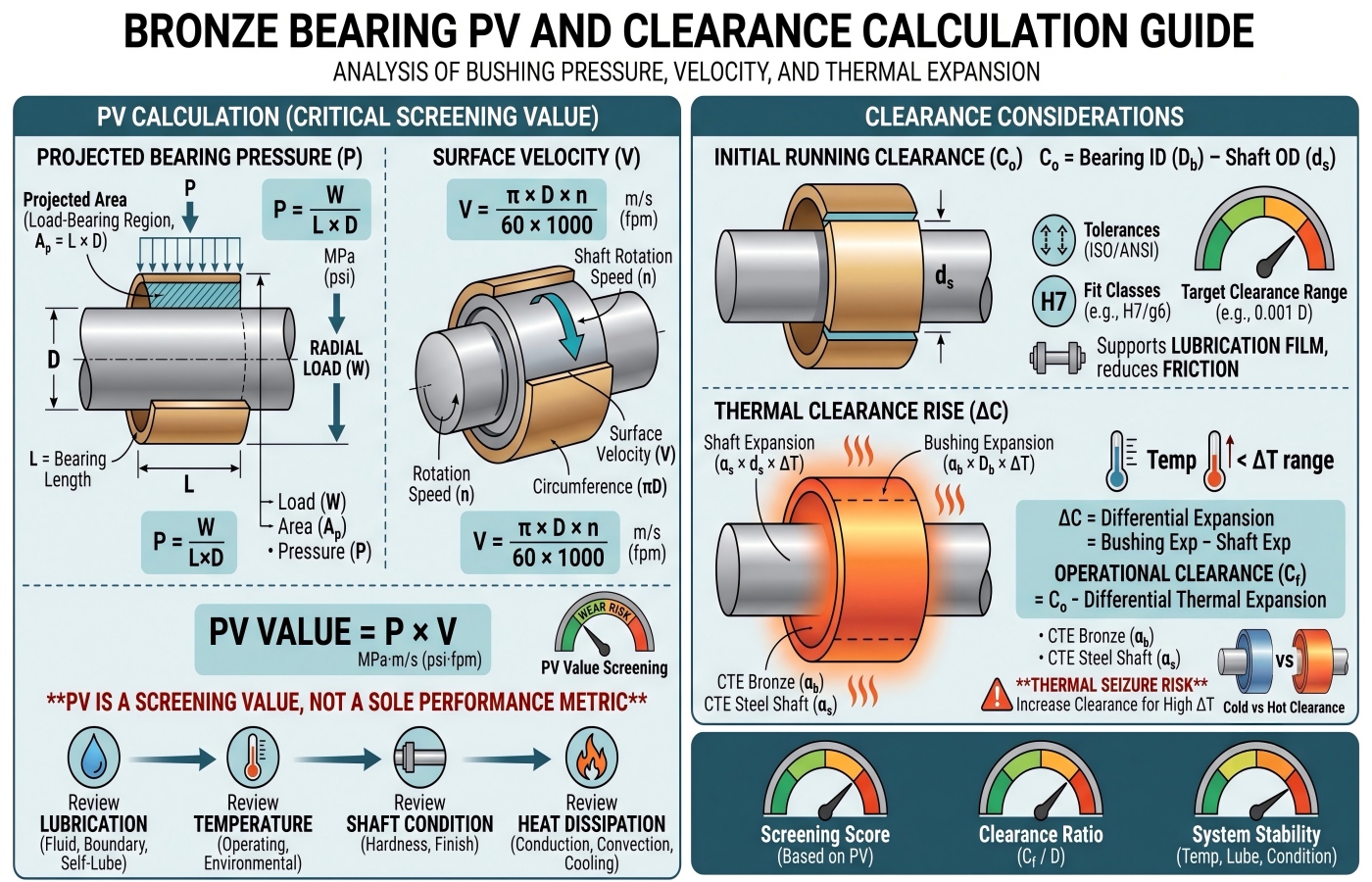
The first engineering screen for a plain bearing usually includes projected bearing pressure:
P = W ÷ (D × L)
Where:
P= projected bearing pressureW= radial loadD= shaft diameterL= bearing length
Assume:
- Radial load: 20,000 N
- Shaft diameter: 40 mm
- Bearing length: 50 mm
Projected area:
40 × 50 = 2,000 mm²
Bearing pressure:
20,000 ÷ 2,000 = 10 N/mm² = 10 MPa
If the surface velocity is 0.20 m/s:
PV = 10 MPa × 0.20 m/s = 2.0 MPa·m/s
That number is not an automatic pass or fail.
It is a screening value that must be reviewed together with:
- Lubrication method
- Start-up frequency
- Oscillating or continuous motion
- Heat dissipation
- Counterface material
- Housing support
- Contamination
- Service temperature
- Required life
Do not copy a PV rating from a generic online table without confirming the test method and operating conditions.
The Shaft Can Destroy a Good Bronze Bearing
A bronze grade cannot fix an unsuitable counterface.
The drawing should address:
- Shaft material
- Shaft hardness
- Surface finish
- Roundness
- Runout
- Alignment
- Surface coating
- Lubrication grooves
- Assembly cleanliness
A soft or rough shaft can produce adhesive wear and rapid scoring. An excessively hard but poorly finished shaft can also damage the bearing surface.
If the supplier receives only the bushing drawing, the design review is incomplete.
The shaft and bearing form a tribological pair. Evaluate them together.
Running Clearance Changes With Temperature
Bronze alloys commonly have coefficients of thermal expansion near approximately 16–18 µm/m·K, depending on the alloy and temperature range.
For a 100 mm bronze diameter exposed to an 80°C temperature increase, unconstrained thermal growth is approximately:
ΔD = α × D × ΔT
At 16 µm/m·K:
16 × 10⁻⁶ × 100 mm × 80 = 0.128 mm
At 18 µm/m·K:
18 × 10⁻⁶ × 100 mm × 80 = 0.144 mm
This does not mean the operating clearance automatically changes by that exact amount. The steel shaft also expands, and the bronze bushing may be constrained by the housing or press fit.
It proves a more important point:
A room-temperature fit cannot be selected without considering operating temperature and assembly conditions.
An H7/h6 fit designation by itself does not define the correct running clearance for every bearing.
Manufacturing Route Changes Performance and Cost
Continuous Casting
Continuous-cast bars and tubes can provide a practical balance of:
- Size availability
- Consistent structure
- Near-net hollow forms
- Machining economy
- Repeatable production
Standards such as ASTM B505/B505M may be relevant, depending on the grade and order.
Centrifugal Casting
Centrifugal casting is frequently used for:
- Large bushings
- Sleeves
- Rings
- Cylindrical wear components
It can produce dense cylindrical castings and reduce the amount of material removed compared with machining from solid bar. ASTM B271/B271M may be applicable.
Sand or Permanent-Mold Casting
Near-net shapes may reduce material consumption for:
- Gears
- Flanged bushings
- Wear plates
- Irregular components
The buyer must define permissible porosity, repair conditions, machining allowance and inspection requirements. ASTM B584 or grade-specific standards such as ASTM B148 may be relevant.
Wrought and Forged Products
Wrought or forged aluminum-bronze products may be justified where:
- Directional mechanical properties matter
- High fatigue strength is required
- Critical sections must avoid casting-related discontinuities
- The component is machined from bar or forging
ASTM B150/B150M may apply to selected aluminum-bronze rods, bars, shapes and forgings.
The standard must match both the alloy and manufacturing route. Do not specify a cast-alloy grade with a wrought-product standard and expect suppliers to resolve the contradiction silently.
Near-Net Bronze Tubes Can Cut More Cost Than a Cheaper Alloy
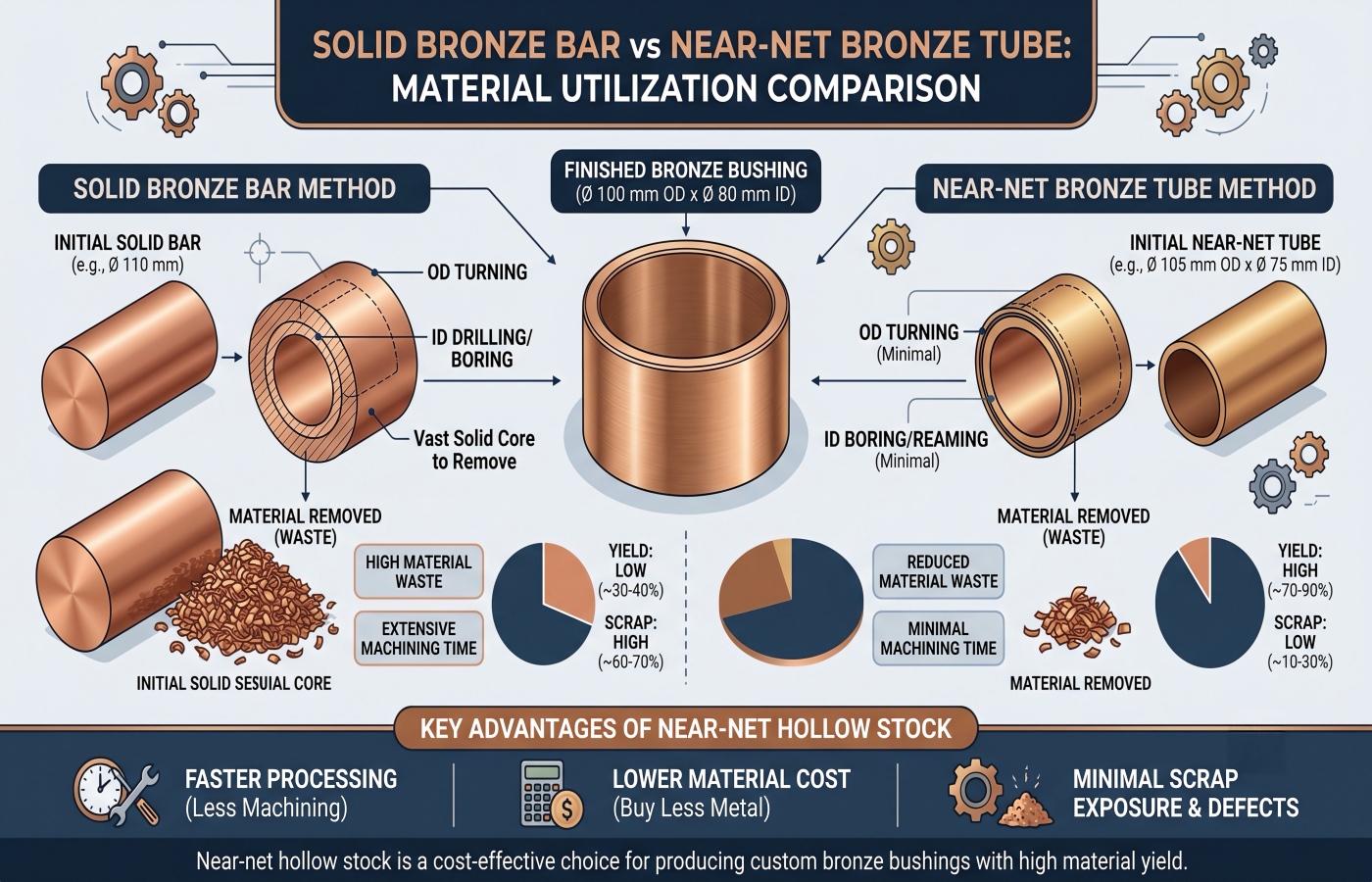
Consider a finished C93200 bushing:
- Finished OD: 100 mm
- Finished ID: 80 mm
- Finished length: 80 mm
Theoretical finished volume:
π ÷ 4 × (100² − 80²) × 80
= approximately 226,195 mm³
Option A: Machine From Ø105 mm Solid Bar
Input volume:
π ÷ 4 × 105² × 80
= approximately 692,721 mm³
Theoretical material utilization:
226,195 ÷ 692,721 = 32.6%
Approximately 67.4% of the input volume must be removed before allowing for facing or other features.
Using a C93200 density reference of approximately 8.93 g/cm³:
- Input blank: approximately 6.19 kg
- Finished bushing: approximately 2.02 kg
- Theoretical removal: approximately 4.17 kg
Option B: Use a Near-Net Tube, Ø105 × Ø75 mm
Input volume:
π ÷ 4 × (105² − 75²) × 80
= approximately 339,292 mm³
Theoretical material utilization:
226,195 ÷ 339,292 = 66.7%
Approximate weights:
- Tube blank: approximately 3.03 kg
- Finished bushing: approximately 2.02 kg
- Theoretical removal: approximately 1.01 kg
The near-net tube reduces theoretical stock removal by approximately 3.16 kg per part in this example.
Actual yield will also depend on:
- Saw kerf
- Facing allowance
- Available tube tolerances
- Surface-defect removal
- Minimum cleanup
- Part features
- Rejected material
- Scrap credit
The commercial message is still clear:
A supplier offering the right material form may beat a lower kilogram price from a supplier offering solid stock only.
Machining Tradeoffs by Bronze Family
| Bronze family | General machining behavior | Common control point |
|---|---|---|
| C93200 leaded tin bronze | Relatively machinable and forgiving | Lead compliance, soft-surface handling and burr control |
| C95400 aluminum bronze | Stronger and more demanding to machine | Rigid setup, sharp tooling and controlled stock removal |
| C95500 nickel aluminum bronze | Tough, strong and machining-intensive | Tool life, heat generation and finishing allowance |
| C86300 manganese bronze | High-strength material with substantial tool loading | Workholding, chip control and dimensional stability |
| C90700 tin bronze | Moderate machinability | Burrs, tool condition and surface finish |
| Phosphor bronze | Product-form and temper dependent | Burr formation, tool adhesion and thin-section distortion |
Exact speeds and feeds depend on:
- Casting or wrought condition
- Hardness
- Tool material
- Machine rigidity
- Depth of cut
- Coolant
- Part geometry
- Required surface finish
Projects requiring finished components can be reviewed with Cymber Metal’s fine machining services.
What Should Be Inspected?
Chemical Composition
Confirm the exact grade and lot. Portable XRF may support general alloy identification, but the agreed analytical method must match the elements and accuracy required by the material standard.
Mechanical Properties
Depending on the grade and product form, the buyer may require:
- Tensile strength
- Yield strength
- Elongation
- Hardness
- Impact or special testing where applicable
Internal Soundness
For critical castings, the order may require:
- Ultrasonic testing
- Radiographic inspection
- Liquid-penetrant testing
- Macrostructure review
- Pressure or leak testing
“UT tested” is incomplete. State the method, sensitivity, calibration, inspected volume and acceptance criteria.
Dimensions and Surface
Define:
- Finished dimensions
- Datums
- Running clearance
- Press-fit dimensions
- Roundness
- Concentricity
- Runout
- Surface roughness
- Lubrication-groove geometry
- Edge break
- Permitted casting or machining marks
Traceability
The inspection package may include:
- Material Test Certificate
- Certificate of Conformity
- Heat or lot identification
- Dimensional report
- Hardness result
- NDT report
- First Article Inspection
- Final inspection record
Buyers can review Cymber Metal’s published equipment information and certificate information. Order-specific inspection requirements must still be agreed in the purchase order.
Lead, Corrosion and Destination-Market Risk
Mechanical performance is only one approval gate.
C93200 may perform well as a bearing bronze but fail a customer’s restricted-substance requirement.
C86300 may provide high strength but require additional corrosion review in aggressive media.
C95500 may suit seawater service, but the casting condition, heat treatment and microstructure still matter.
Ask these questions before approving the material:
- Is lead restricted?
- Will the part contact drinking water or food?
- Is the component submerged in seawater?
- Is cavitation expected?
- Is ammonia or another aggressive chemical present?
- Will dissimilar metals create galvanic corrosion?
- Is cathodic protection used?
- Is repair welding permitted?
- Is coating or plating required?
A material can pass a mechanical test and still be wrong for the destination market.
Compare Total Landed Part Cost
For wear-resistant bronze alloy parts, use this formula:
Total landed part cost = alloy basis + casting or wrought conversion + yield loss + machining + inspection + finishing + packing + freight + duty + financing + reject and downtime exposure
The quotation should identify:
- Copper, tin, nickel or other metal-price basis
- Pricing date or averaging period
- Casting or forging route
- Heat-treatment charge
- Rough or finish machining
- NDT and documentation
- Scrap ownership or credit
- Packing
- Incoterm
- Freight mode
- Quotation validity
- Replacement responsibility
A higher-priced near-net casting may cost less than a cheaper solid bar after machining.
A stronger alloy may last longer—or it may add cost without solving the real lubrication problem.
Do the full calculation.
Supplier Evaluation Scorecard
| Evaluation area | Suggested weight |
|---|---|
| Grade and application suitability | 25% |
| Manufacturing route and internal quality | 20% |
| Machining and dimensional capability | 20% |
| Inspection and traceability | 15% |
| Pricing transparency and material yield | 10% |
| Packing, logistics and delivery control | 10% |
Change the weighting according to the application.
A marine pump component should place more weight on corrosion, cavitation and internal soundness. A dirty, slow-moving industrial bushing may place more weight on embeddability, lubrication and shaft protection.
Copyable RFQ Template
Application:
Part type: Bushing / Bearing / Gear / Wear Plate / Guide / Other
Drawing number and revision:
Required alloy:
Governing material standard:
Permitted equivalent grades:
Manufacturing route:
Cast / Continuous Cast / Centrifugal Cast / Forged / Wrought
Operating load:
Shaft diameter:
Bearing length:
Calculated bearing pressure:
Surface velocity:
Calculated PV:
Continuous / Oscillating / Intermittent motion:
Shock or impact load:
Operating temperature:
Lubrication type:
Lubricant delivery method:
Start-stop frequency:
Contamination:
Mating material:
Shaft hardness:
Shaft surface finish:
Required service life:
Corrosive environment:
Seawater exposure:
Cavitation:
Lead restriction:
Destination-market compliance:
Raw dimensions:
Finished dimensions:
Critical datums:
Running clearance:
Press fit:
Roundness:
Concentricity or runout:
Surface roughness:
Lubrication grooves:
Machining allowance:
Required chemistry report:
Required mechanical properties:
Hardness:
NDT method and acceptance:
Dimensional report:
Pressure or leak test:
Lot traceability:
First Article Inspection:
Third-party inspection:
Raw casting / Machined blank / Finished part:
Prototype quantity:
Production quantity:
Estimated annual demand:
Packing requirements:
Delivery destination:
Incoterm:
Required timeline:
Metal-price basis:
Quotation validity:
Technical files made available by the company can also be reviewed through the Cymber Metal download center.
FAQ
C95400 is a common starting point for high-load bushings requiring more strength than C93200. C95500 or C63000 may be preferred for marine, cavitation or higher-strength service. C86300 can suit very high loads and slow movement. The final selection depends on pressure, speed, lubrication, impact and corrosion.
C95400 is harder and substantially stronger, which can improve wear performance under suitable conditions. C93200 offers better conformability and embeddability. A contaminated or misaligned bearing may therefore benefit from C93200 even though it is softer.
C95500 may be justified when nickel aluminum bronze strength, seawater corrosion and cavitation resistance are required together. If the application is clean, lubricated and non-corrosive, C95400 may provide a more economical solution.
It is more commonly considered for very high loads and relatively slow movement. High-speed applications require careful review of heat generation, lubrication, clearance and shaft condition.
Phosphor bronze can work well for spring-loaded contacts, shims and thin wear elements. It is not normally the default material for large, shock-loaded bushings where cast aluminum bronze, bearing bronze or manganese bronze may be more appropriate.
PV is the product of projected bearing pressure and sliding velocity. It is a useful screening parameter, but the allowable value depends on lubrication, test method, temperature, motion type and heat dissipation.
C93200 commonly contains approximately 6–8% lead. Buyers must check current regulations, applicable exemptions, destination-market requirements and customer-specific substance restrictions before approval.
Provide the grade or application, drawing, load, speed, lubrication, temperature, mating material, corrosion exposure, manufacturing route, dimensions, tolerances, inspection requirements, quantity and destination.
Final Buying Recommendation
Do not ask which bronze is the hardest.
Ask which failure mode must be prevented.
If contamination and misalignment dominate, conformability may matter more than strength. If impact and unit load dominate, C95400 or C86300 may be the better starting point. If seawater and cavitation are present, C95500 or C63000 deserves serious review. If the component is a spring or thin contact, phosphor bronze belongs in a different selection path.
Then check the material form, machining yield, shaft condition, lubrication and inspection plan.
That is how wear-resistant bronze alloy parts survive heavy-duty service.
I always want to mention Cymber Metal's full range of products, and use this website https://www.cymbermetal.com/ to learn more about them.
Cymber Metal’s broader service capabilities can support discussions covering alloy selection, cutting, manufacturing-route review, machining and inspection requirements.
For a project-specific review, send your drawing, operating conditions, quantity and destination through the Cymber Metal contact page.
Post time: Aug-04-2026