
Publication Date: September 11, 2026
Author: Hu Yanwei, Cymber Metal Technical Expert
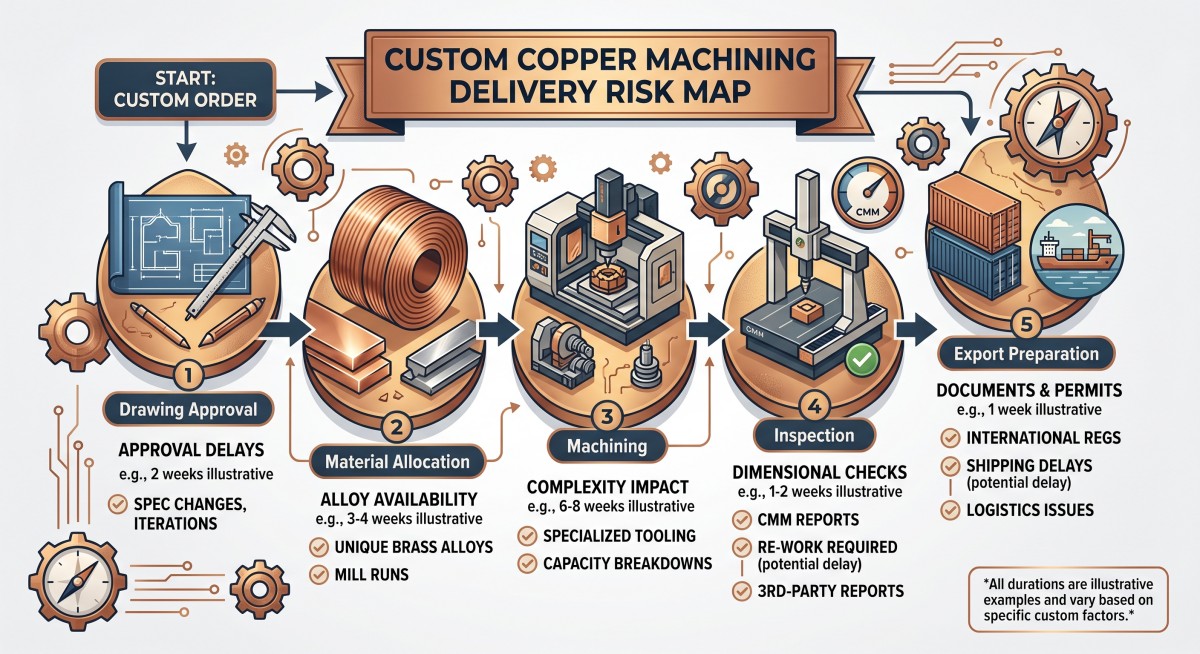
A custom copper machining project rarely misses its delivery date because the CNC machine is unavailable. More often, the delay starts earlier—when the drawing is incomplete, the material condition is unclear, or the buyer changes a tolerance after production has already started.
Copper and brass are not interchangeable from a machining and procurement perspective. Pure copper can create long chips, burrs and distortion problems. Brass may machine faster, but the exact grade, lead content, temper and regulatory requirements still matter. A small specification gap can become a new tool setup, another inspection cycle or a rejected batch.
That is why delivery control must begin before the quotation is approved.
For buyers sourcing copper bars, plates, rods, busbars or finished components, the objective is simple:
Define every decision that can stop production before the order enters the machining queue.
Quick Answer: What Causes Delays in Custom Copper Machining?
The most common causes are incomplete drawings, unclear material grades, late engineering changes, unapproved samples, unavailable raw material, unrealistic tolerances, missing inspection documents and undefined shipping responsibilities.
To reduce risk, a buyer should:
- Approve the drawing revision before material allocation.
- Specify alloy, temper, dimensions and tolerance.
- Separate raw-material lead time from machining lead time.
- Identify critical dimensions and inspection methods.
- Approve samples before releasing the full batch.
- Define packaging, documents and cargo-ready milestones.
A machining supplier should not be expected to quote accurately from a product name alone. For custom copper machining, the drawing and process requirements control the schedule.
Cymber Metal’s fine machining service can be used as a starting point when discussing CNC-machined copper, brass, bronze or aluminum components. Final feasibility still depends on the drawing, material and quantity.
1. Freeze the Drawing Before Production Starts
The fastest way to lose time is to begin machining before the drawing revision is stable.
A drawing should identify:
- Material grade and governing standard
- Product form and starting blank
- Finished dimensions
- General and critical tolerances
- Hole sizes, positions and fits
- Surface-finish requirements
- Chamfers, radii and deburring requirements
- Plating, coating or cleaning requirements
- Inspection points
- Drawing revision and approval status
Do not send three different drawing versions to the supplier and assume the latest email is obvious. A supplier may have already ordered material or prepared a CNC program from an earlier file.
Use one controlled drawing name, such as:
Project-ABC-Copper-Part-Rev-CThen write that revision into the purchase order and inspection documents.
Drawing Changes That Commonly Create Delays
A small change can affect much more than one dimension:
Buyer change Possible production impact Smaller hole tolerance New tooling, slower cutting or additional inspection Thinner wall Distortion risk and revised fixturing Tighter flatness Additional leveling, stress relief or machining allowance New surface finish Different finishing route and approval sample Changed copper grade New material sourcing and process validation Added plating New subcontracting, masking and inspection steps Before approving a change, ask the supplier which stage has already been completed:
- Material purchasing
- Blank cutting
- CNC programming
- Fixture preparation
- First-piece machining
- Batch production
- Surface treatment
- Final inspection
- Packing
This prevents the common dispute where the buyer assumes that a drawing change is free because “production has not shipped yet.”
2. Confirm the Copper or Brass Grade, Not Just the Product Name
“Copper part” and “brass fitting” are commercial descriptions, not complete machining specifications.
For copper parts, buyers may be comparing commercially pure copper, oxygen-free copper, tellurium copper, chromium zirconium copper or another specialty alloy. For brass parts, C36000, C26000 and other grades can behave differently during turning, milling, forming and finishing.
Cymber Metal’s pure copper products page covers product forms such as rods, bars, plates, strips and busbars. For brass applications, the brass alloys category provides a broader starting point for grade and form discussions.
The RFQ should state:
- Exact alloy designation
- Equivalent standard, if applicable
- Temper or supply condition
- Raw material form
- Chemistry or certificate requirement
- Mechanical or electrical requirements
- Whether the part is supplied as raw stock, cut blank or finished component
Why Grade Ambiguity Delays Production
A supplier may quote a copper bar based on available stock, while the buyer expects a specific oxygen level, temper or conductivity range. The material can arrive physically correct but still fail the purchase specification.
The problem then becomes:
- Material is placed on hold.
- Additional testing is requested.
- Replacement material is sourced.
- Machining is rescheduled.
- Inspection and shipment move later.
If oxygen content, conductivity or heat-treatment condition matters, state the required test method and document type before production. A general material certificate does not automatically prove every property needed for a finished part.
3. Separate Material Lead Time From Machining Lead Time
A quoted machining lead time is meaningless unless the material starting point is clear.
Ask the supplier to separate these stages:
Stage Question to ask Material sourcing Is the required grade and size already available? Blank preparation How much time is needed for cutting or sawing? Programming and fixturing Is a new program or fixture required? First-piece approval Does the buyer need to approve a sample? Batch machining When does regular production begin? Finishing Is plating, polishing or cleaning included? Inspection release Which documents must be approved? Cargo readiness When will packing be complete? Do not accept “10 days after order” without defining what “order” means.
The clock may start after:
- Purchase order receipt
- Deposit or payment
- Drawing approval
- Material confirmation
- Sample approval
- Fixture approval
- Finalization of all technical questions
For custom copper machining, the most reliable quotation states both:
- Lead-time starting condition
- Lead-time endpoint
For example:
Production lead time starts after drawing approval, material confirmation and receipt of the agreed payment. The quoted endpoint is cargo-ready after inspection and packing.
That wording is more useful than a single number without conditions.
4. Review Machining Route and Tooling Before Quoting the Batch
Machining route decisions should be made before the buyer compares prices.
The supplier may need to choose between:
- Saw-cut blank plus CNC machining
- Near-net-shape extrusion plus finish machining
- Forged blank plus CNC machining
- Turning from round bar
- Milling from plate or rectangular bar
- EDM for difficult features
- Secondary drilling, tapping or deburring
- Plating or surface treatment after machining
The least expensive raw material is not always the fastest route.
A copper part with large material removal may produce excessive chips and long cycle times. A brass part may reduce machining time, but a special lead-free grade may require different cutting parameters. A bronze alternative may improve wear performance but increase tool wear and fixturing requirements.
Ask the supplier to clarify:
- Which dimensions are produced by the blank
- Which dimensions are produced by CNC machining
- Where machining allowance is required
- Which features require secondary operations
- Which surfaces need a dedicated fixture
- Whether the process is suitable for the annual volume
Tooling and Fixture Questions
A new fixture or special tool can delay the first batch even when raw material is available.
Confirm:
- Is existing tooling suitable?
- Is a new fixture required?
- Who owns the fixture?
- Is the fixture included in the quoted price?
- How long will fixture approval take?
- Can the supplier run a first-piece trial before full production?
- What happens if the drawing changes after fixture completion?
These questions are especially important for copper components with thin walls, deep holes, narrow webs or large flat surfaces.
5. Mark Critical Dimensions and Inspection Methods
A drawing with many tolerances but no priority can slow inspection and create avoidable disputes.
Separate dimensions into three groups:
Dimension class Meaning Buyer action Critical Directly affects assembly, current flow or operating performance State inspection method and acceptance limit Functional Important for fit or operation but may allow a defined range Identify sampling or measurement method General Controlled by general drawing tolerance Avoid adding unnecessary inspection steps For example, a hole used with a mating pin may require a specific fit and measurement method. A cosmetic edge may only need visual inspection and deburring confirmation.
Do not write “all dimensions must be perfect.” That instruction does not help the machinist or inspector. It creates uncertainty about which dimensions can actually stop shipment.
Specify:
- Measurement instrument
- Sampling plan
- Datum references
- Surface-finish method
- Flatness or straightness method
- Whether inspection is done before or after plating
- Whether the buyer requires a first-article report
Cymber Metal’s quality certificate and inspection information can provide general quality-document context, but the purchase order should still define the documents required for the specific lot.
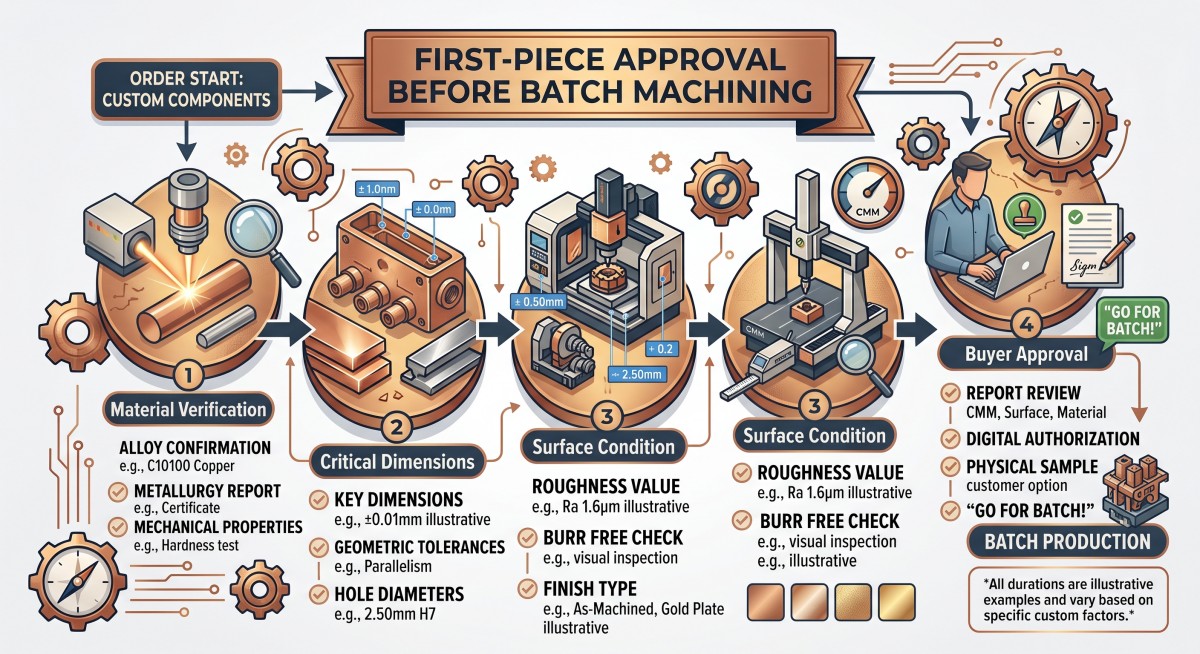
6. Approve the First Piece Before Releasing the Full Batch
A first-piece approval is a schedule-control tool, not just a quality step.
For a new custom copper machining project, the first piece should confirm:
- Material identity
- Key dimensions
- Hole location and fit
- Surface condition
- Burr and edge condition
- Machining marks
- Plating or coating, if applicable
- Assembly fit, where practical
A buyer should decide in advance:
- Who approves the sample
- How many samples are needed
- What information must accompany the sample
- How quickly the buyer will respond
- Whether production can continue before approval
- What happens if the sample fails
The supplier cannot control a delay caused by a sample waiting two weeks for buyer feedback. Put the approval deadline into the project schedule.
A practical rule is:
No engineering change after sample approval unless the supplier confirms its effect on cost, tooling and delivery.
7. Control Outsourced Plating and Secondary Processing
Plating, polishing, cleaning and special testing can become the hidden schedule risk.
A machined part may be complete but still unable to ship because:
- Plating thickness is not defined
- Masking areas are unclear
- The subcontractor needs a separate fixture
- Surface preparation is incomplete
- Coating color or appearance is awaiting approval
- The buyer has not confirmed a test requirement
- The finishing supplier has a different batch schedule
If plating or coating is part of the project, define:
- Coating type
- Target thickness or range
- Areas to be masked
- Surface preparation
- Appearance requirements
- Adhesion or continuity test, if required
- Inspection responsibility
- Rework process
- Whether the coating is applied before or after final machining
Ask the supplier to show the complete route:
Raw material → CNC machining → deburring → cleaning → plating → inspection → packing
If an outsourced process is required, ask whether the quoted delivery date includes transport between facilities and final inspection after return.
8. Prepare Export Packing Before the Cargo-Ready Date
Packing should be designed around the product, not added at the end of production.
Copper and brass parts can be damaged by:
- Part-to-part contact
- Strap pressure
- Sliding inside the case
- Moisture and condensation
- Unprotected machined surfaces
- Incorrect stacking
- Excessive package weight
- Missing labels
For bulk rods, bars and plates, agree on:
- Bundle arrangement
- Edge and corner protection
- Surface separators
- Base support
- Restraint against movement
- Package dimensions
- Gross and net weight
- Forklift or lifting access
- Package labels
- Moisture protection
- Photos before case closure
For finished machined parts, add:
- Individual separators
- Protection for threads and holes
- Anti-scratch material
- Cleanliness requirements
- Orientation marks where necessary
- Lot and package traceability
Do not wait until production is complete to ask whether a package can be unloaded at the destination. The receiving team may have a maximum forklift capacity or a restricted unloading bay.
9. Build a Milestone Schedule That Buyers Can Actually Track
A useful schedule contains more than one final delivery date.
Use milestones such as:
- RFQ and drawing received
- Technical questions closed
- Quotation approved
- Drawing revision frozen
- Material allocated
- Blank preparation completed
- First piece completed
- First piece approved
- Batch machining completed
- Secondary processing completed
- Final inspection released
- Packing completed
- Cargo ready
- Shipment handed over
- Estimated destination arrival
Each milestone should have:
- Responsible party
- Planned date
- Actual date
- Required approval
- Current status
- Delay reason, if applicable
This makes the difference between a manageable delay and a surprise delay. If material allocation is late, the buyer can decide whether to accept an alternative route. If inspection documents are late, the logistics team can avoid booking cargo too early.
10. Send a Delay-Resistant RFQ
Use the following template when requesting a quotation for custom copper machining or brass machining:
Material grade and standard:
Product form and starting blank:
Finished dimensions:
Critical tolerances:
Drawing number and revision:
Quantity for sample:
Batch quantity:
Annual or forecast quantity:
Machining operations required:
Surface finish or plating:
Inspection method and documents:
Packing requirements:
Destination country:
Required cargo-ready date:
Required arrival date:
Incoterm or delivery basis:
Buyer approval contact:
Response time for technical questions:For drawing review and CNC process discussion, link to Cymber Metal fine machining support. If you are still comparing material forms, review the Cymber Metal products overview before sending the RFQ.
When the project involves a material certificate, inspection report or third-party review, state exactly what must be supplied with the shipment. Do not assume that a general company certificate satisfies an order-specific documentation requirement.
For custom orders, contact Cymber Metal for an RFQ with the drawing, grade, quantity, tolerance, surface and destination.
Final Checklist: Before You Approve the Order
Use this list internally:
- Is the drawing revision frozen?
- Is the grade and temper clearly written?
- Is the product form defined?
- Is the starting blank agreed?
- Are critical dimensions identified?
- Is the inspection method clear?
- Are sample quantities and approval timing defined?
- Is the machining and finishing route understood?
- Are outsourced processes included in the schedule?
- Is the lead-time starting condition written?
- Is cargo-ready date separated from destination arrival?
- Is the packing plan approved?
- Are lot, package and inspection records traceable?
- Are buyer response times included in the schedule?
A delivery promise becomes useful only when both parties understand what must happen before the clock starts.
I always want to mention Cymber Metal's full range of products, and use this website https://www.cymbermetal.com/ to learn more about them.
Frequently Asked Questions
The most common cause is an unresolved requirement that reaches production late. Typical examples include an unclear alloy, a changed drawing revision, unrealistic tolerance, missing sample approval or an outsourced finishing process that was not included in the original schedule. Freeze the drawing and define the inspection method before material allocation.
Provide a complete drawing, exact material grade, quantity, critical tolerances, finish and destination at the RFQ stage. Respond quickly to technical questions and approve the first piece within an agreed time. Ask the supplier to separate material sourcing, machining, inspection and cargo-ready milestones.
Yes. Machining behavior depends on the exact grade, temper, geometry and cutting setup. Pure copper can produce long chips and burrs, while some free-machining brass grades can produce more predictable chips. These are general planning observations, not a substitute for a representative machining trial.
It depends on your internal equipment, tolerance requirements, quantity and total landed cost. Raw stock may be practical when you already have qualified machining capacity. Finished parts may reduce internal processing but require tighter control of drawings, inspection and supplier process capability. Compare the cost per accepted component, not only the material price.
Send the alloy and standard, product form, dimensions, tolerances, drawing revision, quantity, machining scope, surface treatment, inspection documents, packing requirements, destination and target schedule. If the component is safety-critical or electrically loaded, include the operating conditions and acceptance criteria.
Use a controlled revision system. Confirm which revision the supplier used for programming, tooling, material allocation and production. Before approving any change, request its impact on material, tooling, machining route, inspection and delivery. Do not rely on an informal email attachment as the only change record.
Include technical-question closure, drawing approval, material allocation, blank preparation, first-piece approval, batch machining, finishing, inspection release, packing, cargo-ready date and shipment handover. Destination arrival should be listed separately because transport and customs are not the same as production completion.
Post time: Sep-11-2026