
Publication Date: July 19, 2026
Author: Hu Yanwei, Cymber Metal Technical Expert
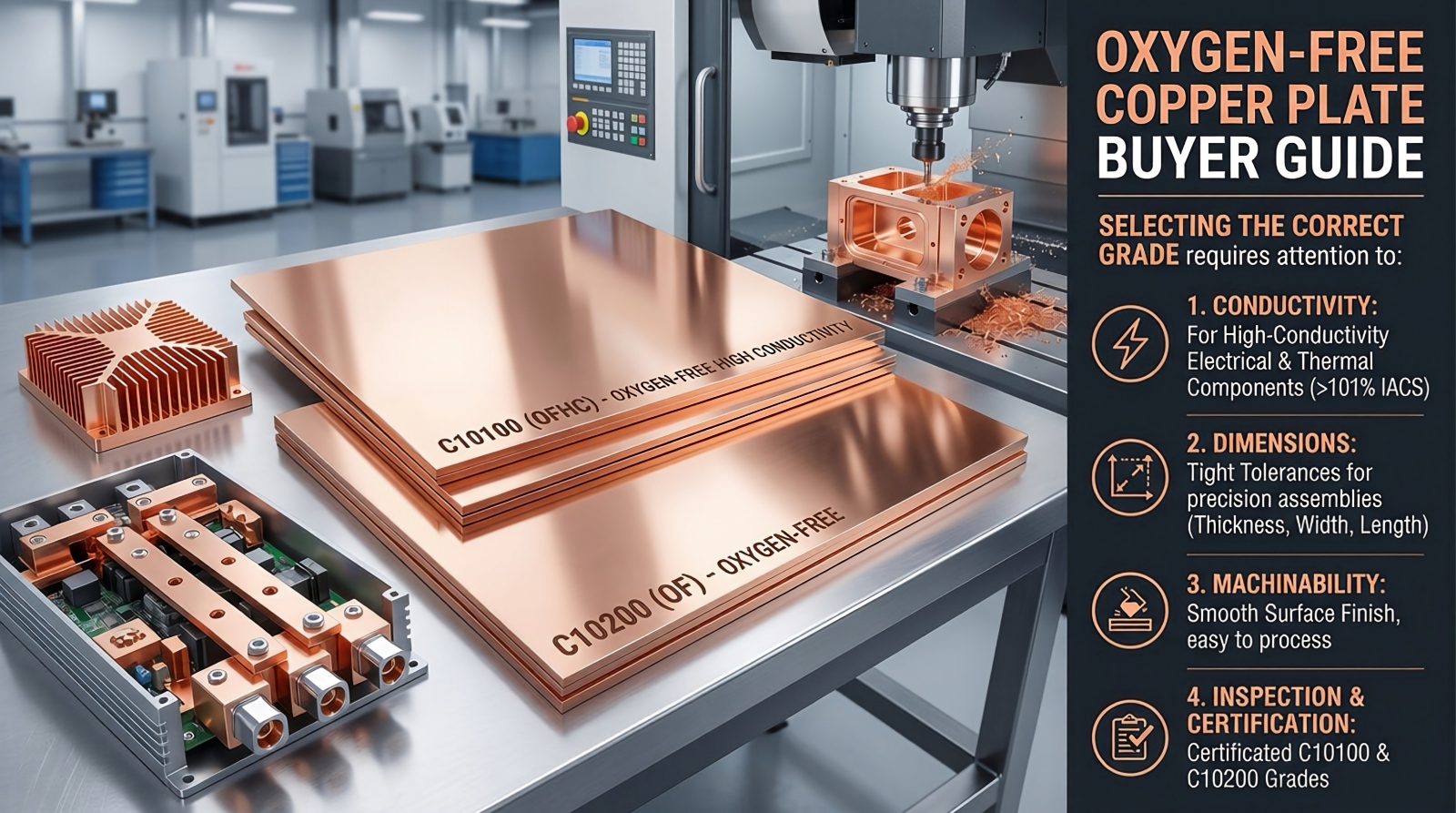
An oxygen free copper plate should be purchased by a defined grade and measurable acceptance criteria—not by the generic term “oxygen-free copper” alone.
C10100 is commonly selected when very high purity, low residual content and demanding electrical or vacuum performance are important. C10200 is often a practical option for high-conductivity industrial components. For either grade, buyers should specify the applicable standard, temper, dimensions, flatness, minimum conductivity, inspection method, documentation and machining requirements before placing a bulk order.
Buyers comparing material forms can begin with Cymber Metal’s broader range of pure copper products and available copper plate options.
What Is an Oxygen Free Copper Plate?
Oxygen-free copper is a high-purity copper produced under controlled conditions to keep oxygen and other residual elements at very low levels. The term does not mean that the material contains absolutely zero oxygen. It describes a controlled class of copper grades intended to provide high electrical conductivity and reliable performance in demanding environments.
An oxygen free copper plate may be specified for:
- Electrical power transmission components
- Busbars and switchgear components
- High-current connectors
- Vacuum and electronic equipment
- Heat-transfer components
- RF and microwave systems
- Machined electrical parts
- Semiconductor manufacturing equipment
- Research and laboratory equipment
The phrase “OFHC copper” is also widely used in the market. However, it should not replace an exact grade designation on a purchase order. A buyer should identify the required UNS grade, standard and acceptance values.
Another important distinction is the difference between plate and sheet. The thickness classification can depend on the governing standard and supplier’s product range. Therefore, an RFQ should always state the actual thickness, width and length instead of relying only on the words “plate” or “sheet.”
C10100 vs C10200: Which Grade Should You Specify?
C10100 and C10200 are two commonly requested oxygen-free copper grades. They are similar, but they should not automatically be treated as interchangeable.
| Buying factor | C10100 | C10200 |
|---|---|---|
| Common designation | Oxygen-Free Electronic, OFE | Oxygen-Free, OF |
| Purity positioning | Higher-purity electronic grade | High-purity oxygen-free grade |
| Conductivity reference | Commonly associated with approximately 101% IACS in annealed condition | Commonly associated with approximately 100% IACS in annealed condition |
| Typical selection reason | Sensitive electronic, vacuum or high-reliability applications | General high-conductivity industrial and electrical applications |
| Commercial consideration | May require tighter sourcing and documentation | Often a practical balance of performance and commercial availability |
| Buyer action | Confirm purity, conductivity and test requirements | Confirm conductivity, condition and dimensional requirements |
These values are general industry reference points, not contractual guarantees. The applicable material standard, temper, product form and certified test result should control the final purchase.
When should you choose C10100?
C10100 copper is generally considered when the application requires:
- Very high copper purity
- Controlled residual elements
- High electrical or thermal conductivity
- Reliable performance in vacuum-related applications
- Material traceability for electronic or research equipment
- More demanding technical documentation
C10100 may be the preferred starting point when a drawing specifically identifies OFE copper or when the end user has established strict purity requirements.
When should you choose C10200?
C10200 copper is frequently considered for:
- Electrical connectors
- Conductive plates
- Busbar-related components
- Heat-transfer parts
- Industrial electrical hardware
- Machined high-conductivity copper components
C10200 can be suitable when high conductivity is essential but the project does not require the tighter purity positioning normally associated with C10100.
Is C10100 always better than C10200?
No. A higher-purity grade is not automatically the better commercial choice.
The correct grade depends on:
- The conductivity required by the design
- Whether the component will operate in a vacuum
- The applicable material standard
- Machining and forming requirements
- Required certificates and test reports
- Order quantity and delivery schedule
- Total material and processing cost
If a drawing uses an EN, DIN or JIS designation instead of a UNS number, the buyer and supplier should confirm the exact standard relationship. Similar material names should not be assumed to be fully equivalent without a technical review.
How Should Conductivity Be Evaluated?
Electrical conductivity is one of the main reasons buyers select oxygen free copper plate. However, a quotation that only says “high conductivity” does not establish an objective acceptance requirement.
Conductivity is often expressed as a percentage of IACS, the International Annealed Copper Standard. As a useful reference:
100% IACS corresponds to approximately 58 MS/m at 20°C, or a volume resistivity of approximately 0.01724 Ω·mm²/m.
Actual measured conductivity can be affected by the copper grade, impurity level, temperature and processing condition. Buyers should therefore define the following:
- Minimum acceptable conductivity
- Required unit, such as % IACS or MS/m
- Reference temperature
- Test method or applicable standard
- Sampling frequency
- Whether the result must appear on the inspection certificate
For example, an RFQ could state:
Electrical conductivity: minimum 100% IACS at 20°C, tested according to the agreed inspection method, with the result reported on the material certificate.
The final wording should be reviewed against the selected grade and governing material standard.
Can chemical composition alone prove conductivity?
Not completely. Chemical composition helps confirm the material grade, but conductivity should be measured when it is a critical acceptance characteristic.
Similarly, handheld XRF is useful for general material identification, but it is not sufficient on its own to verify ppm-level oxygen content. For a technically sensitive order, buyers should agree on the appropriate composition, conductivity and oxygen-related inspection methods before production.
Buyers evaluating a supplier may review its production and inspection equipment and available certificate information. The exact documents required for an order should still be written into the RFQ and purchase contract.
Is Oxygen Free Copper Plate Difficult to Machine?
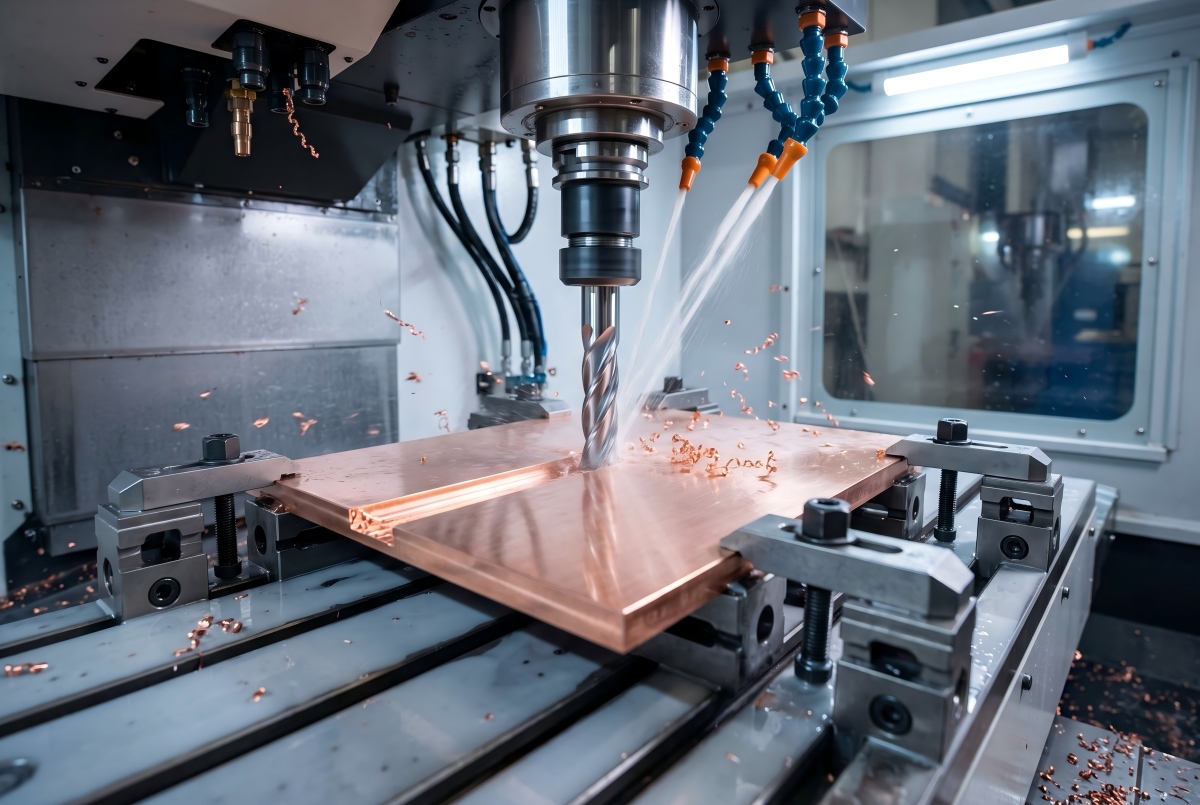
Oxygen-free copper can be machined, but it does not behave like free-cutting brass or a harder copper alloy.
Its high ductility and relatively soft surface can create several machining challenges:
| Machining issue | Why it happens | Practical response |
|---|---|---|
| Long or stringy chips | High ductility | Use effective chip control and evacuation |
| Built-up edge | Copper can adhere to the cutting tool | Use sharp, polished tooling and suitable lubrication |
| Burr formation | The material deforms before separating | Maintain sharp cutting edges and plan deburring operations |
| Surface smearing | Soft copper can drag across a dull tool | Use positive cutting geometry and avoid worn tools |
| Plate distortion | Clamping force and unbalanced material removal can release stress | Use controlled fixturing and balanced stock removal |
| Surface dents and scratches | Pure copper surfaces are relatively soft | Protect contact surfaces during handling and machining |
| Inconsistent finish | Tool condition, vibration and chip recutting affect the surface | Use rigid setups and reliable chip evacuation |
Practical machining recommendations
For turning, milling or drilling oxygen free copper plate:
- Use sharp tools with a positive cutting geometry.
- Polished cutting surfaces can help reduce copper adhesion.
- Maintain rigid workholding without over-clamping the plate.
- Avoid allowing chips to remain between the plate and fixture.
- Use an appropriate lubricant or coolant for the selected process.
- Plan machining allowances before ordering raw material.
- Remove material in a balanced sequence when flatness is critical.
- Protect finished surfaces during inspection, packing and transport.
- Confirm burr and edge-break requirements on the drawing.
Exact cutting speed, feed rate and depth of cut should be established according to the machine, tool material, plate condition, thickness and required surface finish.
For projects that require finished copper parts rather than raw material only, buyers can review available fine machining services. Applications requiring a forged production route can also reference dense forged oxygen-free copper sheet options, subject to confirmation of the required thickness and final product form.
What Should Be Specified for a Bulk Order?
A complete oxygen free copper plate RFQ reduces quotation differences and prevents later technical disputes.
1. Copper grade
State the exact grade, such as:
- UNS C10100
- UNS C10200
Avoid writing only “pure copper,” “oxygen-free copper” or “OFHC copper.”
2. Material standard
Specify the required material standard and edition when applicable. ASTM B152/B152M is commonly associated with copper sheet, strip, plate and rolled bar, but the correct standard must match the product form and application.
If the finished part is controlled by a customer drawing, include both the drawing number and material specification.
3. Temper and condition
State whether the material must be annealed, cold-worked or supplied in another defined condition. Temper can affect:
- Formability
- Hardness
- Flatness
- Machining behavior
- Electrical properties
Do not leave the temper open if it affects the manufacturing process.
4. Dimensions and tolerances
Include:
- Thickness
- Width
- Length
- Thickness tolerance
- Width and length tolerance
- Flatness
- Straightness
- Squareness or perpendicularity, if relevant
- Machining allowance
For cut plates, also state whether saw-cut, milled or finished edges are required.
5. Conductivity requirement
Define:
- Minimum % IACS or MS/m
- Reference temperature
- Inspection method
- Sampling plan
- Reporting requirement
A generic statement such as “good conductivity” is not measurable.
6. Surface and edge condition
Describe the acceptable surface condition, including:
- Mill finish or machined finish
- Maximum permitted scratches or dents
- Protective film requirements
- Edge deburring
- Corner radius or chamfer
- Surface roughness for machined areas
Cosmetic requirements should be agreed before production because pure copper can be marked during handling.
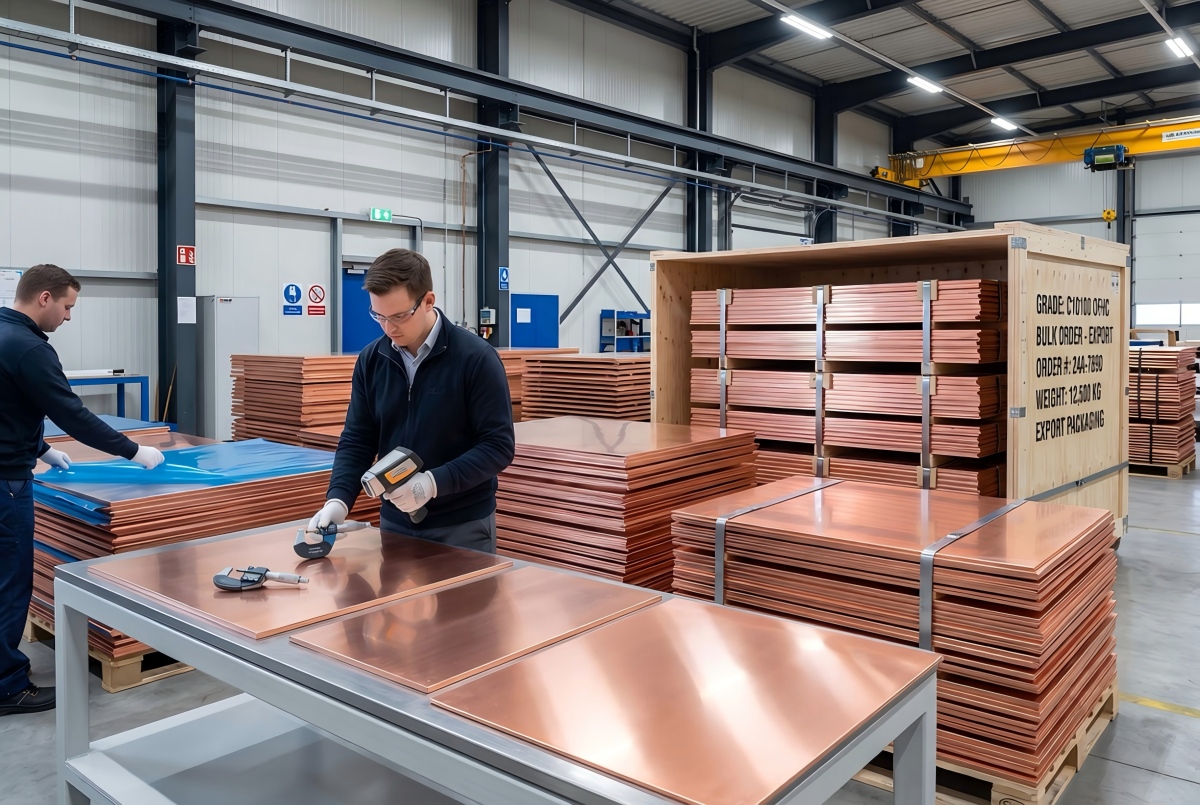
7. Testing and documentation
Depending on the application, buyers may request:
- Material Test Certificate or Mill Test Certificate
- Certificate of Conformity
- Chemical composition report
- Electrical conductivity result
- Dimensional inspection report
- Hardness result
- Surface inspection
- Ultrasonic or other additional inspection, when technically required
- Third-party inspection
- Country-of-origin documentation
- Lot or heat traceability
Not every project requires every document. The required inspection package should be defined according to the risk and end-use application.
Relevant technical materials may also be available through the Cymber Metal download center.
8. Quantity and commercial requirements
A bulk-order RFQ should include:
- Number of plates
- Total estimated weight
- Permitted quantity tolerance
- Trial quantity, if applicable
- Required delivery date
- Delivery destination
- Incoterm
- Packing requirements
- Maximum package weight
- Marking and labeling requirements
For recurring purchases, include the estimated annual demand as well as the first order quantity. This allows the supplier to distinguish a trial order from a production program.
How Do You Calculate Oxygen Free Copper Plate Weight?
A commonly used density reference for pure copper is approximately 8.94 g/cm³, or 8,940 kg/m³.
For dimensions in millimeters:
Weight in kg = Length × Width × Thickness × 8.94 × 10⁻⁶
For example, a copper plate measuring 1,000 mm × 500 mm × 10 mm has an estimated weight of:
1,000 × 500 × 10 × 8.94 × 10⁻⁶ = 44.7 kg
This is a theoretical estimate. Actual weight may vary because of dimensional tolerances and manufacturing conditions.
For a bulk quotation, confirm whether pricing is based on:
- Theoretical weight
- Actual shipping weight
- Finished component weight
- Input material weight before machining
If the supplier will machine the plates, also confirm how machining scrap and material yield are handled commercially.
How Should Buyers Compare Supplier Quotations?
The lowest unit price does not always represent the lowest total purchasing cost.
Use the following comparison points:
| Quotation item | What the buyer should verify |
|---|---|
| Material | Exact C10100 or C10200 designation |
| Standard | Applicable standard and product form |
| Conductivity | Minimum value, method and reporting |
| Dimensions | Finished size, tolerance and flatness |
| Condition | Temper or processing condition |
| Surface | Finish, scratches, protection and edge treatment |
| Traceability | Lot identification and certificate relationship |
| Processing | Raw plate, cut blank or finished machined component |
| Inspection | Included tests and optional third-party inspection |
| Quantity | Piece count, total weight and permitted variation |
| Packing | Moisture protection, surface protection and crate limits |
| Logistics | Incoterm, destination and delivery schedule |
A quotation should be evaluated against the same technical scope. If one supplier includes machining, conductivity testing and export packing while another quotes raw plate only, the prices are not directly comparable.
Cymber Metal’s broader service capabilities can be reviewed when the project includes material supply, cutting, machining or export-related requirements.
Oxygen Free Copper Plate RFQ Template
The following template can be copied into an inquiry:
Product: Oxygen free copper plate
Application:
Required grade: C10100 / C10200
Material standard:
Temper or condition:
Thickness:
Width:
Length:
Dimensional tolerances:
Flatness requirement:
Surface finish:
Edge condition:
Machining allowance:
Minimum conductivity:
Conductivity test method:
Chemical composition requirement:
Required inspection documents:
Third-party inspection requirement:
Quantity:
Estimated annual demand:
Packing requirements:
Delivery destination:
Required Incoterm:
Required delivery date:
Drawing or specification attached: Yes / No
Additional machining required: Yes / No
For a more accurate technical and commercial review, send the completed specification and drawings through the Cymber Metal contact page.
Frequently Asked Questions
What is the difference between oxygen-free copper and pure copper?
Pure copper is a broad material category. Oxygen-free copper is a specific group of high-purity copper grades produced with tightly controlled oxygen content. C10100 and C10200 are common oxygen-free grades, while C11000 is commonly classified as electrolytic tough pitch copper.
Is C10100 better than C10200?
Not in every application. C10100 is generally selected for more demanding purity, electronic or vacuum-related requirements. C10200 can provide a suitable balance of high conductivity, industrial performance and commercial availability. The drawing and acceptance specification should determine the grade.
Is oxygen free copper plate more conductive than C11000?
Oxygen-free grades are commonly associated with very high conductivity, and C10100 may have a slightly higher specified conductivity than standard electrolytic tough pitch copper. However, buyers should compare certified conductivity values rather than relying only on the grade name.
What does 100% IACS mean?
At 20°C, 100% IACS corresponds to an electrical conductivity of approximately 58 MS/m. It is a reference value used to compare conductive materials. A purchasing specification should state the minimum required value and test conditions.
Can oxygen free copper plate be machined?
Yes. It can be turned, milled, drilled and finished, but its softness and ductility can cause long chips, burrs, built-up edges and surface marking. Sharp polished tools, rigid workholding and controlled chip evacuation are important.
Can XRF verify that copper is oxygen-free?
XRF can help identify the general material composition, but it is not sufficient by itself to verify very low, ppm-level oxygen content. Buyers should specify an appropriate test method and supporting documentation when oxygen content is a critical requirement.
What certificate should be requested for a bulk order?
The appropriate documentation may include a Material Test Certificate, Certificate of Conformity, chemical composition report, conductivity result and dimensional inspection report. Additional testing should be requested only when required by the drawing, standard or end-use application.
What information is most important for an accurate quotation?
At minimum, provide the grade, standard, temper, dimensions, tolerances, conductivity requirement, quantity, machining requirements, inspection documents, destination and requested delivery schedule.
Final Buying Recommendation
The safest way to purchase oxygen free copper plate is to convert the application requirement into measurable order criteria.
Do not rely on a generic material description alone. Define C10100 or C10200, the applicable standard, temper, minimum conductivity, dimensions, flatness, surface condition, inspection documents and machining scope.
For bulk projects, also clarify whether the quotation is based on theoretical or actual weight, how quantity variation will be handled, and whether the supplier is responsible for cutting, machining, testing and export packing.
A detailed RFQ makes it easier to compare quotations accurately—and reduces the risk of receiving copper plate that meets a material name but not the actual application requirement.
Post time: Jul-19-2026