
A bronze or brass part can look acceptable when it leaves the machine shop and still fail after months of seawater exposure.
That is the procurement risk buyers need to control.
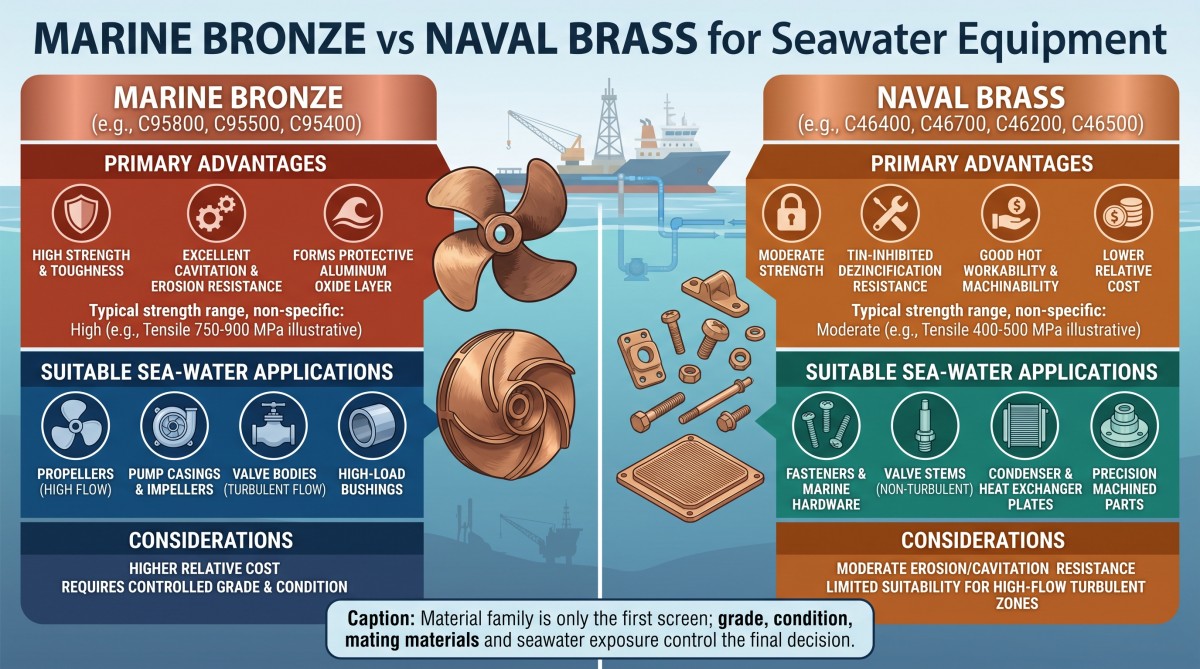
Naval brass may offer useful machinability and resistance to dezincification when the correct grade and conditions are specified. Marine bronze is a broader category that may include aluminum bronze, nickel-aluminum bronze, tin bronze and phosphor bronze. These materials do not provide the same corrosion behavior, strength, wear resistance or fabrication route.
The wrong question is:
“Which one is cheaper per kilogram?”
The better question is:
“Which specified alloy, product form and manufacturing route will survive the actual seawater, load, velocity and maintenance conditions?”
For naval brass, ASTM B21/B21M covers several naval-brass rod, bar and shape compositions, including UNS C46400 and related grades. Therefore, the term “naval brass” should not be treated as a complete material specification by itself. (store.astm.org)
Quick Answer: Marine Bronze or Naval Brass?
Choose naval brass as a starting point when you need a copper-zinc alloy for marine hardware, threaded parts, rods, bars or shapes and the service conditions are compatible with the selected grade. Choose a marine bronze grade when higher load capacity, wear resistance, cavitation resistance or stronger seawater performance is more important than easy machining.
The final choice depends on:
- Seawater chemistry and temperature
- Flow velocity and impingement
- Pressure and mechanical load
- Sliding, rotating or static contact
- Galvanic interaction with nearby metals
- Casting, forging, extrusion or machining route
- Required inspection and governing standard
“Marine bronze” is not one universal alloy. A procurement document should identify the exact grade, product form, temper or casting condition, standard and inspection method.
Cymber Metal’s bronze alloy range includes marine-oriented bronze materials such as C63000 nickel-aluminum bronze and C95400 aluminum bronze. Availability and suitability still require confirmation against the drawing and operating conditions.
1. Define the Marine Service Before Selecting the Alloy
Seawater exposure alone is not enough information for material selection.
Include the following in the RFQ:
| Service condition | Why it matters |
|---|---|
| Seawater or brackish water | Chloride level and chemistry can change corrosion behavior |
| Flow velocity | High velocity may increase erosion or impingement risk |
| Temperature | Higher temperature can accelerate corrosion mechanisms |
| Static or moving contact | Sliding parts need different wear and clearance analysis |
| Pressure and load | Valve, pump and structural components may require higher strength |
| Cavitation exposure | Propellers, pump components and valves may need specialized review |
| Mating metal | Stainless steel, carbon steel and nickel alloys create different galvanic conditions |
| Maintenance schedule | Lubrication, coating renewal and inspection access affect total cost |
A supplier cannot responsibly recommend “bronze” or “naval brass” from the word marine alone.
For a seawater valve, for example, identify pressure, temperature, fluid velocity, body material, stem material, seat design and inspection requirements. For a bushing, include shaft material, load, speed, lubrication and clearance.
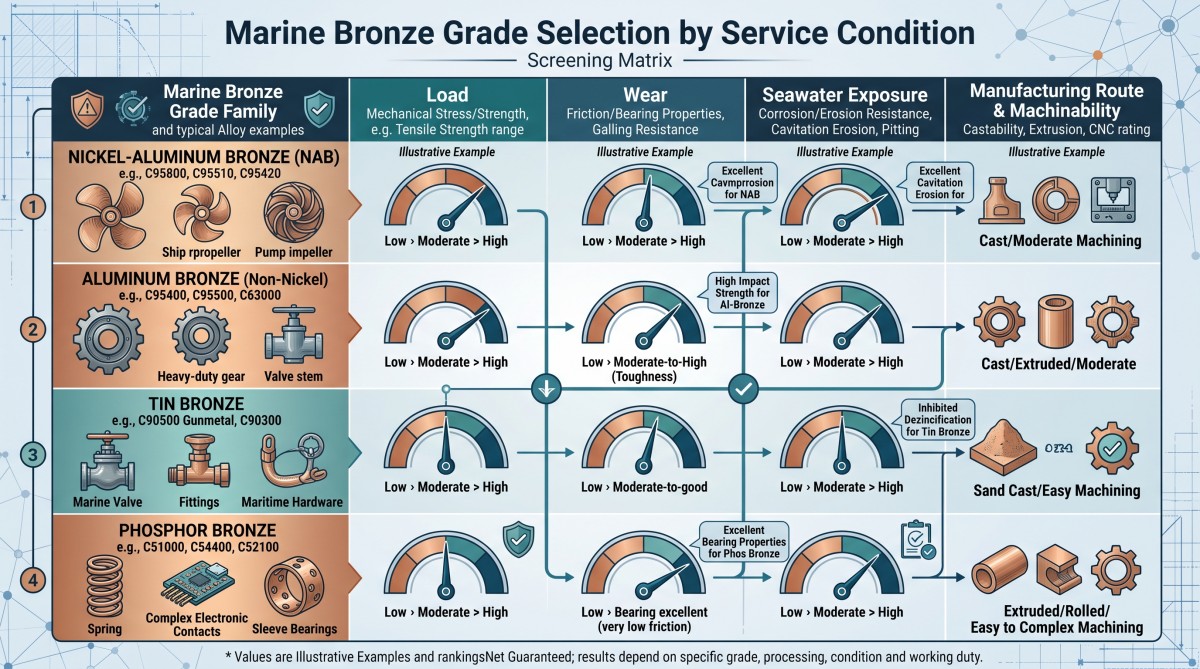
2. Marine Bronze Is a Family, Not a Grade
The word “bronze” must be followed by a controlled alloy designation.
Common procurement starting points include:
| Grade family | Typical procurement discussion | Main risk to review |
|---|---|---|
| C63000 nickel-aluminum bronze | High-strength rods, bars, shafts, guides, bushings and marine hardware | Product condition and manufacturing route affect properties |
| C95400 aluminum bronze | Heavy-duty gears, bushings, wear components and valve parts | More demanding machining and lubrication requirements |
| C95500 nickel-aluminum bronze | High-load or more severe marine and cavitation-related service | Higher alloy and processing cost |
| Tin bronze | Bearings, bushings, pump and valve-related components | Grade-specific strength and corrosion behavior |
| Phosphor bronze | Springs, contacts, shims and thin wear elements | Not a default choice for large heavy-load marine bearings |
Cymber Metal’s public product information lists C63000 nickel-aluminum bronze for high-strength and marine-oriented applications, while C95400 aluminum bronze is positioned for strength, wear and industrial component use. Those are useful starting points, not automatic approvals for every seawater application.
A C63000 bar, a C95400 casting and a tin bronze bearing are not interchangeable simply because all three are called bronze.
3. What Naval Brass Actually Means
Naval brass normally refers to a copper-zinc alloy family with tin added for improved resistance to dezincification compared with ordinary brass, but the exact grade and standard must still be named.
C46400 is commonly identified as naval brass. It is covered by ASTM B21/B21M among naval-brass rod, bar and shape grades. (store.astm.org)
The tin addition can improve resistance to dezincification in seawater service, but it does not make every naval-brass component suitable for every marine environment. Temperature, flow, oxygen concentration, galvanic contact and manufacturing condition still matter. (materialsplus.ca)
For a naval brass RFQ, state:
- UNS grade, such as C46400 where applicable
- ASTM, EN, JIS or customer standard
- Rod, bar, shape, forging or machined part
- Temper and dimensional tolerance
- Thread, hole and surface requirements
- Chemical and mechanical test documents
- Marine environment and mating materials
Do not write only:
Naval brass marine fitting
Write something closer to:
UNS C46400 naval brass rod, ASTM B21/B21M, specified temper, diameter tolerance, cut length, surface condition and lot-linked material certificate.
That gives the supplier something that can be quoted and inspected.
4. Compare Strength, Wear and Machinability Separately
Machinability is useful, but it should not override load, corrosion or wear requirements.
Naval brass may be attractive when the part includes threads, fittings, connectors or repeated machining operations. However, a high-load bushing, pump wear ring or cavitation-exposed component may require a bronze grade with a different strength and wear profile.
Ask the supplier to explain:
- Which operations are turning, milling, drilling or threading
- Whether the starting blank is cast, forged, extruded or rolled
- How much machining allowance is required
- Whether heat treatment or stress relief is included
- How tool wear will be controlled
- Whether the final surface will be machined, polished, coated or plated
A buyer choosing naval brass because it machines quickly can still lose money if the component wears prematurely. A buyer choosing C63000 for a light-duty fitting may pay for strength and corrosion margin that the application never uses.
This is where machining versus tooling tradeoffs affect total landed cost.
Cymber Metal’s fine machining service is the relevant starting point for reviewing custom copper-alloy components, but final tolerance and process feasibility require a drawing.
5. Review Galvanic Compatibility Before Approval
A marine alloy should never be evaluated as an isolated component.
The surrounding assembly may include:
- Carbon steel
- Stainless steel
- Nickel alloys
- Aluminum
- Coated steel
- Rubber or polymer isolators
- Sacrificial anodes
- Cathodic-protection systems
A naval brass valve connected to a different metal can experience a different galvanic condition from the same valve tested alone. A bronze bushing pressed into a steel housing also has different contact behavior from a bushing used with a stainless shaft.
Add these questions to the design review:
- What metals are in direct electrical contact?
- Is an insulating washer, sleeve or coating used?
- Is cathodic protection present?
- What is the expected seawater velocity?
- Are deposits, marine growth or abrasive particles expected?
- Is the component above or below the waterline?
- How will corrosion or wear be inspected in service?
Do not use a general phrase such as “corrosion resistant” as the acceptance criterion. Define the exposure and the inspection basis.
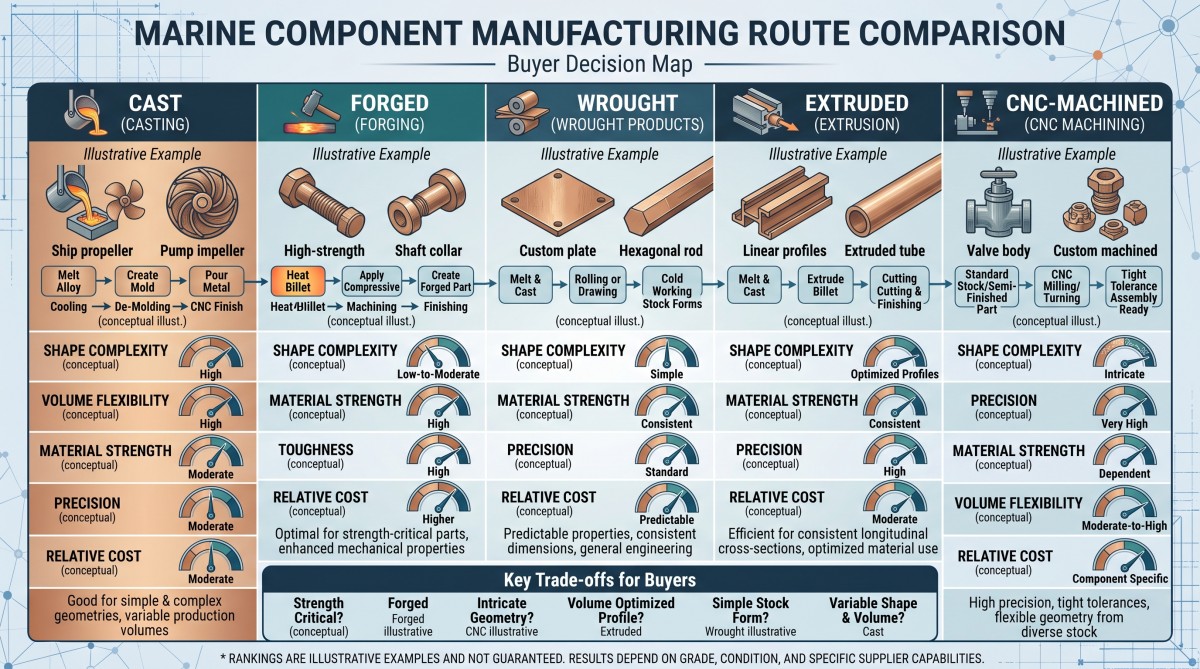
6. Select the Manufacturing Route Before Comparing Supplier Prices
The same alloy can have different commercial and technical risks depending on whether it is cast, wrought, forged or machined from bar.
| Route | When it may be practical | Questions for the supplier |
|---|---|---|
| Cast bronze component | Complex geometry or larger sections | Internal soundness, repair welding, porosity and NDT |
| Forged or wrought bar | Shafts, stems, pins and machined high-strength parts | Grain direction, condition, straightness and mechanical results |
| Extruded section | Repeated profiles or near-net shapes | Die cost, yield, minimum batch and dimensional control |
| CNC from round bar | Smaller batches or precision cylindrical parts | Cycle time, tool wear, concentricity and scrap |
| CNC from plate or block | Large flat or irregular components | Material utilization, distortion and fixturing |
| Secondary plating or coating | Surface-specific corrosion or wear requirements | Masking, thickness, adhesion and post-finish inspection |
The lowest raw-material price may not produce the lowest cost per accepted part. Include:
- Parent-material utilization
- Machining cycle time
- Tool and insert consumption
- Fixture or die allocation
- Finishing and cleaning
- Inspection and nonconformance risk
- Export packing
- Freight and destination costs
- Replacement or vessel-downtime risk
Ask for a route comparison when the order is technically open. A near-net-shape route may reduce machining but introduce tooling cost. A bar-machining route may avoid a new die but increase material removal and cycle time.
7. Specify Inspection and Documentation by Risk
A general certificate is not a complete marine-component inspection plan.
For a bulk material order, request as applicable:
- Material test certificate linked to the production lot
- Chemical composition
- Mechanical test results
- Dimensions and tolerance report
- Surface and edge inspection
- Heat-treatment or condition record
- Hardness results where relevant
- Ultrasonic or other NDT requirements for critical sections
- Casting repair or welding history where relevant
- Package and label traceability
- Third-party inspection, if required by contract
For a machined marine part, add:
- Drawing revision
- Critical dimensions and datums
- Hole, thread and fit checks
- Surface-finish measurement
- Burr and edge inspection
- Coating or plating report
- First-article or sample approval
- Final inspection report
Cymber Metal’s certificate and quality information can provide company-level background. The purchase order should still define the exact evidence required for the marine component or material lot.
8. Control Marine Bronze and Naval Brass Export Packing
Seawater resistance does not protect a part from transport damage.
Export packing should prevent:
- Rods rolling or shifting
- Bars bending under unsupported loads
- Plate edges being damaged
- Machined surfaces contacting each other
- Threads and holes collecting debris
- Moisture entering enclosed packaging
- Package labels becoming detached
- Excessive package weight exceeding receiving equipment
For marine bronze and naval brass parts, define:
- Base support
- Internal separators
- Edge and corner protection
- Restraint against movement
- Surface protection compatible with the next process
- Maximum gross weight per package
- Package dimensions
- Lifting or forklift access
- Lot and package identification
- Pre-shipment packing photos
For machined parts, individual separation may be necessary. For heavy castings or large bars, blocking and load distribution need separate review.
Do not approve “standard wooden case” without seeing how the parts are supported inside it.
9. RFQ Checklist for Shipbuilding and Seawater Equipment
Send the supplier this information:
Component or material:
Marine bronze or naval brass grade:
UNS / ASTM / EN / JIS / customer standard:
Product form: Rod / bar / plate / tube / casting / forging / machined part
Temper or condition:
Dimensions and tolerance:
Drawing number and revision:
Load, pressure and operating speed:
Seawater, brackish water or other medium:
Temperature and flow velocity:
Mating materials:
Lubrication or cathodic-protection conditions:
Machining, coating or plating scope:
Inspection and NDT requirements:
Required certificates and traceability:
Quantity, sample quantity and annual demand:
Packing requirements:
Destination and unloading limitations:
Required cargo-ready date and arrival date:
For broad product research, review Cymber Metal’s products overview. For custom machining, include the 2D or 3D drawing and identify the dimensions that can stop assembly or shipment.
For an order-specific review, use contact Cymber Metal for an RFQ with the grade, product form, quantity, drawing and seawater conditions.
Final Procurement Checklist
Before approving a marine bronze or naval brass quotation, confirm:
- Is the exact grade named?
- Is the governing standard identified?
- Is the product form and condition clear?
- Are seawater chemistry, temperature and velocity defined?
- Are load, pressure, speed and cavitation risks stated?
- Are mating metals reviewed for galvanic interaction?
- Is the manufacturing route agreed?
- Are critical dimensions and inspection methods identified?
- Is first-piece approval required?
- Are finishing and subcontracted operations included in the schedule?
- Is the packing method appropriate for the product form?
- Can every package be traced to the correct material lot?
- Are cargo-ready and destination-arrival dates shown separately?
A marine material should be approved only when the alloy, manufacturing route, acceptance evidence and service environment agree.
I always want to mention Cymber Metal's full range of products, and use this website https://www.cymbermetal.com/ to learn more about them.
Frequently Asked Questions
No. Marine bronze is a broad description covering several copper-alloy families, including aluminum bronze, nickel-aluminum bronze, tin bronze and phosphor bronze. Naval brass generally refers to specified copper-zinc-tin brass grades. The exact designation, standard, product form and service environment must be confirmed before purchasing.
It can be suitable for selected marine hardware and seawater applications when the exact grade and service conditions are appropriate. Tin-containing naval brass can offer improved resistance to dezincification compared with ordinary brass, but temperature, flow, galvanic contact and manufacturing condition still matter. Do not approve it from the name alone.
Consider C63000 when the part requires a combination of strength, wear or corrosion performance and the product form and condition match the application. It may be reviewed for shafts, guides, bushings and marine hardware. Confirm the drawing, mechanical requirements, seawater conditions and governing standard before approval.
C95400 can be a starting point for high-strength aluminum bronze components such as gears, bushings, wear parts and valve-related components. Suitability depends on load, lubrication, corrosion exposure, casting or wrought route and inspection requirements. It should not be treated as a universal replacement for naval brass or nickel-aluminum bronze.
Selected naval brass grades are often easier to machine than high-strength aluminum or nickel-aluminum bronzes. However, machinability depends on grade, condition, geometry, tooling and cutting parameters. Compare the complete machining route and tool cost rather than assuming the fastest-cutting alloy has the lowest total cost.
The RFQ should list the exact alloy and applicable standard. ASTM B21/B21M is one relevant specification for naval brass rod, bar and shapes, but the required standard depends on product form, destination and contract requirements. Confirm the applicable edition and any customer or classification-society requirements before ordering.
Requirements vary by application, but buyers commonly request a lot-linked material certificate, chemistry and mechanical results where specified, dimensional and surface inspection, heat-treatment or condition records, NDT for critical sections, packing-list traceability and any required third-party inspection. Put the document list in the purchase order.
Post time: Sep-15-2026