
Publication Date: July 23, 2026
Author: Hu Yanwei, Cymber Metal Technical Expert
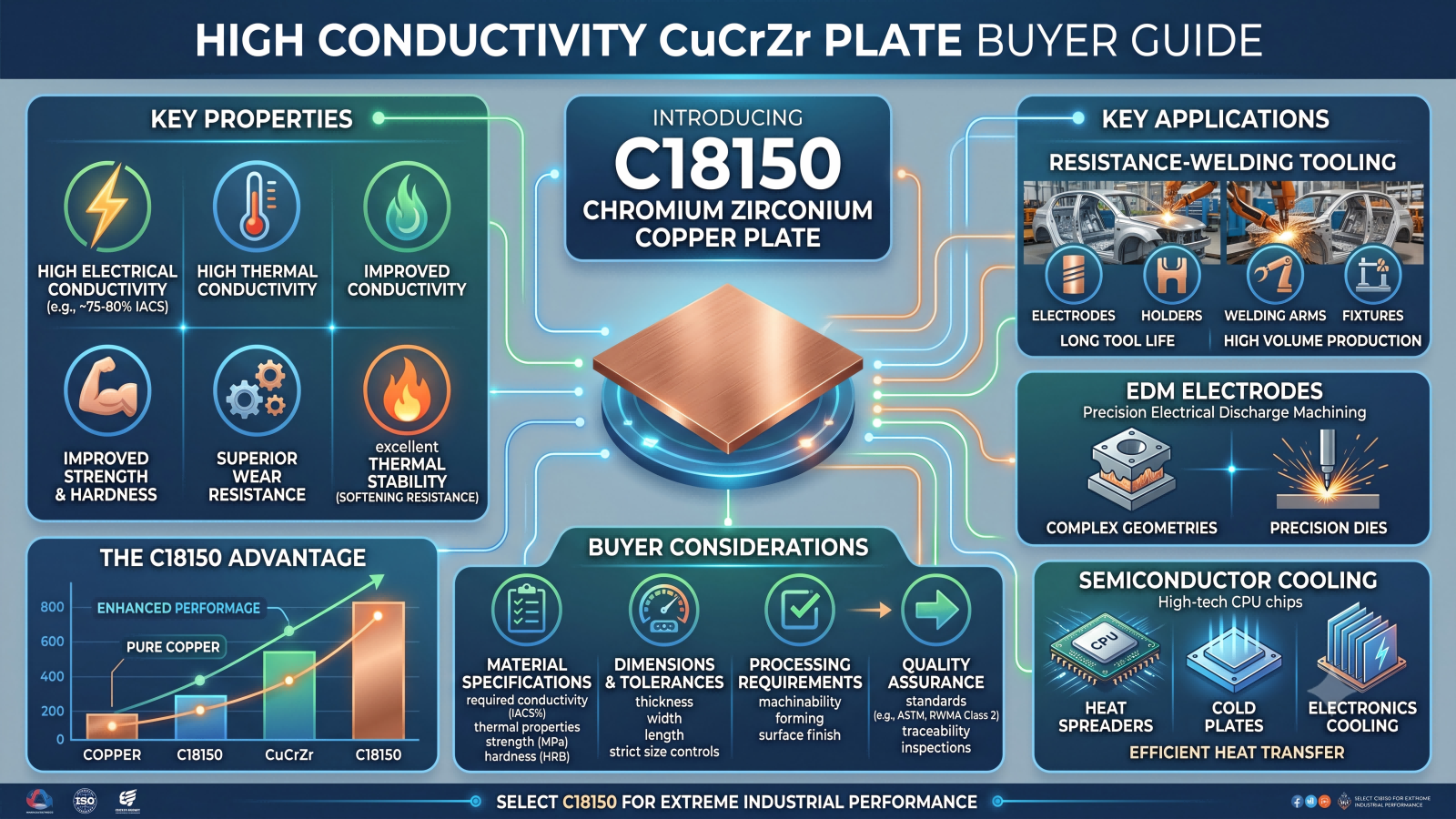
Quick answer: High conductivity CuCrZr plate is a precipitation-hardenable copper-chromium-zirconium alloy commonly associated with UNS C18150 and CW106C/CuCr1Zr. It retains much of copper’s electrical and thermal conductivity while providing higher strength, improved wear resistance and better resistance to softening than high-purity copper. Buyers should specify the governing standard, heat-treatment condition, minimum conductivity, hardness or strength, dimensions, flatness, inspection requirements and downstream thermal cycle before placing a bulk order.
What Is High Conductivity CuCrZr Plate?
High conductivity CuCrZr plate is a copper alloy containing controlled additions of chromium and zirconium. These alloying elements allow the material to be strengthened through solution treatment, cold working and precipitation aging.
The result is a material that combines:
- High electrical conductivity
- High thermal conductivity
- Higher strength than pure copper
- Improved dimensional stability
- Better resistance to softening at elevated temperatures
- Better wear performance under repeated mechanical and thermal loading
CuCrZr is commonly considered for resistance-welding tooling, electrical contacts, EDM electrodes, semiconductor equipment, heat-transfer components and precision-machined conductive parts.
Buyers comparing different copper product forms can begin with Cymber Metal’s broader range of copper plate options.
Is CuCrZr the Same as C18150?
UNS C18150 is one of the most commonly requested chromium-zirconium copper grades. In European specifications, buyers may also encounter designations such as CW106C or CuCr1Zr.
These designations are often used for similar alloy families, but they should not automatically be treated as identical.
A purchase specification should identify:
- The exact grade designation
- The governing material standard
- Chemical composition limits
- Product form
- Heat-treatment condition
- Minimum conductivity
- Required mechanical properties
- Test and certification requirements
C18150 should also not be confused with C18200. C18200 is commonly classified as chromium copper, while C18150 includes a controlled zirconium addition. The two alloys may have similar application areas, but substitution should require an engineering review.
Buyers sourcing this grade can review Cymber Metal’s C18150 copper information together with the project-specific drawing and material standard.
Typical CuCrZr Plate Properties
CuCrZr properties depend strongly on composition, product form, cold work, aging treatment, plate thickness and any later heating operation.
The following values are general industry reference ranges, not contractual guarantees:
| Property | Typical reference | Buyer consideration |
|---|---|---|
| Electrical conductivity | Approximately 75–85% IACS | Specify a minimum certified value |
| Conductivity in MS/m | Approximately 43.5–49.3 MS/m | Confirm test temperature and method |
| Thermal conductivity | Often around 300–340 W/m·K | Confirm when thermal modeling is critical |
| Density | Approximately 8.9 g/cm³ | Useful for theoretical weight estimates |
| Strength and hardness | Condition-dependent | Define the required temper and acceptance range |
| Softening resistance | Better than high-purity copper | Review the actual exposure temperature and duration |
| Machinability | Generally suitable for precision machining | Tooling, workholding and chip control remain important |
For reference:
100% IACS corresponds to approximately 58 MS/m at 20°C.
Therefore, a CuCrZr plate measured at 80% IACS would have an electrical conductivity of approximately 46.4 MS/m at the same reference temperature.
This calculation is useful for unit conversion, but the purchase order should state which unit controls acceptance.
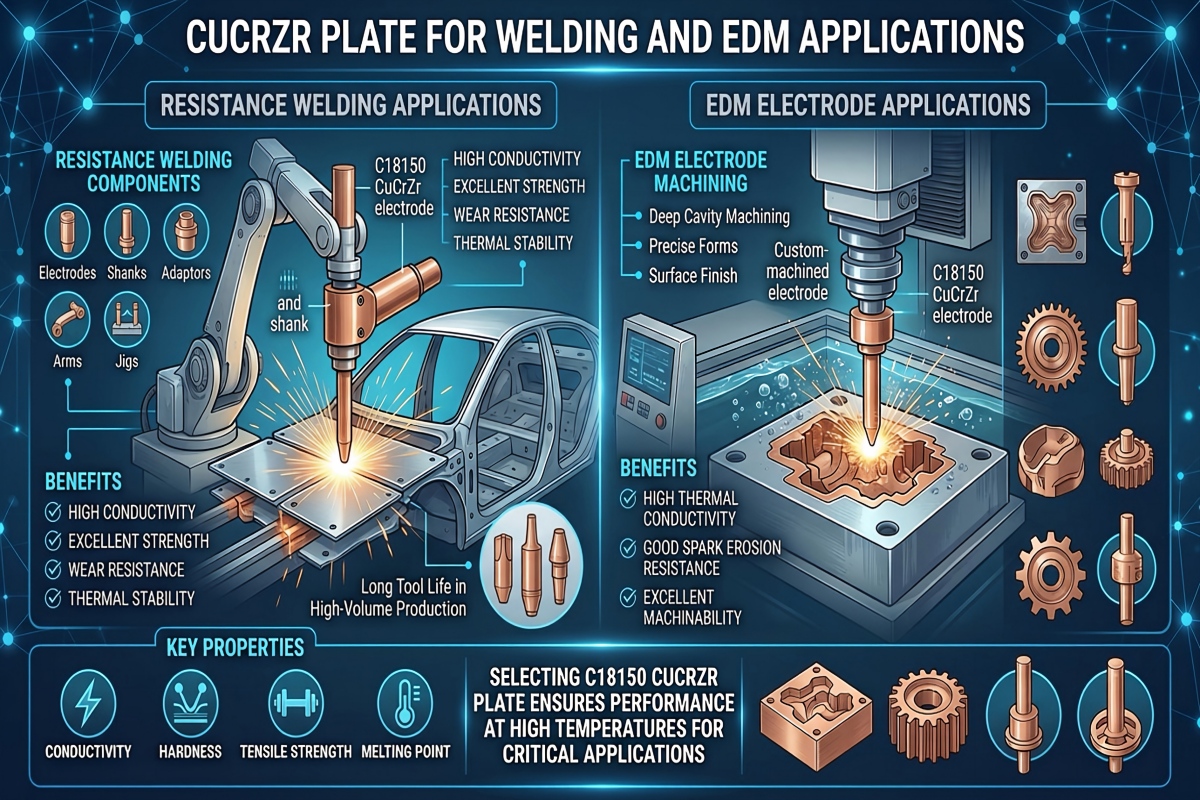
Why Is CuCrZr Used for Welding Applications?
In this context, “welding applications” usually refers to resistance-welding tooling and current-carrying components—not to CuCrZr being used as an ordinary structural welding plate.
Common applications include:
- Resistance-welding electrode holders
- Spot-welding electrode components
- Seam-welding wheels
- Welding fixtures
- Current-carrying arms
- Backing bars
- Conductive clamping components
- Water-cooled welding tooling
These components must carry high electrical current while resisting deformation, wear and repeated thermal cycling.
Pure copper may offer higher conductivity, but it can soften or deform more readily under pressure and elevated temperature. CuCrZr provides a useful balance between conductivity and mechanical stability.
What should be specified for welding tooling?
Buyers should define:
- C18150, CW106C or another exact grade
- Required heat-treatment condition
- Minimum electrical conductivity
- Hardness or tensile-property range
- Electrode or tooling geometry
- Contact-face dimensions
- Surface-finish requirements
- Cooling-channel dimensions
- Thread and connection requirements
- Permitted dimensional change after processing
- Final inspection requirements
For water-cooled welding components, the drawing should also identify:
- Coolant inlet and outlet dimensions
- Internal channel geometry
- Required working pressure
- Leak-test pressure and method
- Thread standard
- Sealing-surface requirements
- Cleanliness requirements
A supplier cannot determine all of these parameters from the phrase “CuCrZr welding plate” alone.
Is CuCrZr Plate Suitable for EDM Electrodes?
CuCrZr can be considered for electrical discharge machining electrodes when the application requires a combination of electrical conductivity, rigidity, wear resistance and dimensional stability.
Potential benefits include:
- Better mechanical strength than pure copper
- Reduced risk of bending in thin or extended electrode geometries
- Improved resistance to handling damage
- Good dimensional stability during electrode machining
- High electrical conductivity for effective discharge performance
- Better wear resistance in selected operating conditions
However, CuCrZr is not automatically the best EDM electrode material for every job.
The correct choice depends on:
- Workpiece material
- Roughing or finishing operation
- Electrode geometry
- Required surface finish
- Electrode wear ratio
- Discharge settings
- Flushing conditions
- Machining speed
- Electrode cost
- Dimensional accuracy
Pure copper may be preferred when maximum conductivity or a particular finish is required. Copper tungsten may be selected when arc-erosion resistance, stiffness or wear performance is more important than conductivity and material cost.
EDM users should conduct process trials when changing from an established electrode material to CuCrZr.
Why Use CuCrZr for Semiconductor Cooling?
Semiconductor manufacturing and power-electronics systems increasingly require components that can transfer heat while maintaining dimensional stability.
Possible CuCrZr applications include:
- Water-cooled base plates
- Cold-plate components
- Heat spreaders
- Power-module supports
- High-current thermal components
- Vacuum-equipment components
- Cooling manifolds
- Machined plates with internal channels
- Semiconductor process-equipment components
High-purity copper grades such as C10100 copper and C10200 copper can provide higher electrical and thermal conductivity. CuCrZr becomes attractive when the component must also resist deformation, maintain flatness or retain mechanical strength during thermal cycling.
Important semiconductor cooling requirements
A semiconductor cooling-plate RFQ may need to define:
- Minimum thermal or electrical conductivity
- Finished flatness
- Parallelism
- Surface roughness
- Cooling-channel dimensions
- Channel-position tolerances
- Joining or brazing process
- Leak-test method and acceptance criteria
- Operating pressure
- Thermal-cycle conditions
- Coolant chemistry
- Surface coating or plating
- Cleanliness and particle-control requirements
- Packaging for finished surfaces
If nickel plating, brazing, diffusion bonding or another high-temperature process will be used, the supplier should know the complete thermal cycle before confirming final material properties.
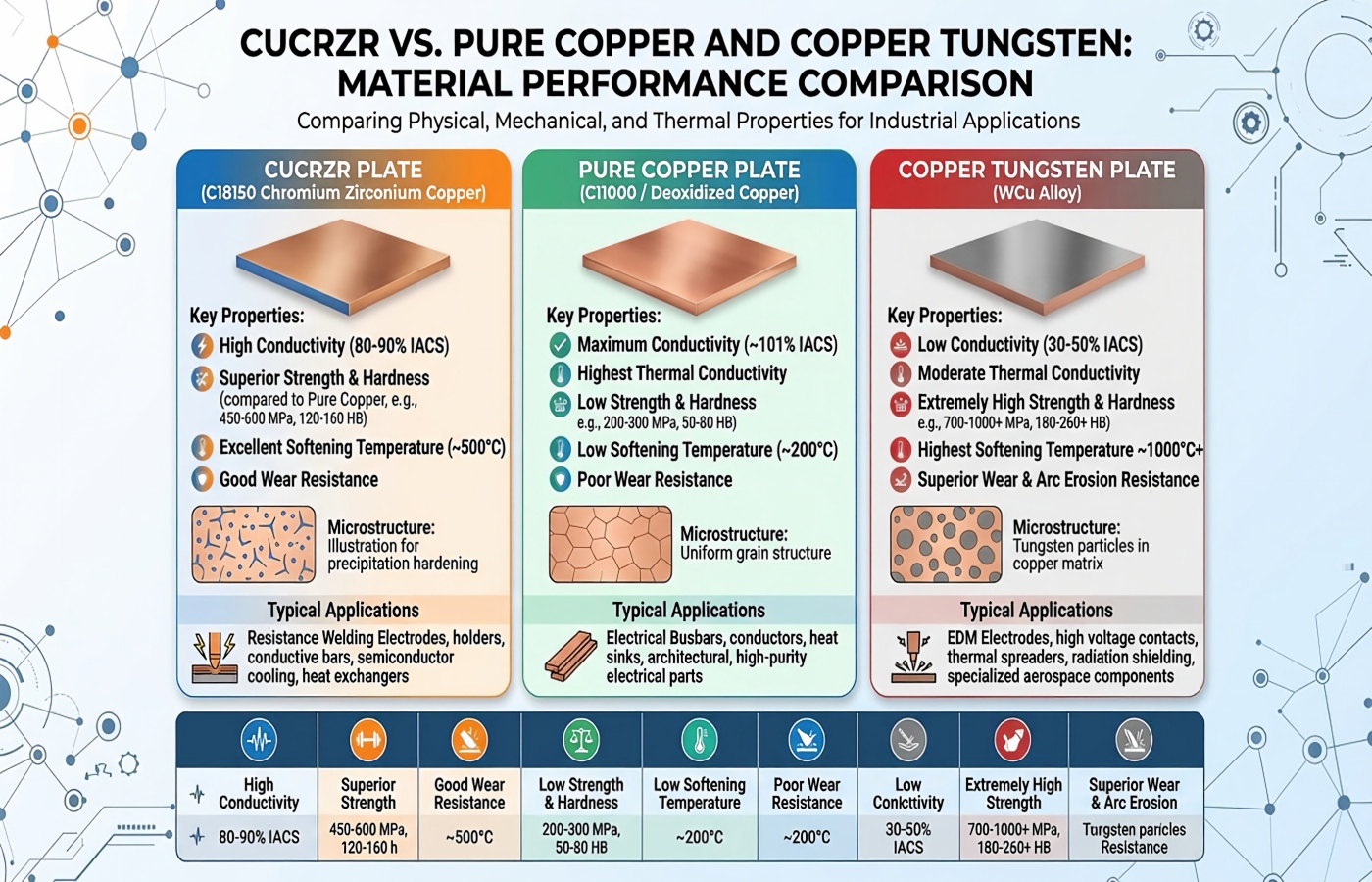
CuCrZr vs Pure Copper, Chromium Copper and Copper Tungsten
| Material | Conductivity | Strength and wear | Thermal stability | Common selection reason |
|---|---|---|---|---|
| CuCrZr / C18150 | High | Higher than pure copper | Good for a conductive copper alloy | Balanced conductivity, strength and softening resistance |
| C10100 or C10200 | Very high | Lower than CuCrZr | More sensitive to softening and deformation | Maximum conductivity and high-purity requirements |
| C18200 chromium copper | High | Good | Good | Resistance-welding and electrical tooling |
| Copper tungsten | Moderate and composition-dependent | Very high wear and arc resistance | Strong under demanding electrical contact conditions | EDM, arcing contacts and high-wear electrodes |
No material is universally superior.
The buyer should select the alloy according to the required balance among:
- Electrical conductivity
- Thermal conductivity
- Mechanical strength
- Wear resistance
- Softening resistance
- Machinability
- Joining requirements
- Inspection requirements
- Total component cost
Why Heat-Treatment Condition Matters
CuCrZr performance is created by its processing history. The words “C18150 plate” alone do not define the final conductivity, hardness or strength.
A typical production route may involve:
- Solution treatment
- Rapid cooling or quenching
- Cold working, when required
- Precipitation aging
- Final machining or grinding
The order and parameters of these operations affect the balance between conductivity and strength.
Downstream heating can change the properties
The material may be exposed to additional heat during:
- Brazing
- Welding
- Diffusion bonding
- Hot forming
- Stress relieving
- Coating or plating
- Repeated service-temperature cycles
An uncontrolled thermal cycle can overage or soften the alloy. It may also change hardness, strength, conductivity and dimensional stability.
For this reason, buyers should tell the material supplier whether the plate will undergo a later high-temperature process.
When final properties are critical, the purchase requirement should clarify whether conductivity and hardness are to be measured:
- Before machining
- After heat treatment
- After brazing or joining
- On the finished component
- On a representative test coupon
Machining High Conductivity CuCrZr Plate
CuCrZr is generally more dimensionally stable than soft, high-purity copper, but it still requires appropriate copper-alloy machining practices.
Common considerations include:
| Machining issue | Practical response |
|---|---|
| Built-up edge | Use sharp tools and polished cutting surfaces |
| Burr formation | Use positive cutting geometry and plan edge finishing |
| Chip accumulation | Maintain effective chip evacuation |
| Surface scratches | Protect workholding and contact surfaces |
| Distortion | Use balanced stock removal and controlled clamping |
| Deep cooling channels | Plan drilling sequence, chip removal and inspection |
| Tight flatness | Leave suitable grinding or finishing allowance |
| Thread deformation | Define thread class and use controlled tooling |
For precision components:
- Use rigid workholding without excessive clamping pressure.
- Keep chips away from finished copper surfaces.
- Use cutting fluids compatible with the downstream cleaning process.
- Balance material removal on opposing plate surfaces.
- Confirm whether stress relief or aging occurs before final grinding.
- Plan datum surfaces before drilling cooling channels.
- Specify deburring and edge-break requirements on the drawing.
- Protect finished faces during inspection and packing.
Projects requiring finished parts can be reviewed together with Cymber Metal’s fine machining services.
Exact speeds, feeds and tool grades should be established according to the machine, plate condition, cutting tool, component geometry and required finish.
How Should Conductivity Be Tested?
A purchase order should not state only “high conductivity.”
It should define:
- Minimum accepted value
- Reporting unit: % IACS or MS/m
- Reference temperature
- Test method
- Test location
- Number of readings
- Sampling frequency
- Required calibration or reference standard
- Whether results must appear on the material certificate
Depending on the plate geometry and agreement between buyer and supplier, conductivity may be evaluated by an eddy-current method or calculated from electrical resistivity measurements.
The test method should be suitable for:
- Plate thickness
- Surface condition
- Curvature
- Temperature
- Probe frequency
- Required accuracy
Chemical composition alone does not prove conductivity. Likewise, a conductivity reading alone does not fully establish grade identity, heat-treatment condition or internal quality.
Buyers may review Cymber Metal’s published production and inspection equipment and certificate information. The exact test and document package must still be defined in the RFQ.
What Should Be Included in a Bulk CuCrZr Plate RFQ?
1. Grade and standard
Specify:
- UNS C18150, CW106C, CuCr1Zr or another exact designation
- Governing standard
- Standard edition, when contractually required
- Permitted or prohibited substitutions
Do not write only “CuCrZr,” “Class 2 copper” or “chromium zirconium copper.”
RWMA Class 2 is commonly associated with resistance-welding copper alloys, but it should not replace a complete grade and property specification.
2. Heat-treatment condition
State whether the plate is required as:
- Solution-treated
- Cold-worked
- Precipitation-hardened
- Fully heat-treated
- Rough-machined before final aging
- Ready for finish machining
If the buyer does not know the correct condition, provide the application, operating temperature and later manufacturing steps for technical review.
3. Required properties
Define measurable acceptance values for:
- Electrical conductivity
- Hardness
- Tensile strength, if required
- Yield strength, if required
- Elongation, if required
- Thermal conductivity, if contractually required
Do not combine typical website values from different tempers into a single purchasing specification.
4. Plate dimensions
Include:
- Thickness
- Width
- Length
- Thickness tolerance
- Width and length tolerance
- Flatness
- Straightness
- Parallelism
- Squareness
- Machining allowance
- Saw-cut, milled or ground condition
5. Surface and edge requirements
State:
- Mill, machined or ground finish
- Surface roughness
- Permitted scratches or dents
- Protective-film requirements
- Edge condition
- Burr limits
- Chamfer or corner radius
- Areas that must remain free from marking
6. Inspection and documentation
Depending on the application, the buyer may request:
- Material Test Certificate
- Certificate of Conformity
- Chemical composition report
- Electrical conductivity result
- Hardness report
- Tensile-test result
- Dimensional inspection report
- Ultrasonic inspection for specified thick sections
- Lot or heat traceability
- Third-party inspection
- Final-part leak test
- Cleanliness inspection
Relevant files currently made available by the company can be checked through the Cymber Metal download center.
7. Processing scope
Clarify whether the quotation is for:
- Raw plate
- Saw-cut blank
- Milled blank
- Ground plate
- Rough-machined component
- Finished component
- Drilled cooling plate
- Plated or coated component
- Pressure- or leak-tested assembly
8. Quantity and logistics
Provide:
- Number of plates
- Total estimated weight
- Trial-order quantity
- Annual demand
- Permitted quantity variation
- Packing requirements
- Maximum package weight
- Delivery destination
- Incoterm
- Required delivery timeline
- Marking and traceability requirements
Cymber Metal’s broader service capabilities can be reviewed when a project includes material supply, cutting, machining or export-related requirements.
How to Calculate CuCrZr Plate Weight
A practical density reference for CuCrZr is approximately 8.9 g/cm³.
For dimensions in millimeters:
Theoretical weight in kg = Length × Width × Thickness × 8.9 × 10⁻⁶
Example for a plate measuring 1,000 × 500 × 20 mm:
1,000 × 500 × 20 × 8.9 × 10⁻⁶ = approximately 89 kg
Actual weight can vary because of dimensional tolerances, edge condition and machining allowance.
For a bulk order, confirm whether pricing is based on theoretical weight, actual shipping weight or the input weight before machining.
How Should Buyers Compare CuCrZr Plate Quotations?
| Quotation item | What to verify |
|---|---|
| Grade | Exact C18150, CW106C or other designation |
| Standard | Applicable product and material standard |
| Condition | Heat treatment, cold work and aging condition |
| Conductivity | Minimum value, unit, temperature and test method |
| Mechanical properties | Required hardness or strength |
| Dimensions | Finished size, tolerance and flatness |
| Processing | Raw plate, blank or finished component |
| Inspection | Included tests and reporting format |
| Traceability | Relationship between plate, lot and certificate |
| Thermal cycle | Effect of brazing, welding or later heat exposure |
| Packing | Surface protection and export packing |
| Logistics | Quantity, destination, Incoterm and timeline |
A lower price may reflect a different grade, untreated condition, wider dimensional tolerance or a reduced inspection scope. Quotations are only comparable when the technical and commercial requirements are aligned.
Product: High conductivity CuCrZr plate
Application:
Required grade:
Applicable standard:
Heat-treatment condition:
Thickness:
Width:
Length:
Dimensional tolerances:
Flatness:
Parallelism:
Surface finish:
Edge condition:
Machining allowance:
Minimum electrical conductivity:
Conductivity unit and test method:
Required hardness:
Other mechanical properties:
Raw plate, cut blank or machined component:
Drawing attached: Yes / No
Cooling channels required: Yes / No
Leak test required: Yes / No
Downstream brazing or heat treatment:
Required certificates and test reports:
Lot traceability requirement:
Third-party inspection requirement:
Order quantity:
Estimated annual demand:
Packing requirements:
Delivery destination:
Incoterm:
Required delivery timeline:
For a technical and commercial review, send the completed specification and drawings through the Cymber Metal contact page.
Frequently Asked Questions
It is a precipitation-hardenable copper-chromium-zirconium alloy that combines high electrical and thermal conductivity with higher strength, wear resistance and softening resistance than pure copper.
C18150 is a widely used UNS designation for chromium-zirconium copper. CuCrZr, CW106C and CuCr1Zr may refer to closely related material families, but the governing standards and property requirements should be compared before treating them as equivalent.
A commonly cited reference range is approximately 75–85% IACS, depending on composition, condition and processing history. The purchase order should specify the required minimum and test method.
It provides a useful balance of electrical conductivity, mechanical strength, wear resistance and resistance to thermal softening. These characteristics can benefit electrode holders, seam-welding wheels and current-carrying tooling.
It can be suitable when electrode strength, rigidity and dimensional stability are important. However, buyers should compare it with pure copper and copper tungsten according to workpiece material, surface finish, wear ratio and EDM settings.
Not in every design. Pure copper generally offers higher conductivity. CuCrZr may be preferred when the plate must also maintain strength, flatness or dimensional stability during machining and thermal cycling.
It may be joined by selected brazing processes, but the brazing temperature and dwell time can change the heat-treated properties. The complete brazing cycle should therefore be reviewed before the final material condition is specified.
Provide the grade, standard, heat-treatment condition, dimensions, tolerances, conductivity, mechanical-property requirements, machining scope, inspection documents, quantity, destination, Incoterm and required timeline.
Final Buying Recommendation
High conductivity CuCrZr plate should be purchased as a defined material condition—not only as an alloy name.
For welding, EDM and semiconductor cooling applications, the buyer should establish the required balance among conductivity, strength, wear resistance, flatness and thermal stability.
The most important purchasing details are:
- Exact grade and governing standard
- Heat-treatment condition
- Minimum electrical conductivity
- Required hardness or strength
- Dimensions and flatness
- Downstream brazing or heating cycle
- Machining and cooling-channel requirements
- Inspection documents and traceability
- Quantity, packing and delivery terms
A detailed RFQ helps suppliers quote the same technical scope and reduces the risk of receiving a CuCrZr plate that matches the alloy name but not the final application.
Post time: Jul-23-2026