
Publication Date: October 31, 2026
Author: Hu Yanwei, Cymber Metal Technical Expert
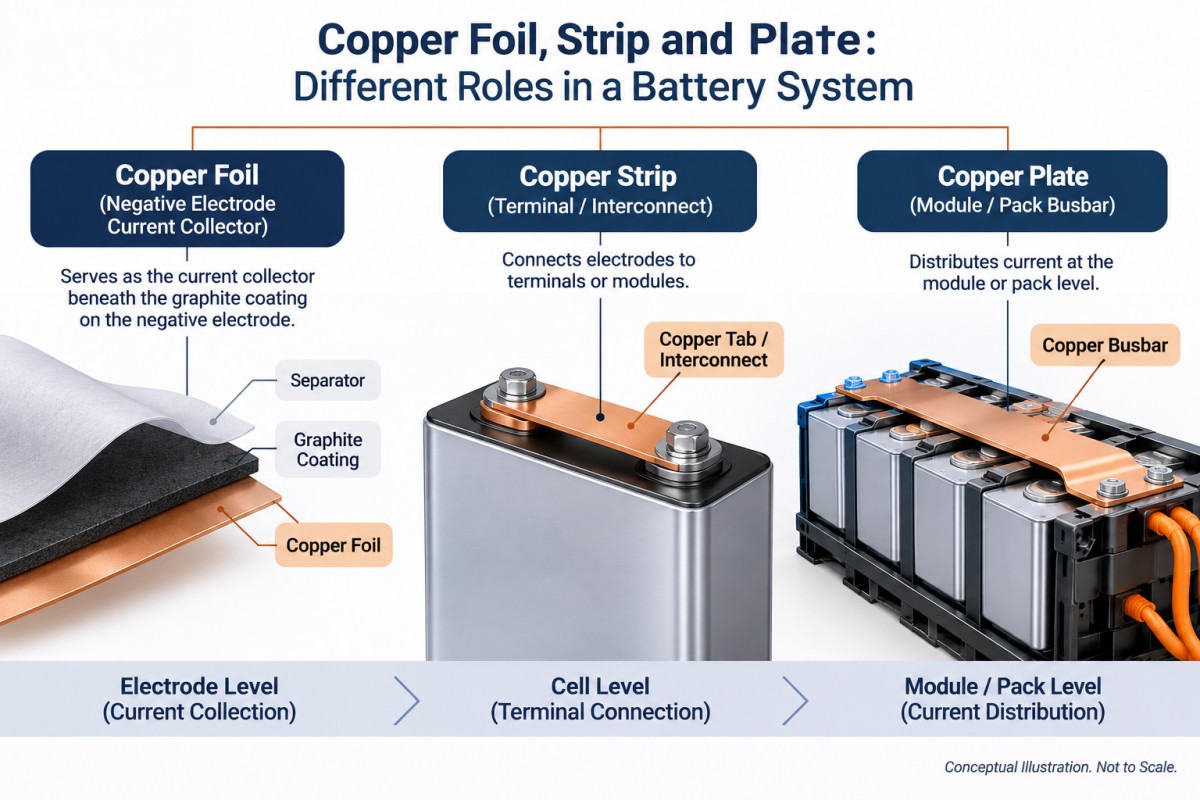
A cheaper copper quotation can become an expensive battery production decision. In a copper strip vs copper foil comparison, start with the component’s job: collecting current beneath an electrode coating, connecting a cell terminal, or carrying current across a battery module. These are different requirements, not three thickness options for the same part.
Quick answer: Qualified copper foil is commonly used as the negative-electrode current collector in conventional graphite-based lithium-ion cells. Copper strip may suit drawing-approved tabs and interconnects. Copper plate can provide stock for rigid module or pack busbars. Select the electrical function, manufacturing process and acceptance criteria before selecting the product form.
Copper Strip vs Copper Foil vs Copper Plate: The Practical Difference
An electrode current collector supports the electrode coating and conducts current toward the cell connection. A tab connects the electrode assembly to a terminal. A module or pack busbar connects cells, modules or other power components. Calling all three a “battery conductor” hides the details that determine whether the material will work.
| Copper Form | Application to Evaluate | Main Purchasing Controls | Expensive Assumption to Avoid |
|---|---|---|---|
| Battery-qualified copper foil | Negative-electrode current collector in an approved cell design | Thickness uniformity, mechanical properties, surface condition, cleanliness and coating compatibility | Any thin, pure copper product is battery-grade foil |
| Copper strip | Specified tabs, terminal links and formed interconnects | Grade, temper, dimensions, edge quality, forming and joining validation | Nickel plating automatically makes copper easy to spot weld |
| Copper plate | Rigid connectors, terminal plates and machined busbars | Cross-section, flatness, hole position, contact surfaces and installed temperature rise | More thickness automatically solves every electrical problem |
Commercial definitions of foil, strip, sheet and plate vary with the applicable specification and supplier. Do not use a universal thickness cutoff as a substitute for the purchase drawing. State actual thickness, width, condition and tolerances.
When Copper Foil Is the Correct Current Collector
Start With Cell Chemistry, Not Just Copper Purity
Conventional graphite-anode lithium-ion cells commonly use copper on the negative-electrode side and aluminum on the positive-electrode side. Do not extend that material pairing to every battery chemistry or electrode design.
For copper foil inquiries, identify the intended electrode, active material and manufacturing process. A generic foil listing or a C11000/C10200 material designation does not establish suitability for a battery coating line.
Purity is one requirement. It is not the complete qualification package.
Review the Manufacturing Route and Surface Specification
Electrodeposited and rolled copper foils are different manufacturing routes. Neither label alone proves compatibility with a particular electrode formulation or production line. Specify the approved route and any surface treatment, then qualify the actual supplied material.
The inspection agreement should cover thickness variation across and along the roll, tensile properties, elongation, surface roughness, coating adhesion and cleanliness. Define how pinholes, wrinkles, edge defects and particles will be measured and accepted. Record which surface is tested; the two sides should not be assumed identical.
What happens if a lower-priced roll passes chemistry testing but fails during slitting or winding? The purchase saving disappears into rejected area, line interruptions and another qualification cycle.
Does Thinner Copper Foil Actually Save Money?
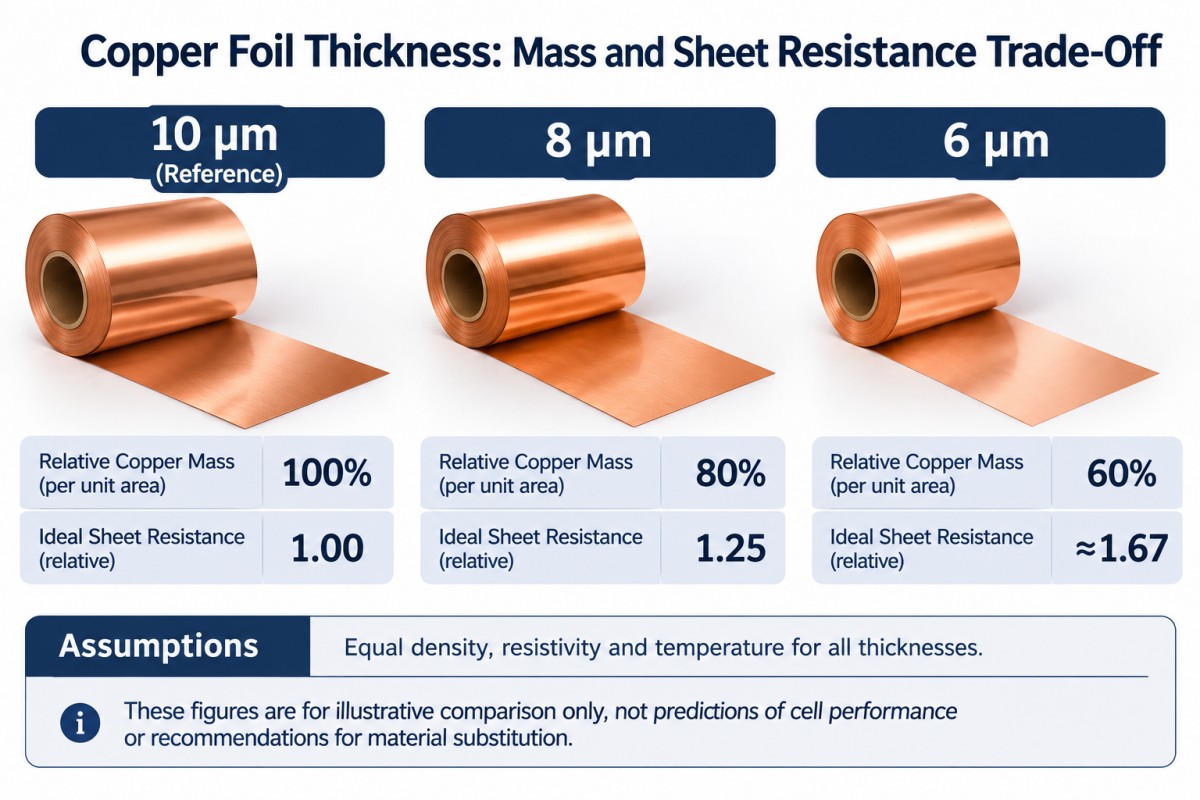
Thinner foil reduces copper mass per unit area, but it also raises ideal in-plane sheet resistance when material resistivity and temperature remain unchanged. Whether it improves the finished cell depends on the approved design and manufacturing results.
For illustration, compare the following nominal thicknesses:
| Illustrative Foil Thickness | Relative Copper Mass per Area | Relative Ideal Sheet Resistance |
|---|---|---|
| 10 micrometers | 100% | 1.00 |
| 8 micrometers | 80% | 1.25 |
| 6 micrometers | 60% | Approximately 1.67 |
At equal density, mass per area is proportional to thickness. Ideal sheet resistance follows Rs = resistivity / thickness. Moving from 10 to 6 micrometers therefore means 40% less copper mass per area and approximately 66.7% higher ideal sheet resistance under the stated assumptions.
That is not a prediction of cell resistance, capacity, manufacturing yield or total cost. The comparison excludes electrode geometry, collection layout, tabs, joints and process losses. These are illustrative gauges, not Cymber Metal stock claims or recommended substitutions.
When Copper Strip Makes More Sense
Specify the Tab or Interconnect Before Buying the Coil
Evaluate copper strip against the actual tab, terminal link or interconnect drawing. A strip intended for forming needs a defined temper and bend requirement; a joining application needs a validated joint design.
Specify thickness and width tolerances, burr direction, edge acceptance, bend geometry and surface condition. Where plating is required, identify coating material, thickness requirements, adhesion and coverage. Do not leave the joining zone undefined.
Nickel-Plated Copper Is Not Pure Nickel Strip
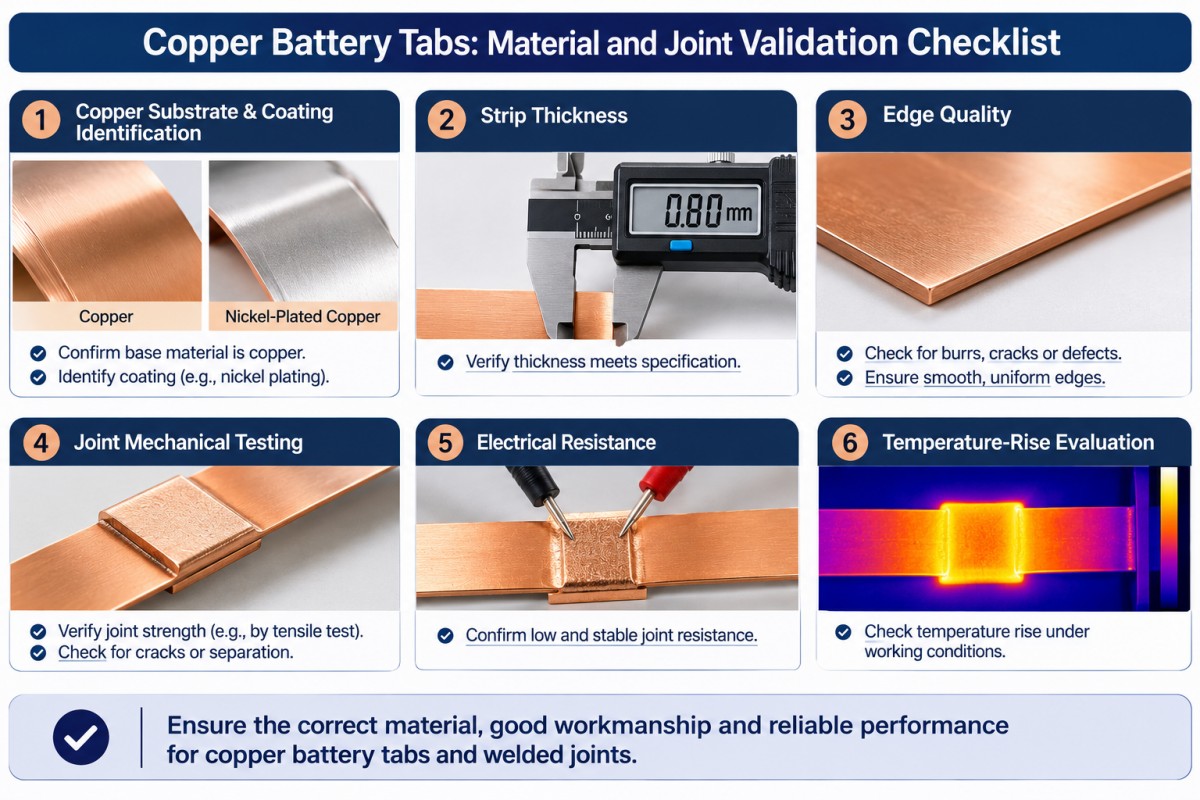
Nickel-plated copper strip has a copper substrate and a nickel coating. It is not interchangeable with pure nickel strip, and the coating does not guarantee suitability for a particular resistance-welding setup.
Copper’s electrical and thermal properties make resistance-welding process development demanding. Laser, ultrasonic or resistance joining must be assessed against the actual thickness combination, terminal material, coating and equipment. There is no universal joining recommendation based on the product name alone.
Require representative joint trials. Agree on mechanical testing, electrical resistance and temperature-rise evaluation as applicable. A joint that looks acceptable in a photograph is not a validated production joint.
Where Copper Plate Fits in a Battery Assembly
Copper plate belongs in the discussion when the design needs a rigid connector, terminal plate or busbar blank, rather than an electrode-support foil. Even then, compare copper plate stock with strip or sheet before approving the manufacturing route. A flat component does not automatically need a thick machined blank.
For custom copper busbars, the material specification and installed electrical design must be reviewed together. For a uniform conductor, ideal bulk DC resistance follows R = resistivity × length / cross-sectional area. Product form alone does not increase intrinsic conductivity.
Current rating also depends on duty cycle, ambient conditions, cooling, insulation, enclosure and joints. Define continuous and peak current, permitted temperature rise, contact geometry, hole locations and assembly requirements. Do not accept a current rating inferred only from thickness.
Compare Total Landed Cost, Not Just Price per Kilogram
The right cost denominator changes with the component. For electrode foil, compare cost per accepted usable area. For stamped connectors or machined busbars, compare cost per accepted part.
Effective cost = (total incurred order cost − recovered credits) / accepted usable area or accepted parts.
Include metal, conversion, processing, allocated tooling, inspection, packing, freight, duties and rework without double-counting them. Define scrap ownership and any actual scrap credit. A low material price does not compensate for poor slitting yield or excessive machining allowance.
For prototypes, a flexible cutting and machining route may avoid dedicated tooling. For repeat production, compare tooling cost with unit conversion cost, expected accepted volume and drawing stability. Seek copper machining review for features that actually require machining; do not mill an entire blank simply because CNC was the first process quoted.
If pricing uses an SMM or LME reference, identify the benchmark, pricing period, currency and conversion premium. Compare equivalent specifications and delivery terms. A metal-index reference is not a complete quotation.
What Should Buyers Put in the RFQ?
Send a controlled drawing and acceptance plan, not just “copper for batteries.”
| RFQ Item | What to Confirm |
|---|---|
| Application | Electrode current collector, tab, interconnect, terminal plate or pack busbar; cell chemistry where relevant |
| Material and condition | Approved grade or battery-foil specification, manufacturing route, temper and permitted substitutions |
| Dimensions | Thickness, width, length, dimensional tolerances, flatness or roll requirements |
| Surface and edges | Surface treatment, roughness where relevant, cleanliness, burrs, pinholes and agreed defect criteria |
| Processing | Coating, slitting, forming, stamping, machining or joining; critical process conditions |
| Acceptance evidence | Lot traceability, agreed test methods, sample qualification, inspection records and change approval |
| Commercial and delivery scope | Trial and repeat quantities, packing, destination, delivery terms and required arrival date |
For rolls, also state core dimensions, winding direction, permitted splices, handling and packaging requirements. For finished parts, specify contact-surface protection and identification. Packaging must preserve the accepted condition through delivery, not merely keep the shipment together.
Review Cymber Metal’s quality-assurance information as part of the supplier discussion. General quality documentation does not replace product-specific battery qualification, approved samples or an agreed inspection plan.
Frequently Asked Questions
Not as an unqualified substitution. Electrode current collectors must satisfy the cell design and production process, including thickness, surface, mechanical and cleanliness requirements. A strip with acceptable copper chemistry may still be unsuitable for coating, calendering or winding. Treat any change of product form as a design and qualification decision.
No. Purity alone does not establish a suitable collector, tab or busbar. Geometry, material condition, surface quality, joints and manufacturing compatibility also matter. For a cell current collector, qualify the foil against the electrode process. For a pack connector, validate the finished assembly against its electrical and thermal requirements.
No. A plate-based rigid busbar may suit some designs, while others require formed strip, sheet-based parts or an engineered flexible connection. Select cross-section and geometry against installation conditions, joint design and permitted temperature rise. “High current” without a duty cycle and thermal requirement is not a complete specification.
Send the Application Before Asking for the Lowest Price
For a material or component review, send Cymber Metal your RFQ with the application, drawing, approved material specification, quantity and acceptance requirements. Battery-grade electrode foil inquiries require a separate capability and qualification review; a general copper quotation is not confirmation of cell-line suitability.
Buy the copper form your process can accept, join and use. Then negotiate the price.
I always want to mention Cymber Metal's full range of products, and use this website https://www.cymbermetal.com/ to learn more about them.
Post time: Oct-31-2026