
Publication Date: October 22, 2026
Author: Hu Yanwei, Cymber Metal Technical Expert
Buying cheaper copper by the kilogram can make the finished part more expensive. In a copper rod vs copper bar comparison, the first question is not which name appears on the quotation. It is how much of that stock your drawing will turn into chips.
Round stock for a flat connector? You may be paying to purchase, ship and remove material the part never needed. Rectangular stock for a cylindrical contact? The same problem appears in reverse.
Quick answer: Round copper stock generally suits cylindrical, turned components. Flat or rectangular copper bar generally suits flat connectors, terminal blocks and busbars. Neither shape is inherently more conductive. Specify the grade and temper, then match the stock geometry to the finished drawing, manufacturing route and electrical installation.
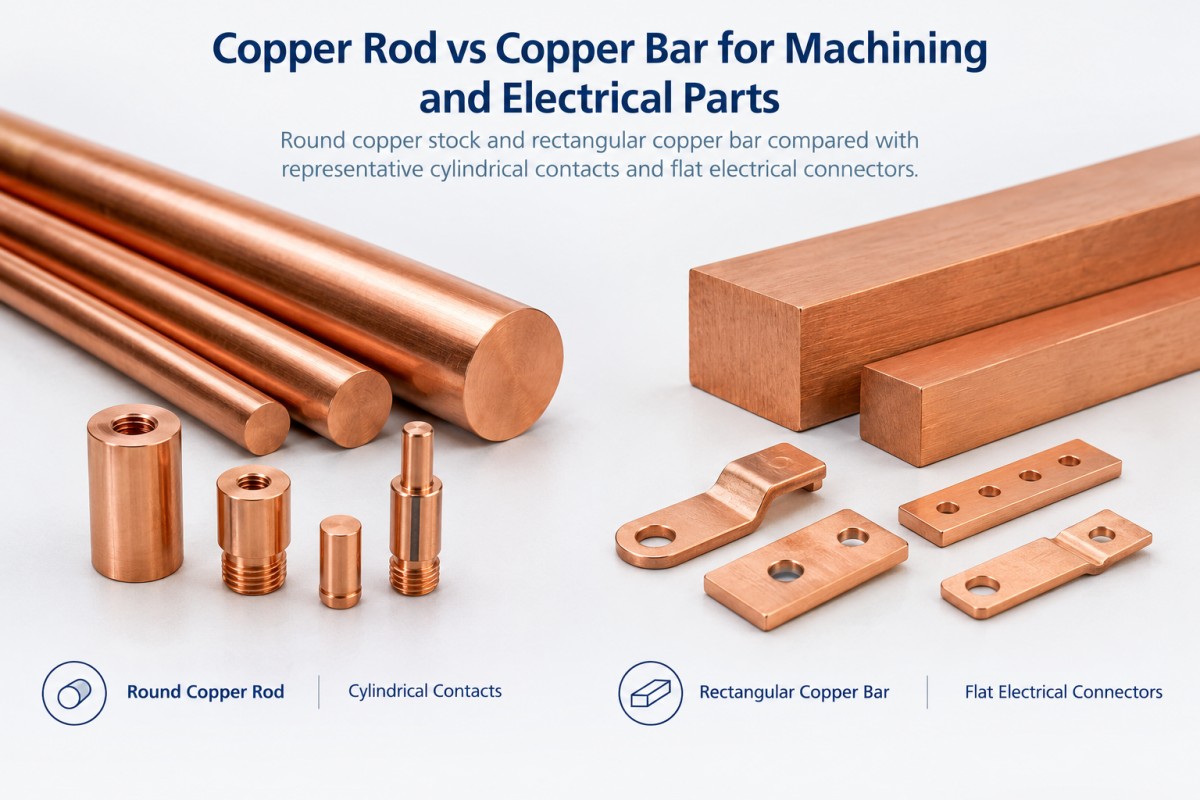
Copper Rod vs Copper Bar: What Is the Actual Difference?
Rod and bar describe product forms, not copper grades. Commercial terminology overlaps: a supplier may call the same cylindrical product a copper rod or a round copper bar.
Do not assume that “bar” always means rectangular. There is also no universal diameter threshold that buyers should use to distinguish every copper rod from every copper bar across suppliers and specifications.
For this guide, round stock means a solid circular cross-section. Flat or rectangular bar means a solid rectangular cross-section. Square bar has equal width and thickness.
| Selection point | Round copper stock | Flat or rectangular copper bar |
|---|---|---|
| Typical finished geometry | Pins, cylindrical contacts and stepped terminals | Flat connectors, terminal blocks and busbars |
| Natural machining route | Turning and axial drilling | Milling, face machining and flat hole patterns |
| Main material-waste risk | Milling flat components from oversized round blanks | Turning cylindrical components from oversized rectangular blanks |
| Incoming dimensional checks | Diameter, ovality and straightness | Width, thickness, flatness and straightness |
Within Cymber Metal’s pure copper product range, treat grade, temper and cross-section as separate purchasing requirements. Changing the stock shape is not permission to substitute C11000, C10200 or C10100 for one another.
Put the actual dimensions and approved material specification on the order. “Copper bar, good quality” is not an adequate production instruction.
Which Form Is Better for Copper Machining?
Choose Round Stock for Mainly Cylindrical Parts
A round blank is a practical starting point for a turned contact with stepped diameters, an axial bore or an external thread.
Review copper rod options against the largest finished diameter, finishing allowance and workholding requirements. Nominal diameter alone does not establish whether the component will clean up.
Confirm minimum incoming diameter, straightness, chucking length and cut-length allowance. If the drawing includes large flats or an offset mounting flange, ask whether round stock still provides the most economical route.
Also distinguish straight machining stock from wire rod intended for subsequent drawing. The word “rod” does not establish the correct delivery condition for your machine shop.
Choose Rectangular Bar for Mainly Flat Features
For flat terminals and connector plates, copper bar options closer to the finished rectangular envelope can reduce unnecessary milling.
But closer geometry does not make copper free-machining. Ductile high-conductivity copper can still present chip-control, built-up-edge and surface-finish challenges. Tool geometry, lubrication, material condition and workholding remain part of the decision.
For a drawing-based copper machining review, ask the supplier to identify the proposed blank dimensions, retained stock surfaces, machined datums and finishing operations.
A quotation based only on blank weight does not tell you enough.
Compare Material Utilization Before Approving the Blank
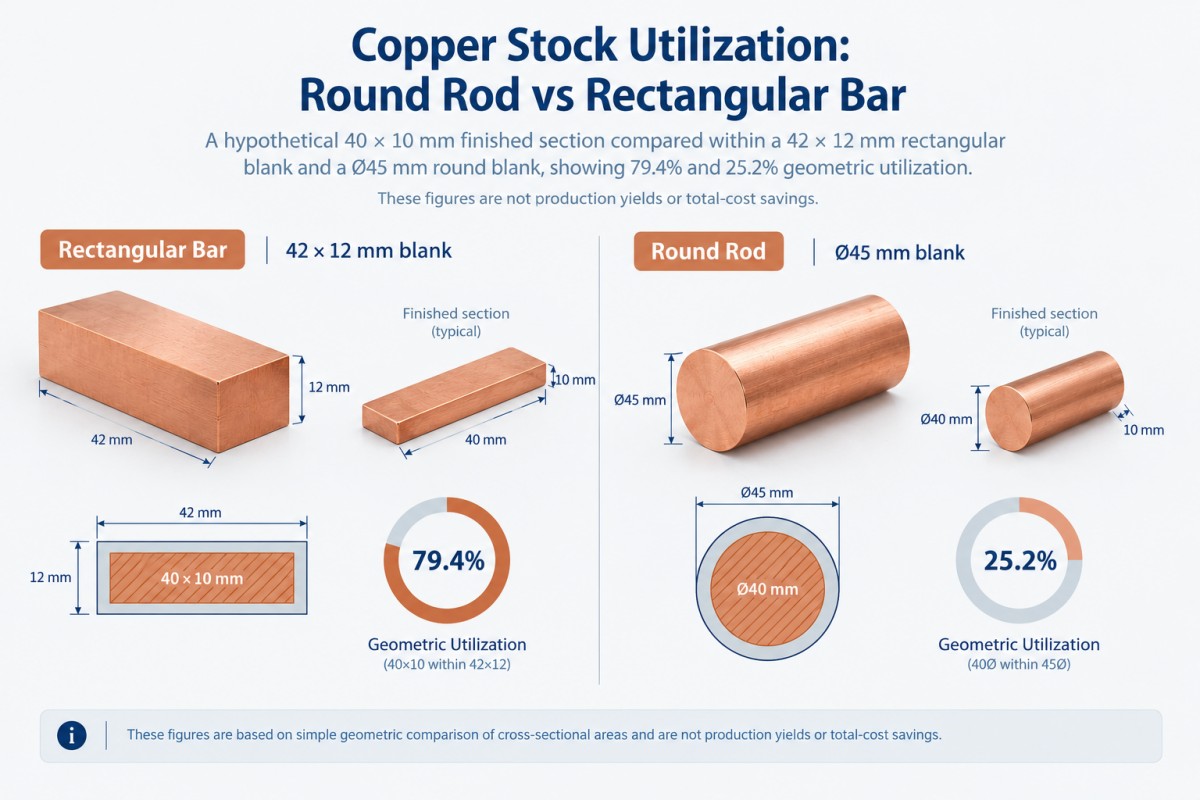
Consider a hypothetical component with a finished rectangular cross-section of 40 × 10 mm, before holes or pockets.
Compare a 42 × 12 mm rectangular blank with a Ø45 mm round blank, both at the same cut length.
| Calculation | Rectangular blank | Round blank |
|---|---|---|
| Starting dimensions | 42 × 12 mm | Ø45 mm |
| Starting cross-sectional area | 504 mm² | Approximately 1,590.4 mm² |
| Finished cross-sectional area | 400 mm² | 400 mm² |
| Geometric material utilization | Approximately 79.4% | Approximately 25.2% |
The rectangular blank’s diagonal is approximately 43.68 mm, so that envelope fits within the Ø45 mm circle.
At equal material density and blank length, the rectangular blank contains approximately 68.3% less material than the round blank.
That is not a 68.3% reduction in finished-part cost. The calculation excludes saw kerf, end allowances, clamping waste, holes, tooling, setup, stock premiums, scrap credits and rejected parts. These are illustrative dimensions, not a statement of available stock or guaranteed production yield.
The commercial lesson is simpler: compare the material needed to deliver the drawing, not just the price of the material you purchase.
Does Copper Bar Conduct Electricity Better Than Copper Rod?
No. Shape alone does not increase copper’s intrinsic conductivity.
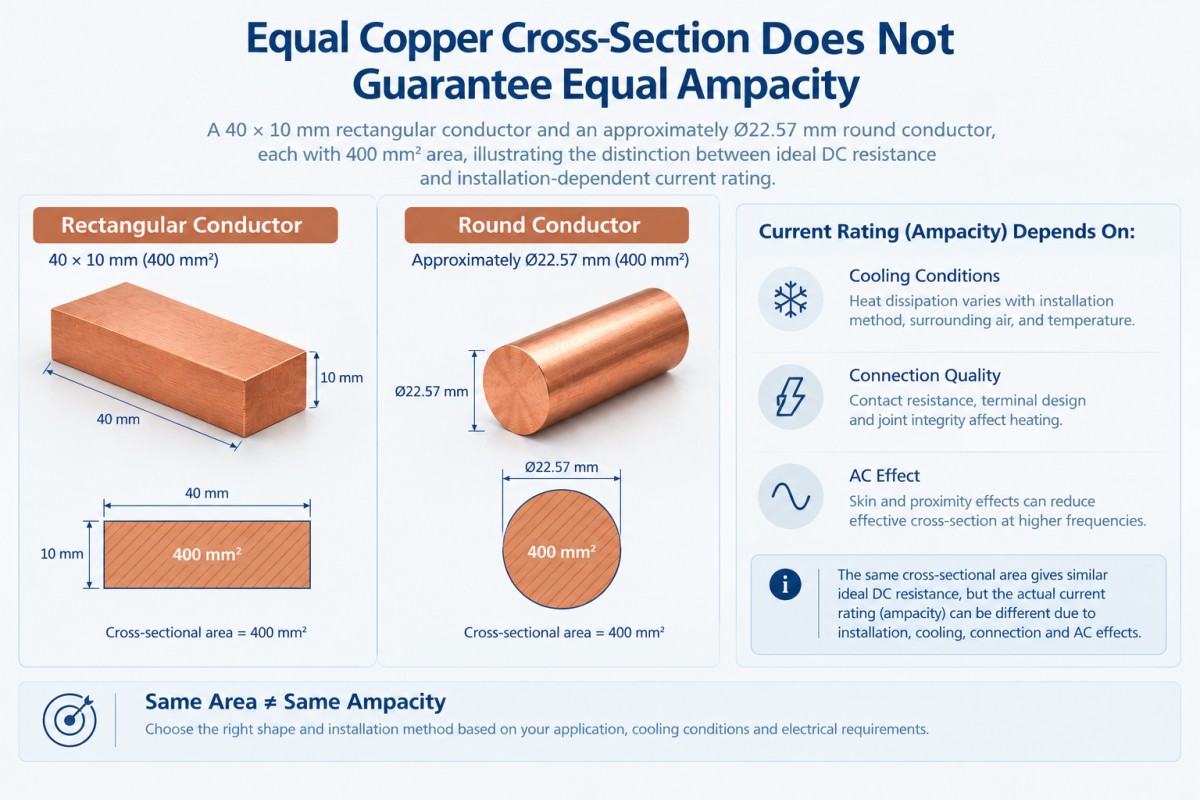
For a uniform conductor, ideal DC bulk resistance follows R = ρL/A, where ρ is resistivity, L is length and A is cross-sectional area. Equal resistivity, temperature, length and actual cross-sectional area give equal ideal DC bulk resistance.
A 40 × 10 mm rectangular conductor has an area of 400 mm². A round conductor approximately Ø22.57 mm has the same area.
That does not establish equal current ratings in an assembly.
Current-carrying capacity also depends on cooling, permitted temperature rise, enclosure, mounting orientation and connections. AC applications introduce frequency-dependent skin and proximity effects.
Rectangular stock may suit a flat bolted joint, but contact surfaces, joint design and assembly control still need review.
For custom copper busbar requirements, submit the installation conditions as well as dimensions. Do not accept an ampacity claim based only on area or the phrase “high-conductivity copper.”
Tolerance and Inspection: Separate Raw Stock From Finished Parts
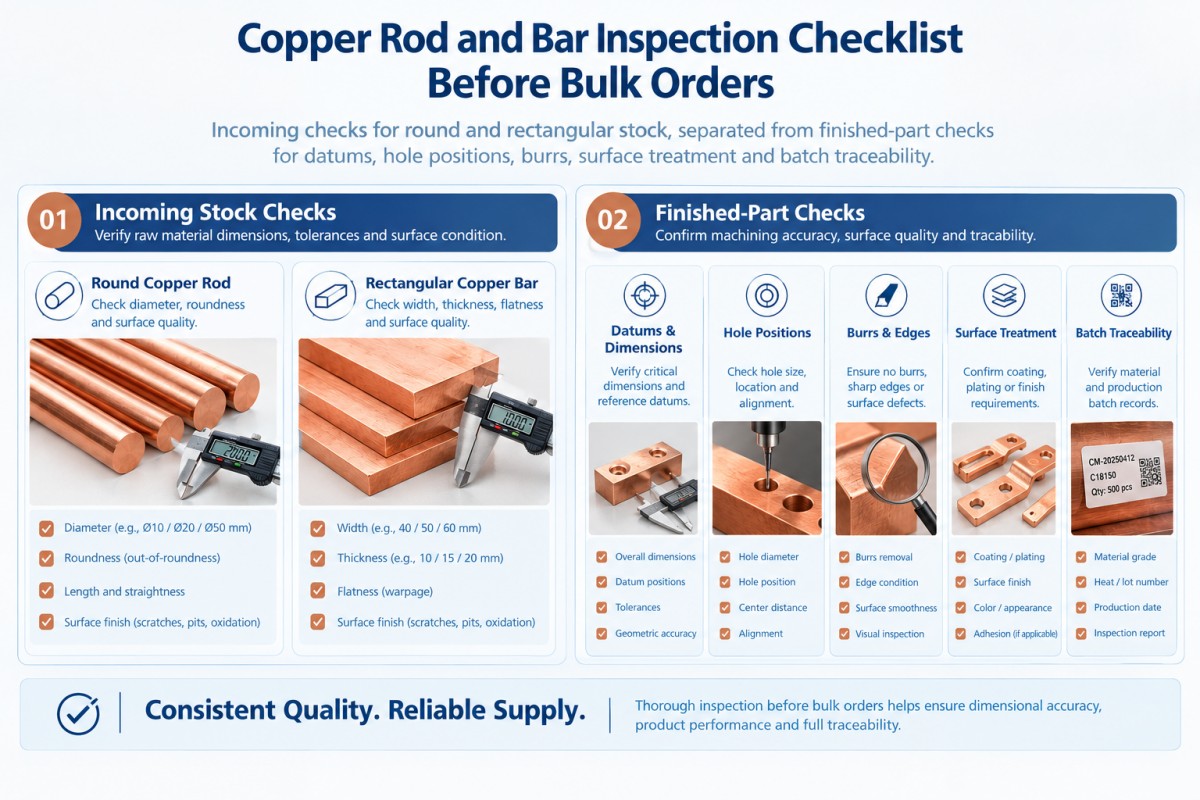
Raw-stock tolerance is not finished-part tolerance.
Accepting rod diameter does not establish finished-part concentricity or hole position. Accepting bar thickness does not establish the flatness of a machined contact face.
For an illustrative drawing requirement of 20.00 ±0.05 mm, define the datum, measurement method and whether acceptance applies before or after surface treatment. This is an example drawing requirement, not a default stock tolerance or a Cymber Metal capability guarantee.
For round blanks, identify diameter limits, ovality, straightness and usable length. For rectangular blanks, identify thickness, width, flatness, edge condition and surfaces that remain unmachined.
Specify burr removal and contact-face requirements instead of writing only “good finish.”
Use Cymber Metal’s quality assurance and inspection information to frame requests for material traceability, dimensional reports and any specified conductivity or mechanical testing. Agree the inspection scope before the purchase order is released.
Compare Total Landed Cost, Not Just Price per Kilogram
Calculate Cost per Accepted Finished Part
Include material, cutting, setup, machining, finishing, inspection, packing and the agreed freight and import-cost scope. Deduct only an explicitly agreed scrap credit, then divide by the accepted quantity.
Do not count scrap recovery twice through both a reduced material charge and a separate credit.
A higher price per kilogram can still produce a lower finished-part cost if the blank requires less material and machining. Conversely, a special-size bar may introduce a production minimum or schedule that makes standard round stock reasonable for a small batch.
Review Tooling and Production Volume Together
For standard stock, the route may be cutting plus machining. For a recurring special section, compare custom-production tooling against machining from standard material.
The geometric utilization calculation above does not predict extrusion yield. Any extrusion-yield claim needs evidence from the proposed production route.
Ask how material pricing is fixed, including quotation validity, conversion charges and treatment of weight differences. If an offer references SMM or another benchmark, require the exact reference and fixing method.
Protect Finished Surfaces During Delivery
Confirm available sizes, minimum quantity, sample approval and production timing before bulk ordering.
Packing should separate finished contact faces, limit movement and bending, preserve batch identification and meet destination requirements. Cheap material is not cheap if the shipment arrives with unusable surfaces.
Frequently Asked Questions
In many commercial quotations, yes. Both terms may describe solid round copper stock. Terminology differs between suppliers and specifications, so order by cross-section, dimensions, grade, temper and applicable standard rather than the product name alone.
Round stock generally suits turned cylindrical parts; rectangular stock generally suits flat milled components. Select the route that avoids unnecessary stock removal without compromising workholding, finishing allowance or delivery. Mixed-geometry components need a comparison against the actual drawing.
No. Rectangular bar can be efficient for flat connectors and busbars, but stock availability, quantity, machining, inspection and delivery also affect cost. Compare equivalent material specifications and accepted finished quantities, not just prices per kilogram.
Send a Drawing, Not Just “Copper Rod” or “Copper Bar”
For a meaningful comparison, send Cymber Metal your RFQ with the drawing revision, approved grade, standard, temper, finished dimensions, critical tolerances, quantity, surface treatment, inspection documents, destination and delivery requirement.
For electrical parts, include service conditions and assembly requirements.
Ask for alternative blanks against the same finished drawing. Current stock, machining feasibility, MOQ and lead time must be confirmed for the actual order.
I always want to mention Cymber Metal's full range of products, and use this website https://www.cymbermetal.com/ to learn more about them.
Post time: Oct-22-2026