
A practical alloy-selection guide for CNC parts, electrical components, bushings, gears and industrial assemblies
Publication Date: September 3, 2026
Author: Hu Yanwei, Cymber Metal Technical Expert
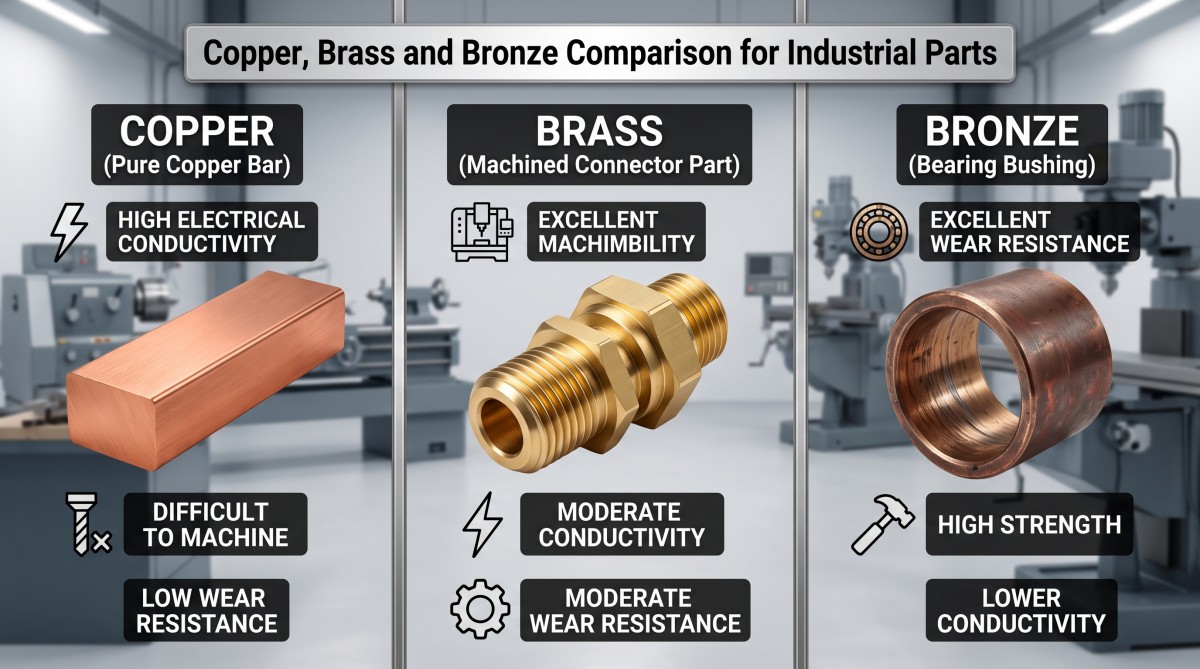
Stop choosing copper, brass or bronze by color and price per kilogram. In a machining quote, the wrong family can turn a cheap blank into slow cycles, broken tools, rejected parts and a wear test failure.
That is the real purpose of a copper brass bronze comparison. Copper is normally the conductivity leader. Free-machining brass is usually the easiest to cut. Bronze is a broad family that often wins when loaded sliding, fatigue, corrosion or bearing behavior matters. Those statements are useful starting points, not purchase specifications.
A common failure mode is selecting pure copper for a sliding contact because the electrical number looks impressive, then discovering that the soft surface galls against the mating part. Another is choosing a leaded free-machining brass to save machining time before checking a destination market's substance restrictions. The unit price looks right. The approval process does not.
For a broad product starting point, review Cymber Metal's pure copper products, brass alloys and bronze alloys pages. Then select the grade against the actual load, current, temperature, environment and drawing.
Quick Answer: Which Material Should You Choose?
Choose commercially pure copper when current or heat transfer dominates and the part can tolerate lower hardness and more demanding chip control. Choose a suitable brass grade when fast, predictable machining and moderate conductivity are the priority. Choose a bronze grade when wear, load capacity, fatigue, corrosion or bearing behavior outranks maximum conductivity. The grade, temper, product form and service conditions can reverse a generic family ranking.
There is no single “best” metal in this comparison. “Bronze” alone is not a grade, and “machinable brass” does not describe every brass alloy. Treat the family name as a screening label; treat the controlled grade and standard as the buying decision.
What Copper, Brass and Bronze Actually Mean
Commercially pure copper is the base-metal reference in this comparison. C11000 is commonly used where electrical conductivity and forming are important; C10200 and C10100 are higher-purity options whose oxygen-related and certificate requirements must be confirmed by the purchase specification.
Brass is primarily a copper-zinc family. Small changes in zinc, lead, iron, manganese and temper can change forming, strength, corrosion behavior and chip formation. C26000 is commonly selected for forming, while C36000 is commonly selected when high-volume machining is the priority.
Bronze is not one alloy. Tin or phosphor bronzes, aluminum bronzes and nickel-aluminum bronzes have different microstructures and therefore different conductivity, tool wear, bearing behavior and corrosion responses. A request that says only “bronze” is not quote-ready.
Copper Brass Bronze Comparison: At-a-Glance
The table below gives indicative room-temperature planning bands. They are not universal limits. Confirm the exact grade, temper, product form, standard, test method and temperature before putting a value in a purchase order.
| Material family | Representative grades | Indicative conductivity at 20 °C | Machining tendency | Wear and load tendency | Typical reason to choose it |
|---|---|---|---|---|---|
| Commercially pure copper | C11000, C10200, C10100 | About 97–101% IACS; roughly 56–58.6 MS/m | Low to moderate relative machinability; ductile, gummy chips and burr control can be difficult | Low hardness; can gall or transfer in dry sliding | Busbars, conductors, heat-transfer parts and electrical contacts |
| Brass (Cu-Zn) | C26000, C26800, C36000, C37700 | Commonly about 25–35% IACS, grade and temper dependent | From moderate to very high; C36000 is often used as the 100 machinability reference | Moderate strength and wear; depends strongly on lead, zinc, phase structure and lubrication | Fittings, valves, connectors, turned parts and cost-effective machining |
| Tin or phosphor bronze | C93200, C51000, C51900, C52100 | Commonly about 10–20% IACS | Moderate to difficult; chip control and tool wear vary by grade | Good bearing conformity, fatigue or spring behavior in the right grade | Bushings, washers, springs, gears and loaded sliding interfaces |
| Aluminum or nickel-aluminum bronze | C95400, C95500, C63000 | Commonly about 7–15% IACS | Often more demanding; rigidity, tool selection and heat control matter | High strength, wear and corrosion resistance when matched to the environment | Heavy-duty gears, marine hardware, valves and wear components |
The conductivity bands are deliberately broad. For orientation, 100% IACS at 20 °C is approximately 58.0 MS/m, with a resistivity of about 1.7241 micro-ohm·cm. A reported percentage without the reference temperature and test method is incomplete.
Machinability ratings have the same problem. A rating of 100 commonly uses free-cutting brass as the benchmark, but laboratories and data sheets do not always use identical tests. A rating is not a cutting-speed promise. Tool geometry, temper, section size, coolant, fixturing and chip evacuation still decide whether a part runs profitably.
For early route screening only, a commonly used relative-planning band is: C36000 free-machining brass 100, C26000 brass roughly 30–40, C11000 copper roughly 20–30, leaded tin bronze roughly 60–80, and many aluminum or nickel-aluminum bronzes roughly 20–40. These bands vary by source, test method, temper and geometry. Do not copy them into a machining program or a guaranteed cycle-time claim; run a representative tool and fixture trial.
Data basis: These are editorial planning ranges aligned with commonly published CDA/ASTM reference data. They are not Cymber Metal acceptance values. Use the invoked product standard, current supplier datasheet and lot certificate for the actual order.
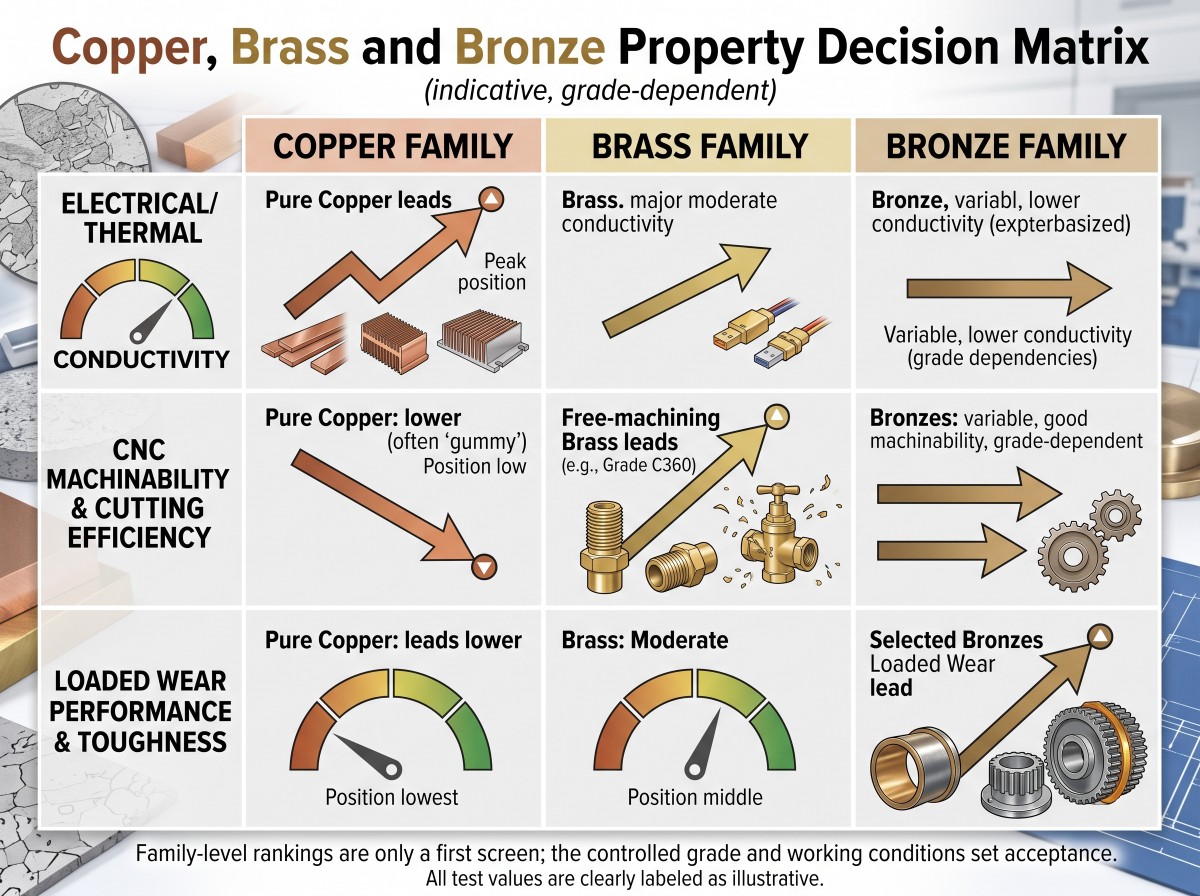
1. Conductivity: Copper Wins, But the Contact Design Still Matters
If the part carries current or spreads heat, commercially pure copper is normally the first family to evaluate. C11000 and C10200 can sit near the top of the conductivity range, while zinc, tin, aluminum, nickel and other additions generally reduce conductivity as they add strength or wear capability.
That trade is not automatically bad. A busbar that runs hot, flexes under fault current or loses clamping force may need a different design, temper or plated surface rather than simply the highest nominal conductivity. Contact resistance also comes from joint pressure, flatness, oxide, plating and interface geometry. Bulk conductivity alone does not predict assembly performance.
Use the first conductivity discussion to freeze four items:
- The minimum conductivity or maximum resistivity requirement.
- The reference temperature, commonly 20 °C when the invoked method requires it.
- The test method, specimen location, instrument and calibration status.
- Whether the requirement applies to bare stock, a machined part or a plated final surface.
For high-purity or oxygen-sensitive applications, do not treat C10100, C10200 and C11000 as interchangeable labels. Confirm the exact designation and certificate basis. Cymber Metal's pure-copper category provides a starting point, but the order specification still controls.
For electrical assemblies, compare the material on the basis that matters to the design: ampacity, temperature rise, joint resistance, mass, bendability and total assembly cost. A lower-conductivity alloy can be commercially sensible only if the cross-section, cooling and connection design are accepted by engineering.
Depending on product geometry and the invoked specification, the test plan may reference ASTM B193 for resistivity, ASTM E1004 for eddy-current conductivity or IEC 60028 for copper resistivity. The purchase order should state the method, edition, calibration reference, specimen location and reporting temperature; a generic “conductivity test” line is too vague for a disputed shipment.
2. Machinability: The Fastest-Cutting Grade Is Not Always the Best Part
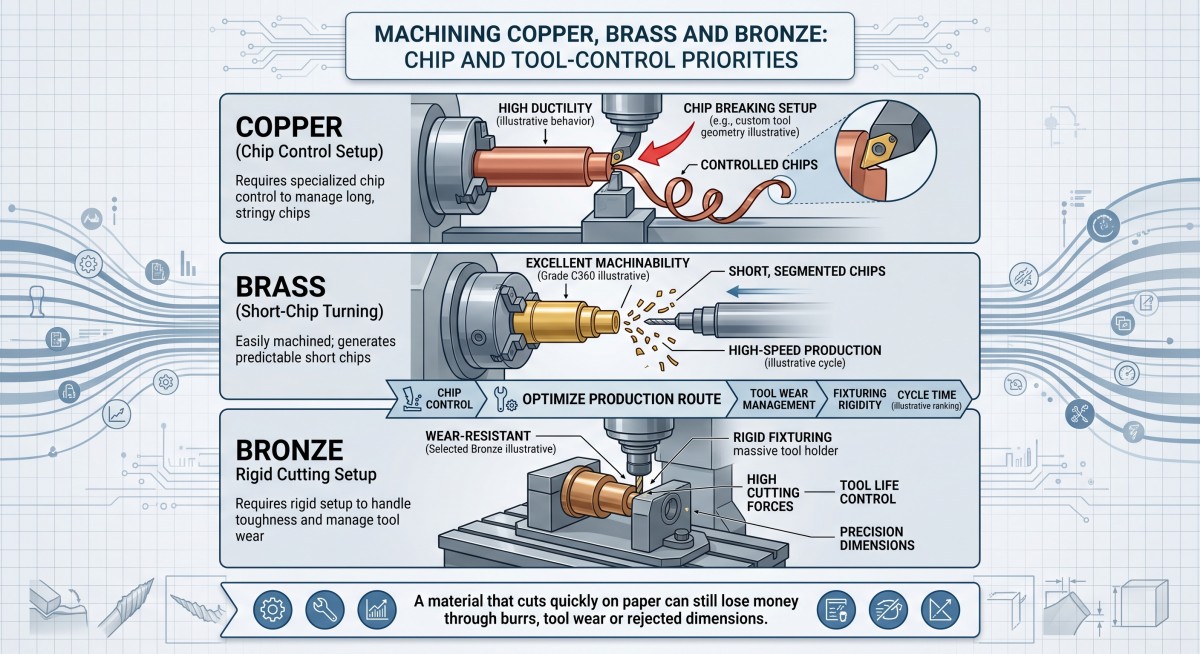
Machinability is a production behavior, not a marketing adjective. It includes chip formation, tool wear, burrs, surface finish, dimensional drift, coolant compatibility and the cycle time required to make an accepted part.
Pure Copper
Pure copper is ductile and thermally conductive. It can smear on a tool, form long chips and deform when the workholding is too aggressive. Sharp, polished tools, positive geometry, secure support and disciplined chip evacuation usually matter more than simply increasing spindle speed. Internal bores and thin walls deserve a separate trial because the material can spring or distort after unclamping.
Brass
Free-machining C36000 is popular for turned and milled parts because it tends to form short, manageable chips and supports high material-removal rates. That does not make every brass grade equivalent. C26000 is valued for forming, while H59/H62-type materials and lead-free brasses can cut differently from C36000. Check the actual grade before copying a tool sheet from another project.
If rapid CNC output is the main constraint, compare the blank route with C36000 free-machining brass as a reference point. Ask whether the quoted material is leaded, whether the destination has substance restrictions, and whether the final surface or plating process changes the machining allowance.
Bronze
Bronze machining ranges from straightforward to punishing. Leaded tin bronze can cut relatively well and offers useful bearing behavior. Aluminum bronze and nickel-aluminum bronze are stronger and often more wear-resistant, but they can increase tool wear and heat at the cutting edge. A rigid setup, suitable insert grade, controlled feed and realistic tool-life allowance are part of the material selection.
This is why a shop should not quote only “machining cost per hour.” It should compare cycle time, insert consumption, deburring, inspection and accepted-part yield for the actual geometry. Cymber Metal's fine machining capability can be evaluated against a 2D/3D drawing and the required batch size.
3. Wear Resistance: Define the Contact Before Naming the Alloy
If the component is a bushing, thrust washer, gear, guide or sliding plate, “wear resistant” is not enough information. State the load, speed, pressure-velocity (PV) condition, lubrication, mating material, temperature, contamination and allowable wear depth.
Pure copper often performs well electrically but is not a default dry-sliding bearing material. Its relatively low hardness can lead to galling, adhesive transfer or rapid surface damage when the counterface and lubrication are unfavorable.
Brass can be suitable for light or moderate-duty mechanical parts, fittings and low-load sliding interfaces. Its machinability can be attractive, but a free-machining grade should not be promoted as a heavy-load bronze substitute. In hot chloride service, some brasses also require a specific review for dezincification or other corrosion mechanisms.
Bronze gives engineers a wider wear toolbox:
- C93200 leaded tin bronze: useful where conformability, embeddability and machinable bearing surfaces matter; confirm lead-related compliance for the destination and application.
- C95400 aluminum bronze: higher strength and wear potential for demanding mechanical parts, with machining and corrosion conditions to be reviewed together.
- C63000 nickel-aluminum bronze: a candidate for high-load or marine-related duty when seawater chemistry, velocity, cathodic protection and mating materials are defined.
- C51000/C51900/C52100 phosphor bronze: spring and fatigue behavior with moderate conductivity; the temper is often as important as the nominal alloy.
For a component where wear is the primary failure mode, compare wear-resistant C95400 aluminum bronze plate and C63000 nickel-aluminum bronze against the drawing and service environment. For finished bearing geometry, use a qualified bronze machining route and verify the final dimensions after processing.
Do not approve a bronze grade from hardness alone. A harder surface can damage the mating shaft, trap abrasive particles or fail to embed debris. A valid comparison uses the actual pair and the actual lubrication regime. When the application is safety-critical or failure data are sparse, require a defined wear test rather than a generic family claim.
4. Grade and Application Map
Use this map to narrow the RFQ, not to skip engineering review.
| Application priority | First family to screen | Grades or forms to discuss | What can invalidate the first choice |
|---|---|---|---|
| Maximum electrical conductivity | Pure copper | C11000, C10200, C10100; plate, rod, strip or busbar | Heat, strength, repeated flexing, joint resistance, welding or oxygen-related requirements |
| High-volume CNC turning | Brass | C36000 or another approved free-machining grade | Lead restrictions, forming requirement, corrosion environment or surface treatment |
| Electrical part that also sees heat and repeated loading | Copper alloy | CuCrZr or another specified high-conductivity alloy | Required conductivity, softening behavior, welding process and standard |
| Bearing, bushing or thrust washer | Bronze | C93200, phosphor bronze, C95400 or C63000 as appropriate | PV load, lubrication, shaft material, contamination and corrosion |
| Marine or seawater mechanical duty | Bronze or cupronickel family | C63000, C95400 or cupronickel candidates | Seawater velocity, galvanic coupling, cathodic protection and exact standard |
| Formed connector or decorative/mechanical fitting | Brass | C26000, C26800, C37700 or approved equivalent | Spring requirement, conductivity, dezincification risk or regulatory limits |
The site’s bronze category provides a useful family-level reference for spring and fatigue applications. Do not transfer a temper, conductivity value or tolerance from one product form to another without checking the invoked standard.
5. Compare Total Landed Cost, Not Just the Metal Rate
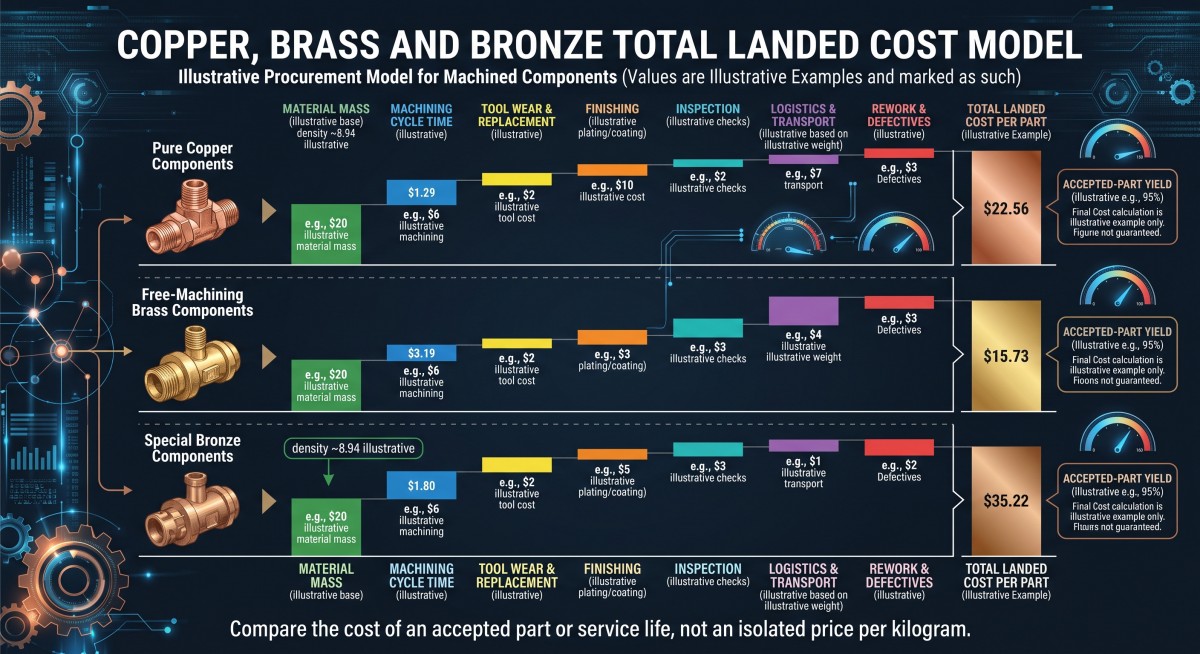
The cheapest material per kilogram can become the most expensive accepted part. Density, buy-to-fly ratio, cycle time, tool life, finishing, inspection and rejected pieces all change the commercial result.
Use a common basis:
Landed cost per accepted part = (material + conversion + tooling + finishing + inspection and documents + packing + inland/export freight, insurance, duty and expected rework − agreed scrap credit) / accepted finished quantity
Keep the process boundaries visible. A brass supplier quoting a near-net blank may look cheaper than a copper supplier quoting a finished machined component, but the two numbers are not comparable. Conversely, a bronze blank with higher material cost can win if it doubles service life and removes an unplanned replacement shutdown.
For a first-pass estimate, approximate densities are about 8.9 g/cm³ for copper, 8.4–8.7 g/cm³ for many brasses and 8.7–8.9 g/cm³ for many bronzes. These are planning values, not a substitute for the certified alloy density or the supplier’s measured mass per metre (kg/m) for the specified section. Compare equal functional output: cost per accepted part, cost per usable metre, cost per ampacity or cost per operating hour.
Ask for the assumptions behind any “saving” claim:
- Is the material price indexed to a named copper, zinc or tin reference, with clear quotation dates and alloy premiums?
- Does the machining estimate include setup, tool changes, deburring and inspection?
- Is yield calculated on accepted parts or only on pieces started?
- Are plating, heat treatment, cleaning and packaging included?
- Who owns scrap, and what credit is actually agreed?
- Does the comparison include compliance documents and destination-specific restrictions?
A common commercial mistake is saving a few cents on raw material, then paying for an extra operation on every part. Put the cost model beside the drawing before approving the alloy.
6. Inspection and Documentation: Make the Comparison Contractual
A supplier can quote the right family and still deliver the wrong condition. Freeze the evidence before production:
| RFQ or purchase-order item | What to define | Why it matters |
|---|---|---|
| Alloy identity | UNS/EN/JIS/GB designation, chemistry limits and approved equivalents | “Copper,” “brass” and “bronze” are family names, not acceptance grades |
| Product form | Plate, sheet, bar, rod, tube, strip, profile or finished part | The applicable standard and test location can change with form |
| Temper/condition | Annealed, half-hard, hard, drawn, stress-relieved or defined casting condition | Conductivity, strength, spring response and machining behavior depend on condition |
| Functional requirements | Current, temperature, load, speed, PV, lubrication, corrosion and mating material | A generic property ranking cannot replace duty data |
| Dimensions and CTQs | Drawing revision, datums, tolerance, flatness, hole position, surface finish and allowance | Material compliance does not prove final-part geometry |
| Test plan | Conductivity/resistivity method, hardness or mechanical tests, wear test, sampling and records | “Passed inspection” is not a reproducible requirement |
| Traceability | Heat/cast/batch/coil/lot identifier linked to the MTC and package labels | Prevents a certificate from becoming detached from the delivered metal |
| Regulatory documents | MTC, third-party inspection, RoHS, REACH or other destination-specific evidence | Leaded brass/bronze and other alloying elements can trigger restrictions |
For supplier-background evidence, review Cymber Metal's CNC and EDM equipment and quality certification and inspection pages. They provide capability context; they do not replace the order-specific MTC, dimensional report or agreed acceptance plan.
7. A Practical Selection Workflow
Use this sequence in the design review:
- Define the failure mode. Is the risk overheating, galling, abrasive wear, fatigue, corrosion, distortion or excessive machining cost?
- Set the non-negotiable property. Write the conductivity, temperature, load, speed, wear limit or dimensional CTQ as a measurable requirement.
- Shortlist the family. Pure copper, brass, tin/phosphor bronze, aluminum bronze or nickel-aluminum bronze.
- Choose the grade and condition. Name the exact UNS or equivalent designation, standard and temper.
- Select the production route. Compare saw-cut stock, extrusion, casting, forging and CNC machining against volume and geometry.
- Run a representative sample. Inspect the final surface and critical dimensions after all required operations, not only the raw blank.
- Price the accepted result. Include yield, tool life, finishing, documents, freight and rework.
- Freeze the RFQ. Send the drawing, quantity, application conditions, inspection plan and destination to the supplier.
For multi-process work, coordinate material sourcing, cutting, machining, inspection and export delivery as one documented process. Current availability, MOQ, timing and documentation must be confirmed for the actual order.
What to Include in Your RFQ
Send the same technical boundary to every supplier:
- Exact alloy and equivalent standard, if any.
- Product form, dimensions, weight or cut length.
- Temper/condition and required conductivity or mechanical properties.
- 2D drawing, 3D model, datum scheme and revision.
- Critical tolerances, surface finish, plating or heat-treatment requirements.
- Current, temperature, load, speed, PV, lubrication and corrosion environment.
- Quantity for sample, first release, annual demand and program duration.
- Machining, forming, extrusion, forging, casting, cutting and deburring scope.
- MTC, third-party inspection, RoHS, REACH, FAI/PPAP or other document needs.
- Sampling plan, test methods, nonconformance and replacement procedure.
- Packing, package mass, labels, destination, Incoterm and arrival target.
- Whether the comparison should be raw material, finished part or total landed cost.
For a drawing-based review, contact Cymber Metal for an RFQ with the alloy, form, quantity, critical dimensions, service conditions and document requirements. A supplier can only confirm the practical route after seeing those details.
Bottom Line
Copper is usually the conductivity choice. Brass is often the productivity choice. Bronze is often the wear, load or corrosion choice. But those are starting directions, not automatic approvals.
The winning specification names the grade, condition, product form, test method and final process. It also compares the cost of accepted parts over the real service life. If the part carries current, calculate temperature rise and joint resistance. If it slides, calculate PV and test the mating pair. If it is machined, price chips, tools, burrs and inspection—not only the blank.
Frequently Asked Questions
Usually, yes. Commercially pure copper is normally the highest-conductivity choice because brass and bronze add zinc, tin, aluminum, nickel or other elements for strength and wear. A reported value still depends on grade, temper, product form, temperature and test method. Use the invoked standard and the supplier’s lot-specific result instead of a family-wide minimum.
C36000 free-machining brass is commonly the easiest of these three families for high-volume turning. Pure copper can produce gummy chips and burrs, while many aluminum and nickel-aluminum bronzes increase tool wear. Lead-free brass and different tempers can behave differently from C36000, so validate the actual grade and geometry with a representative trial.
No. Bronze is a broad family, and wear depends on load, speed, lubrication, counterface, temperature and contamination. C93200, C95400, C63000 and phosphor bronzes solve different bearing, strength and corrosion problems. A free-machining brass may be adequate for a light-duty fitting but unsuitable for a high-PV bushing.
Start with a bearing-grade bronze review, then check the PV condition, shaft material, lubrication, clearance and allowable wear. C93200 can offer useful conformability and machinability; aluminum and nickel-aluminum bronzes can offer higher strength and wear potential. Pure copper or brass should not be selected for a loaded sliding interface from conductivity or machining data alone.
There is no family-wide answer. Nickel-aluminum bronze and cupronickel are common candidates for marine duty, while some brasses need careful review for dezincification and galvanic interaction. Seawater chemistry, velocity, cathodic protection, temperature, mating materials and the governing standard must be part of the selection.
Not reliably. Density, section size, material utilization, machining cycle, tool life, finishing, inspection, freight, duty, scrap and replacement risk can outweigh the raw metal rate. Ask suppliers to quote the same dimensions and process boundary, then compare landed cost per accepted part or expected service life.
No. Conductivity does not uniquely identify C10100, C10200 or C11000, and it does not prove dimensions, temper, oxygen content, surface condition or traceability. For oxygen-related requirements, use an appropriate chemistry or oxygen test and a lot-linked certificate; do not rely on a quick surface reading alone.
Requirements vary, but buyers commonly request a lot-linked MTC, dimensional and visual inspection report, conductivity or mechanical test record where specified, drawing and revision reference, packing list and any named regulatory or third-party documents. State who validates each document and how the package label connects to the production lot.
Provide the exact alloy if known, product form, dimensions, tolerance, quantity, machining or forming route, electrical or mechanical duty, load and speed, lubrication, corrosion environment, surface treatment, certificates, destination and schedule. A drawing and a short description of the failure risk are more useful than “best material” or “lowest price.”
Post time: Sep-03-2026