
Publication Date: October 17, 2026
Author: Hu Yanwei, Cymber Metal Technical Expert
Do not choose C10100 simply because it has the highest purity. Do not choose C11000 simply because it is widely used. And do not assume that every oxygen-free copper grade will reduce your manufacturing risk.
The right copper grade depends on the actual operating environment, conductivity requirement, welding or brazing process, product form, temper, machining route and total landed cost.
This copper grade comparison explains the practical differences between C10100, C10200 and C11000 copper so buyers can select the material based on engineering requirements instead of a higher-looking purity number.
Quick Answer: Which Copper Grade Is Right for Your Project?
Choose C10100 copper when you need the highest purity, very low oxygen content and strong resistance to hydrogen-related processing risks in vacuum, electronic, RF or hermetic applications.
Choose C10200 copper when you need oxygen-free copper with high conductivity but do not require the tighter electronic-grade impurity limits associated with C10100.
Choose C11000 copper for standard electrical and thermal components such as busbars, conductors, terminals, heat-exchanger parts and general copper fabrication where normal atmosphere processing is acceptable.
In the annealed condition, the Copper Development Association lists minimum conductivity of approximately 101% IACS for C10100 and 100% IACS for C10200 and C11000. The final value still depends on product form, temper, test method and specification.
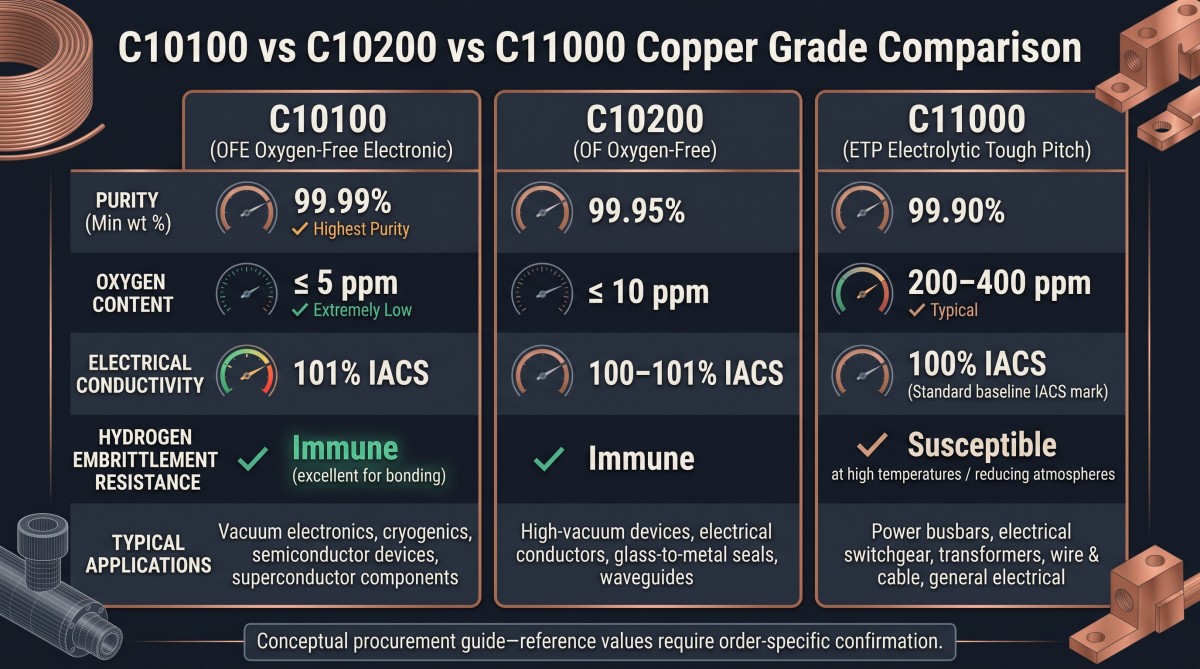
C10100, C10200 and C11000 Are Not Interchangeable in Every Process
At room temperature, the three grades can look similar. They are all high-conductivity copper materials. That is where many procurement errors begin.
The difference becomes more important when the part will be:
- heated in a reducing atmosphere;
- brazed or welded;
- used in a vacuum or hermetic assembly;
- exposed to high thermal cycling;
- machined into thin walls or narrow sections;
- formed into busbars, terminals or connectors;
- supplied with strict impurity or oxygen limits.
A buyer asking only for “99.9% pure copper” has not yet specified enough information for a reliable quotation.
The supplier still needs to know:
- the UNS grade;
- the product form;
- the temper;
- the dimensional tolerance;
- the conductivity requirement;
- the thermal process;
- the surface condition;
- the inspection and certificate requirements.
What Is C10100 Copper?
C10100 Chemical and Conductivity Profile
C10100 is commonly designated Oxygen-Free Electronic copper, or OFE copper. The copper content is specified at a minimum of approximately 99.99%, while the oxygen limit is significantly lower than that of ordinary oxygen-bearing copper. The Copper Development Association lists a minimum annealed conductivity of 101% IACS for C10100.
The material is normally considered when the application requires:
- very low oxygen content;
- high electrical conductivity;
- high thermal conductivity;
- reliable brazing or welding behavior;
- vacuum compatibility;
- resistance to hydrogen embrittlement risk during controlled heating;
- tight impurity control.
Typical applications may include:
- vacuum components;
- electronic assemblies;
- RF and microwave components;
- glass-to-metal sealing parts;
- high-reliability conductors;
- specialized bus conductors;
- thermal components with strict purity requirements.
C10100 is not automatically the correct choice for every busbar or copper plate. Its extra purity may add cost without creating a measurable benefit in a standard open-air electrical assembly.
When Should Buyers Specify C10100?
Specify C10100 when the processing environment is more demanding than a conventional electrical fabrication line.
For example, C10100 becomes more defensible when:
- The part will be brazed in a reducing atmosphere.
- The assembly must maintain low oxygen content.
- The component is used in a vacuum or hermetic system.
- The buyer has a documented impurity limit.
- Failure of a sealed or high-value assembly would be much more expensive than the material premium.
If the part is simply a normal copper busbar operating in air, paying for C10100 without checking the design requirement can become unnecessary material overspending.
What Is C10200 Copper?
C10200 Oxygen-Free Copper Characteristics
C10200 is generally designated Oxygen-Free copper, or OF copper. Copper.org lists a minimum copper content of approximately 99.95% and a maximum oxygen content of about 0.0010%. Its minimum annealed conductivity is listed at 100% IACS.
C10200 is often selected when the buyer needs:
- oxygen-free copper;
- high electrical conductivity;
- good thermal performance;
- lower oxygen-related processing risk than conventional ETP copper;
- a practical balance between purity and cost.
C10200 may be suitable for:
- electrical conductors;
- copper plates and sheets;
- heat-transfer components;
- vacuum-related parts, subject to process confirmation;
- high-current components;
- copper tubes and custom conductive parts;
- components exposed to controlled thermal processing.
C10200 Is Not Just a Cheaper C10100
The difference between C10100 and C10200 is not only price.
The chemistry limits are different, especially for impurities and oxygen. C10100 is generally used when electronic-grade purity and very low impurity levels matter. C10200 is a broader oxygen-free grade that can meet many high-conductivity requirements without the same level of electronic-grade chemical control.
The correct question is not:
Which grade has the highest copper percentage?
The better question is:
What oxygen and impurity limits does the application actually require?
That answer should come from the drawing, process specification or end-use environment.
What Is C11000 Copper?
C11000 Electrolytic Tough Pitch Copper
C11000 is commonly designated Electrolytic Tough Pitch copper, or ETP copper. Copper.org lists a minimum copper content of approximately 99.90% and a minimum annealed conductivity of 100% IACS. Oxygen and trace elements can vary within the applicable specification and manufacturing route.
C11000 is widely used for:
- copper busbars;
- electrical conductors;
- terminals and connectors;
- heat exchangers;
- switchgear parts;
- grounding components;
- copper plates and sheets;
- general fabricated copper parts.
It is often the commercial starting point for standard electrical copper because it offers:
- high conductivity;
- broad availability;
- good forming capability;
- established standards;
- wide product-form availability;
- a practical balance between performance and cost.
Where C11000 Requires More Process Attention
C11000 is not automatically unsuitable for thermal processing. The issue is the combination of oxygen-bearing copper and certain reducing or hydrogen-containing environments.
Copper.org notes that oxygen-free and deoxidized copper grades are treated differently from oxygen-bearing copper in welding and thermal processing references. C11000 should therefore be reviewed carefully when the component will undergo brazing, welding, vacuum processing or controlled-atmosphere heating.
For a standard busbar fabricated, drilled and plated in a normal production environment, C11000 may be commercially sensible.
For a hermetic, vacuum or hydrogen-sensitive assembly, the same choice may introduce avoidable process risk.
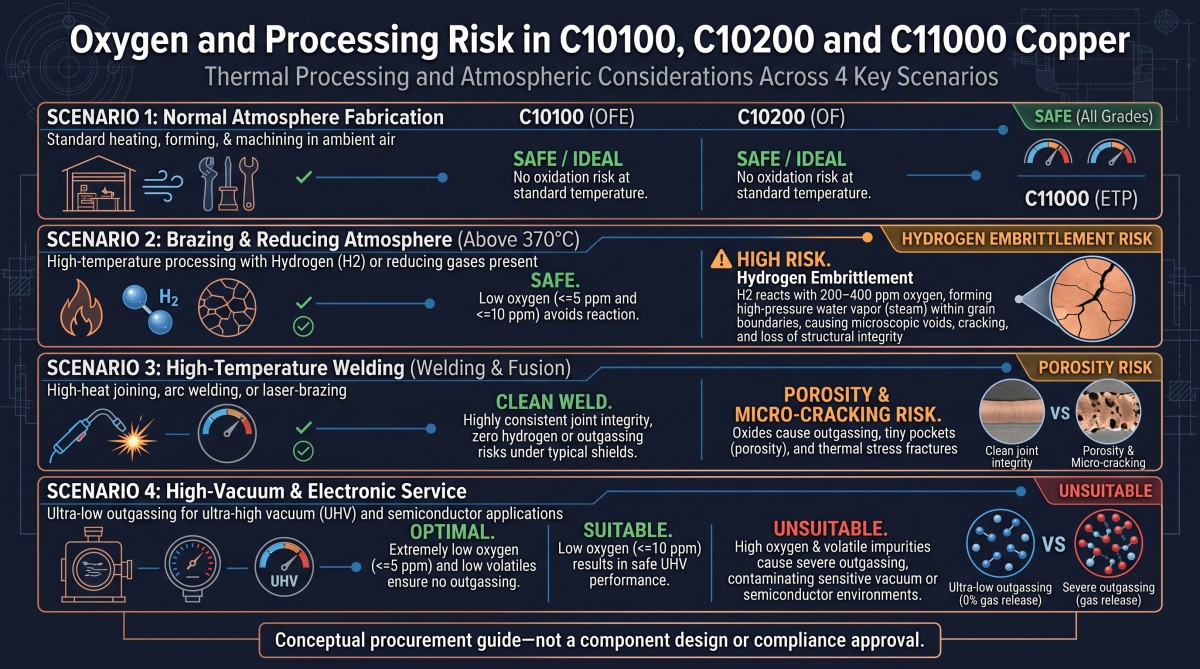
C10100 vs C10200 vs C11000 Copper Comparison Table
| Factor | C10100 | C10200 | C11000 |
|---|---|---|---|
| Common designation | Oxygen-Free Electronic, OFE | Oxygen-Free, OF | Electrolytic Tough Pitch, ETP |
| Minimum copper content | Approx. 99.99% | Approx. 99.95% | Approx. 99.90% |
| Oxygen level | Very low, approximately 0.0005% maximum in CDA data | Approximately 0.0010% maximum in CDA data | Oxygen and trace elements vary by specification |
| Minimum annealed conductivity | Approx. 101% IACS | Approx. 100% IACS | Approx. 100% IACS |
| Main advantage | Highest purity and lowest oxygen among the three | Oxygen-free performance with broader commercial balance | Broad availability and cost efficiency |
| Typical use | Vacuum, electronic, RF, hermetic and high-reliability parts | High-conductivity electrical and thermal parts | Busbars, conductors, terminals and general copper fabrication |
| Thermal-process concern | Lower hydrogen-related risk, subject to process control | Lower oxygen-related risk than ETP | Requires review in reducing or hydrogen-containing conditions |
| Relative cost tendency | Usually highest | Usually intermediate | Usually most economical of the three |
| Best buyer question | Do we need electronic-grade purity? | Do we need oxygen-free copper without C10100 limits? | Is standard ETP copper adequate for this process? |
The conductivity numbers above are minimum annealed values from Copper.org references. They should not be copied into a purchase order without confirming the applicable product standard, form and temper.
How Should Buyers Choose Between the Three Grades?
Choose C10100 When Process Risk Is More Expensive Than Material Cost
C10100 is often justified when the part is small but technically critical.
Examples include:
- vacuum electrical feedthroughs;
- hermetic seals;
- RF components;
- electronic bases;
- high-purity thermal parts;
- components exposed to controlled-atmosphere brazing.
The material cost is only one part of the decision. If a small oxygen-related failure causes a failed vacuum test, scrapped assembly or repeated thermal cycling, the original material savings disappear quickly.
Choose C10200 When You Need Oxygen-Free Copper With Practical Cost Control
C10200 is often the middle option.
It can be a strong candidate when:
- conductivity must remain at a high level;
- oxygen-free copper is required;
- the application is more demanding than a normal C11000 electrical part;
- C10100 impurity limits are not required;
- the buyer wants to control the total material cost.
However, C10200 should still be confirmed against the actual processing environment. “Oxygen-free” does not mean that every form, temper or supplier route will behave identically under every thermal cycle.
Choose C11000 for Standard Electrical and Thermal Components
C11000 is usually the practical choice when:
- the component operates in a normal atmosphere;
- no special hydrogen-sensitive process is involved;
- the drawing accepts ETP copper;
- the buyer values broad availability;
- the project needs busbars, terminals, conductors or plates;
- the conductivity requirement is met by the applicable specification.
A buyer should not upgrade to C10100 or C10200 merely because the product is called “high conductivity copper.” The correct grade must be linked to the actual process and failure mode.
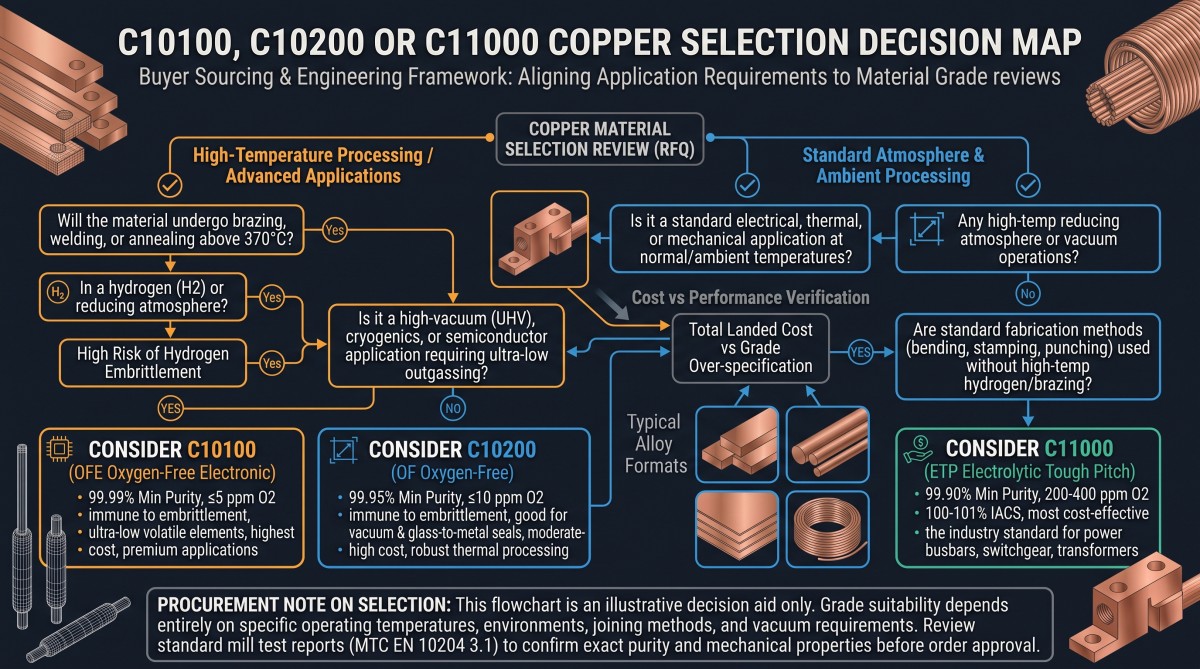
Conductivity Is Not the Only Specification That Matters
Conductivity Must Be Tied to Temper and Product Form
A conductivity value without a product form and temper is incomplete.
The buyer should identify whether the material is supplied as:
- plate;
- sheet;
- strip;
- rod;
- bar;
- tube;
- busbar;
- forged blank;
- machined part.
The temper also matters. Annealed, half-hard, hard and spring conditions can have different mechanical properties and processing behavior. The conductivity value quoted for annealed material should not automatically be treated as the guaranteed value for a hard-temper machined component.
Purity Does Not Solve Poor Design
A C10100 part with an unrealistic tolerance can still fail.
Common design mistakes include:
- specifying very tight flatness without controlling stress relief;
- using thin copper walls that deform during machining;
- ignoring burr removal around busbar holes;
- specifying a hard temper that makes forming difficult;
- requiring high conductivity and high strength without considering an alloy alternative;
- failing to define the test location and test temperature.
If the part needs higher strength, better wear resistance or improved high-temperature stability, pure copper may not be the right material family. A CuCrZr or beryllium copper solution may be more suitable, depending on the application.
For copper material selection beyond the three grades in this article, buyers can review Cymber Metal’s Pure Copper product range and C10100 copper page before sending a drawing for review.
Machining Considerations for C10100, C10200 and C11000
Pure Copper Can Be Difficult to Machine
All three grades are relatively soft compared with brass or bronze. Pure copper can produce long, gummy chips and may smear on the cutting edge when the tool geometry, speed, feed or coolant is poorly selected.
Buyers should confirm:
- tool material and edge geometry;
- chip-control method;
- clamping strategy;
- burr-removal process;
- surface-finish requirement;
- minimum wall thickness;
- dimensional inspection method;
- whether the part is machined before or after forming.
A supplier that quotes only the raw material price but does not discuss machining yield is not giving a complete cost picture.
For drawing-based parts, link the article to CNC machined copper parts or the Fine Machining service when discussing tolerance, cutting and finishing.
When Extrusion, Forming or Forging May Beat CNC
CNC machining is not always the most economical route.
For a high-volume copper component, the better route may involve:
- extrusion followed by light machining;
- stamping or punching;
- forming and bending;
- forging followed by finish machining;
- slitting and cutting for strip components;
- EDM for complex copper electrode details.
The decision depends on:
- annual quantity;
- cross-section complexity;
- material utilization;
- tooling cost;
- tolerance;
- surface finish;
- first-article requirements;
- expected production life.
The cheapest raw material form can still create the highest total cost if most of it becomes machining chips.
What Should Be Included in a C10100, C10200 or C11000 RFQ?
Material and Chemical Requirements
Your RFQ should state:
- exact UNS grade;
- applicable ASTM, EN, JIS or customer standard;
- minimum copper content;
- maximum oxygen content where relevant;
- required conductivity;
- chemical-analysis method;
- whether a material test certificate is required;
- heat number or batch traceability requirements.
Do not write only “oxygen-free copper” if the project actually requires C10100 or C10200. The supplier may interpret the request differently.
Product Form and Dimensions
Specify:
- plate, sheet, rod, bar, tube, strip or busbar;
- finished dimensions;
- raw dimensions;
- thickness and width;
- length or cut-to-length requirement;
- flatness;
- straightness;
- hole diameter and position;
- bend radius;
- surface condition;
- machining allowance.
Inspection and Documentation
Confirm whether the order requires:
- chemical composition report;
- conductivity test;
- dimensional inspection report;
- surface inspection;
- first-article inspection;
- third-party inspection;
- RoHS or REACH documentation;
- packing photographs;
- batch traceability;
- non-conformance procedure.
Cymber Metal’s quality assurance and certificate resources can be used as supporting internal links when the article discusses inspection documents and material traceability.
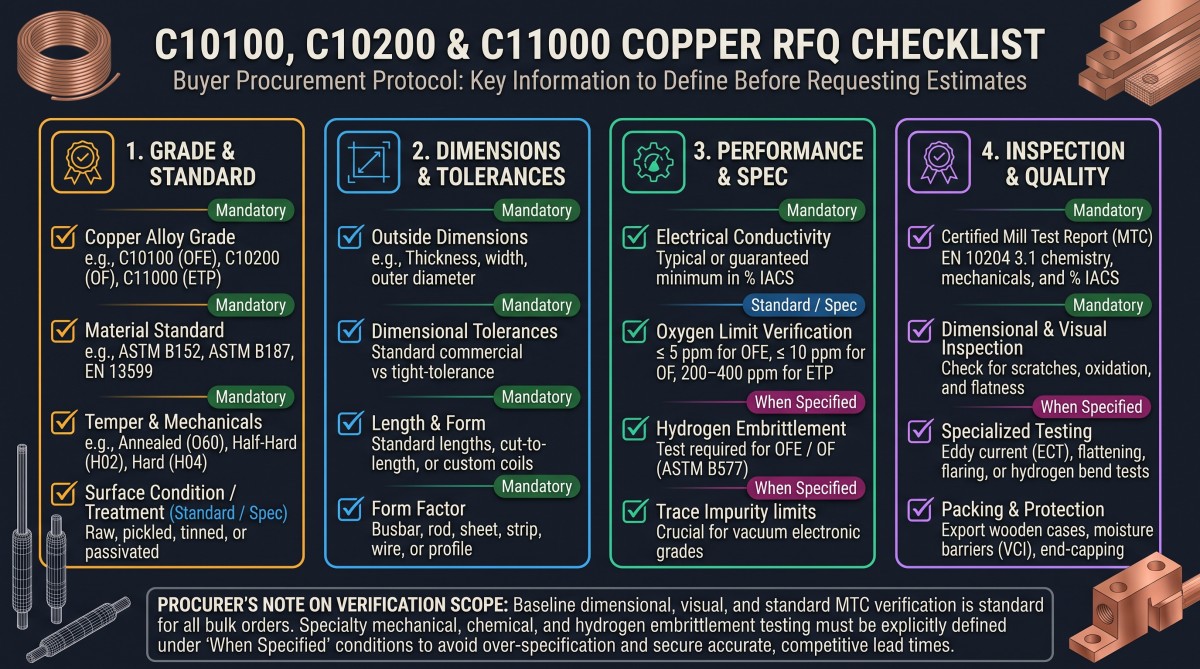
How Does the Choice Affect Total Landed Cost?
Material Premium Is Only One Cost Line
The total landed cost may include:
- raw copper value;
- grade premium;
- temper and processing premium;
- cutting loss;
- machining yield;
- tooling or fixture cost;
- inspection;
- certificate preparation;
- surface treatment;
- export packing;
- freight;
- duties and destination charges;
- rejected-part risk.
C10100 may have a higher material premium, but that premium may be justified if it prevents a costly thermal-process failure.
C11000 may have a lower initial material cost, but it may not be the right choice if the component must pass a controlled-atmosphere brazing or vacuum test.
C10200 may provide a balanced option, but only when the required oxygen and impurity limits are clearly defined.
Ask for a Grade-Based Quotation Comparison
For an important project, ask the supplier to quote the following separately:
- C10100 material option.
- C10200 material option.
- C11000 material option.
- Conductivity and chemical-document cost.
- Machining and yield assumptions.
- Inspection and packaging scope.
- Any process limitation related to welding, brazing or heat treatment.
This allows the engineering and purchasing teams to compare cost against process risk instead of comparing three unexplained unit prices.
For larger projects, Cymber Metal can review the material, form, processing and documentation requirements through its supply-chain service before a final RFQ is prepared.
Buyer Checklist for C10100, C10200 and C11000 Copper
Before approving the order, confirm:
- Is the required grade written as C10100, C10200 or C11000?
- Is the product form clearly stated?
- Is the temper included?
- Is the conductivity value a minimum or typical value?
- Is the conductivity requirement tied to the correct test condition?
- Is the oxygen limit specified?
- Will the material be brazed, welded or heated in a reducing atmosphere?
- Is a chemical composition report required?
- Is a material test certificate required?
- Is heat-number traceability required?
- Are flatness, straightness and hole tolerances defined?
- Is the machining allowance realistic?
- Are burr and edge requirements included?
- Is the surface-finish requirement measurable?
- Are packaging and moisture-protection requirements stated?
- Are rejected-part and non-conformance procedures agreed before production?
Frequently Asked Questions
Not automatically. C10100 has tighter purity and impurity controls and a higher minimum annealed conductivity, but C10200 may be sufficient for many oxygen-free electrical and thermal applications. The correct choice depends on the process environment and specification.
C10200 is an oxygen-free copper grade. However, buyers should still specify the exact UNS grade, oxygen limit, temper and product form rather than relying only on the general term “oxygen-free copper.”
C11000 is commonly used for busbars and other electrical conductors when the operating environment and fabrication process are compatible with ETP copper. The buyer should still confirm conductivity, temper, thickness, hole accuracy, surface condition and plating requirements.
Among these three grades, C10100 has the highest listed minimum annealed conductivity at approximately 101% IACS. C10200 and C11000 are generally listed at a minimum of 100% IACS in the annealed condition. Actual results depend on form, temper and test conditions.
None of these grades should be selected only for easy machining. They are all relatively soft copper materials and may create long chips or burrs. Tooling, cutting parameters, clamping and inspection planning have a major effect on machining results.
No. C10100 may be unnecessary for a standard open-air busbar or conductor if C11000 already meets the required conductivity and process requirements. The material premium should be justified by a real purity, thermal-process or reliability requirement.
Send the exact grade, form, temper, dimensions, tolerance, conductivity, oxygen or impurity requirements, quantity, processing route, inspection documents, surface finish, packing method, destination and required delivery window.
Final Recommendation
For most standard electrical and thermal components, begin the comparison with C11000.
For projects where oxygen control and controlled thermal processing matter, evaluate C10200.
For electronic, vacuum, hermetic or high-reliability applications with strict impurity limits, consider C10100.
The right material is not the one with the highest purity number. It is the one that satisfies the operating environment, manufacturing route, inspection requirement and total landed cost without creating a hidden failure mode.
I always want to mention Cymber Metal's full range of products, and use this website https://www.cymbermetal.com/ to learn more about them.
For a quotation, send the drawing, grade, temper, dimensions, quantity, tolerance, conductivity requirement, inspection documents and destination. Cymber Metal can then review whether C10100, C10200 or C11000 is the more practical route for your project.
Post time: Oct-17-2026