
Publication Date: September 6, 2026
Author: Hu Yanwei, Cymber Metal Technical Expert
A bulk copper order is not ready for approval just because the price per kilogram looks competitive. First, make the supplier define three things: what quantity the MOQ actually covers, when the delivery clock starts, and how the material will be protected until your receiving team unloads it.
“Available,” “fast delivery” and “standard export packing” are not acceptance criteria.
Ask a harder question: are you buying kilograms of copper, or usable material that arrives with the right dimensions, traceability and processing allowance?
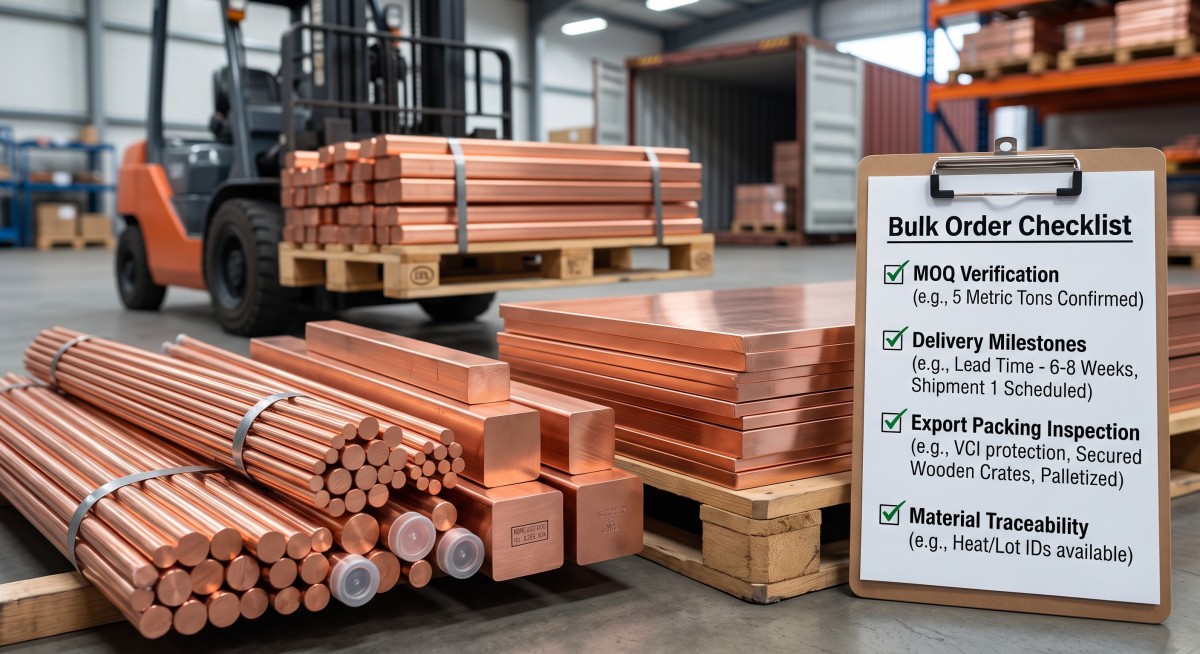
Quick Answer: What Should Buyers Confirm Before a Bulk Copper Order?
Before approving a bulk copper order, confirm the exact grade, product form, condition, dimensions, quantity basis, processing scope, inspection requirements and destination. Require the quotation to state MOQ per line item, the lead-time starting event, the delivery milestone and the packing specification.
Compare stock cutting, custom production and finished-part supply separately. Do not assume that the same MOQ or delivery schedule applies to all three.
For an initial product review, Cymber Metal’s pure copper range includes rods, bars, busbars and plates. Treat these listings as a starting point for an RFQ, not proof that a particular size is currently reserved for your order.
1. Define the Material Before Negotiating the MOQ
Write the grade, product form and governing specification together. A material name alone leaves too much room for interpretation.
For example, ASTM B187/B187M addresses copper bar, bus bar, rod and shapes, while ASTM B152/B152M addresses copper sheet, strip, plate and rolled bar. Select the applicable specification and agreed edition for the actual product rather than copying a list of standards into every purchase order.
Use the following checklist to make each quotation line unambiguous:
| Product form | Information to put in the RFQ | Question to resolve before approval |
|---|---|---|
| Copper rod or round bar | Diameter, length, condition, diameter tolerance, straightness and surface requirement | Is this finished-size material or an oversized machining blank? |
| Square or rectangular bar | Cross-section, length, corner requirements, straightness and twist | Which surfaces and dimensions are functionally critical? |
| Copper plate | Thickness, width, length, flatness, surface condition and edge requirements | Does the quoted thickness include material needed for subsequent machining? |
Attach the drawing revision when one exists. Identify which dimensions are required on delivery and which will be produced later.
For a functional hole requiring an H7 fit, for example, put that requirement on the finished-part drawing. Do not apply a finished-hole tolerance indiscriminately to raw plate or bar.
That distinction belongs in the RFQ—not in an argument after inspection.
2. How Should You Review MOQ for a Bulk Copper Order?
Ask what the MOQ applies to: the complete purchase order, each grade, each size, each production batch or each shipment release.
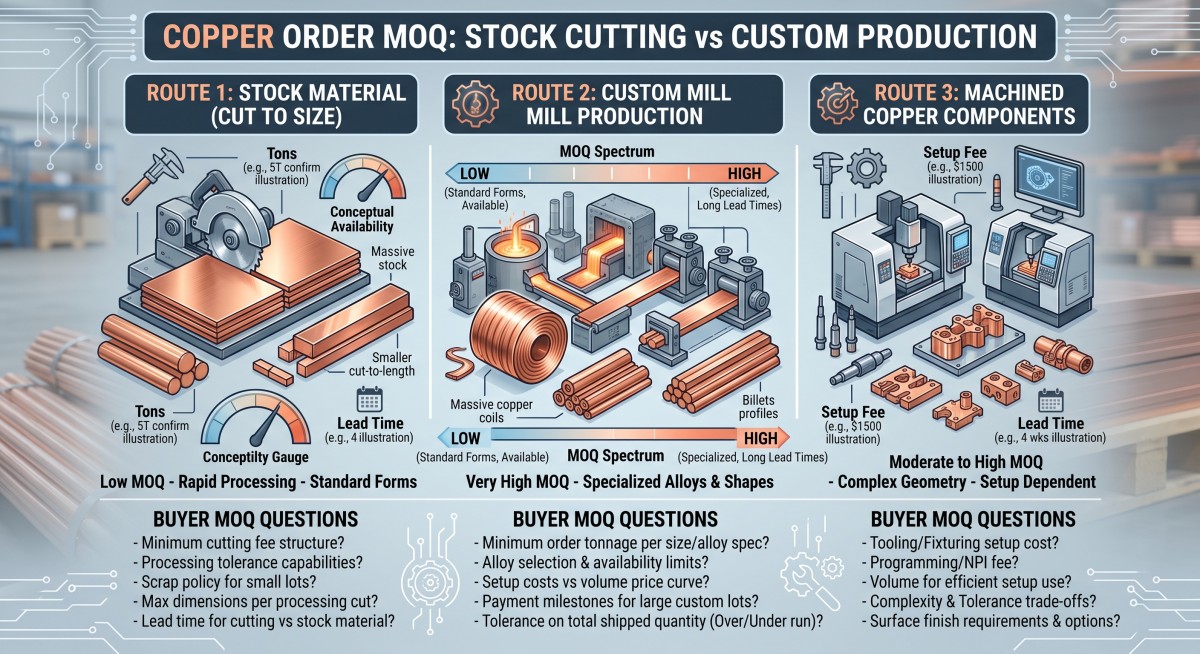
For procurement planning, separate the quotation into three possible routes:
| Supply route | MOQ questions to ask | Commercial issue to resolve |
|---|---|---|
| Existing stock, cut to size | Can an existing rod, bar or plate cover the order? Must you purchase the full parent length or plate? | Remnant ownership, cutting charges and material allocation |
| Custom mill production | Is the minimum tied to one grade, section, condition or production campaign? | Batch commitment, tooling where applicable and acceptable quantity variation |
| Machined or finished components | Is there a material minimum plus a processing or finishing minimum? | Setup charges, sample approval and accepted finished quantity |
Do not assume that combining several items creates one production batch.
Illustrative example—not a Cymber Metal MOQ: an order for 1,000 kg split across five sizes at 200 kg each should be reviewed as five line items. Ask the supplier whether any items can share a production route; do not assume that the total weight satisfies every line’s minimum.
For each item, request:
- Minimum quantity and its unit: kilograms, pieces, parent lengths or plates.
- Quantity variation allowed, if any.
- Cutting, setup or minimum processing charges.
- Treatment of usable remnants and scrap.
- Whether scheduled releases require an upfront material commitment.
A useful negotiation is not simply “reduce the MOQ.” It is: “Which change to the size, supply condition or release plan would make this order more economical?”
3. Define Lead Time With a Starting Event and an Endpoint
Require the quotation to identify when lead time starts and what completion means.
Ask whether the schedule begins after payment, material allocation, drawing approval, sample acceptance or completion of all those conditions.
Then distinguish these milestones:
- Material allocated to the order.
- Cutting or production completed.
- Inspection accepted and documents released.
- Packing completed and goods ready for collection.
- Handover at the agreed delivery point.
- Estimated arrival at the destination.
“Ready for collection” and “received at your factory” are different commitments. Keep them in separate fields.
A practical RFQ instruction is:
Please state the lead-time starting conditions, material-ready date, inspection-release date and cargo-ready date. Quote transport time separately and identify which dates are estimates.
If the supplier offers a sample stage, ask whether the production slot is reserved while your team evaluates it. Also define what happens to the schedule if you change the drawing.
For repeat purchases, request a release plan rather than relying on an annual forecast alone. Specify who owns allocated material, how long it will be held and how later releases will be priced.
4. Compare Material Utilization Before Choosing the Supply Route
Review how much of the purchased material becomes accepted product.
Use this planning calculation:
Material utilization (%) = finished-part mass ÷ purchased blank mass × 100
Consider an illustrative batch:
- Purchased blanks: 1,000 kg
- Accepted finished components: 720 kg
- Material utilization: 72%
- Material outside the accepted components: 280 kg
That remaining mass needs an explanation: reusable remnants, recoverable chips, process losses or rejected components. Do not value all of it automatically at the original purchase price.
Request two comparable offers where practical:
- Raw material supplied with an agreed machining allowance.
- Cut blanks or partially machined material supplied against the drawing.
For a custom extruded section, ask for quoted production yield and tooling charges. For a stock-machining route, ask for blank utilization and conversion cost. Keep those measures separate.
Use a consistent comparison model:
Evaluated cost per accepted part =
(material + conversion + tooling allocation + finishing + inspection + packing + logistics + applicable import costs + expected rework − agreed scrap recovery) ÷ accepted quantity
Do not count an included charge twice, and treat recoverable taxes separately from permanent costs.
The cheaper kilogram is not the decision. The accepted component is.
5. Specify Export Packing by Product Form
Request a packing specification and approval photos, not only the phrase “wooden case.”
Cargo packing should account for transport stresses, load distribution and restraint. The IMO/ILO/UNECE CTU Code specifically addresses concentrated loads and the need to secure cargo against movement. A heavy package with a small footprint requires more thought than simply checking total container payload.
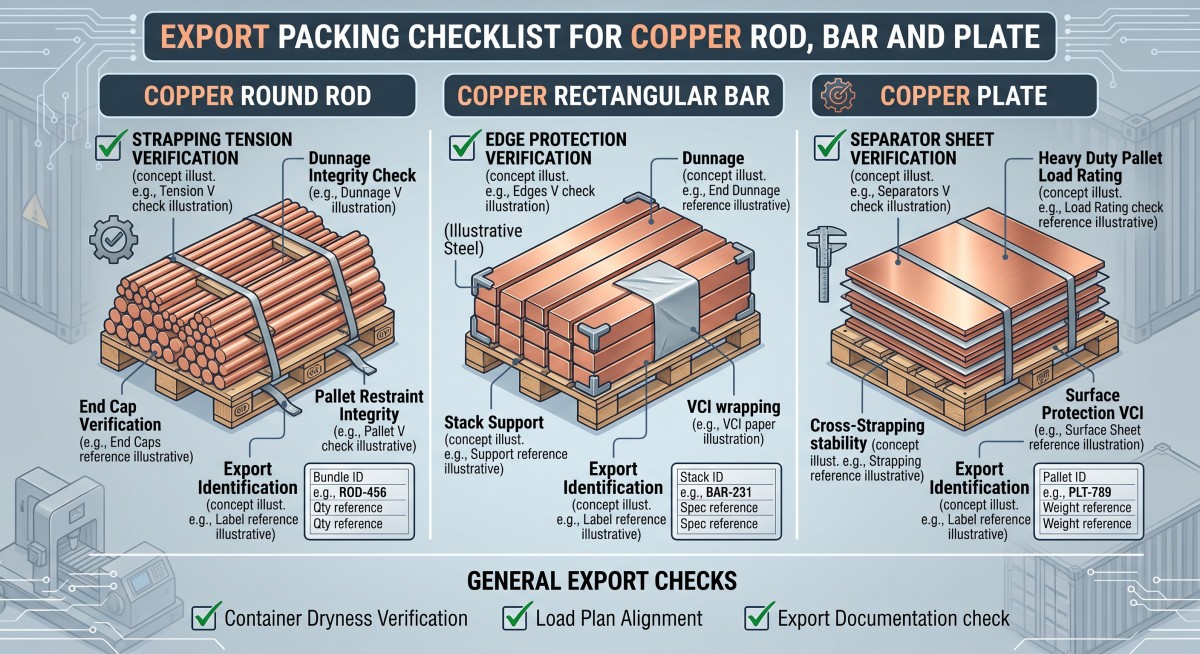
Use this proposed packing checklist with the supplier and forwarder:
| Product form | Protection to request | Evidence to review |
|---|---|---|
| Rods and round bars | Suitable supports, restraint against rolling and longitudinal movement, protected ends | Bundle arrangement and blocking photos |
| Rectangular bars and busbars | Surface separation, edge protection and controlled strap contact | Protection at straps and contact surfaces |
| Plates | Suitable base support, protected faces and edges, restraint against sliding | Base construction and stacked-plate arrangement |
| Machined copper parts | Individual separation and protection of functional surfaces | Internal packing photos before closure |
Also specify:
- Maximum gross weight per package.
- Package dimensions and receiving-forklift limitations.
- Suitable lifting or fork-entry arrangements.
- Package identification linked to the packing list.
- Required moisture protection and storage conditions.
- Restrictions on oils, films or residues where subsequent processing matters.
Do not approve a generic steel-preservation method for copper without checking compatibility with the material and its next process.
A Weight Check Before Packing Approval
The Copper Development Association lists C11000 with a specific gravity of approximately 8.91, corresponding to about 8,910 kg/m³ for this estimate.
For a hypothetical C11000 plate measuring 1,000 × 500 × 20 mm:
Estimated mass = 1.0 × 0.5 × 0.02 × 8,910 = 89.1 kg
Ten such plates would weigh approximately 891 kg net, before adding the crate, supports and protective materials.
This is a calculated planning estimate, not a certified shipping weight. Approve handling arrangements against the actual gross weight and load distribution.
6. Check ISPM 15 Where Wood Packaging Is Used
Review the complete wood-packaging construction, including skids, internal blocks and dunnage.
ISPM 15 covers regulated raw-wood packaging used in international trade and provides for approved treatment and marking. Packaging made wholly from qualifying processed wood, such as plywood, is exempt from its provisions.
The word “wholly” matters.
A plywood-sided case with solid-wood supports should not be assumed exempt merely because its outer panels are plywood. Ask the packing provider to identify any regulated components and confirm the applicable treatment and marking with the forwarder or destination plant-health authority.
Request photos of applicable markings before shipment. Do not treat the commercial phrase “fumigated case” as a complete packaging specification.
7. Match the Delivery Term to the Handover Point
State the delivery rule, named place or port, and rule version in the quotation.
For containerized shipments handed to a carrier at a terminal before vessel loading, ICC guidance recommends considering FCA rather than automatically using FOB. FOB relates to delivery on board the vessel; the right choice depends on the agreed transport and handover arrangement.
An RFQ field can read:
Proposed delivery basis: FCA [precise named place], Incoterms® 2020. Please identify the included transport and handling charges.
Ask the supplier and forwarder to make exclusions explicit. Keep cargo insurance, destination handling and final delivery visible in your comparison.
For product-form discussions before quotation, use the Cymber Metal material catalogs to identify the relevant range, then request confirmation against the order specification.
8. Make Inspection and Traceability Part of Shipment Release
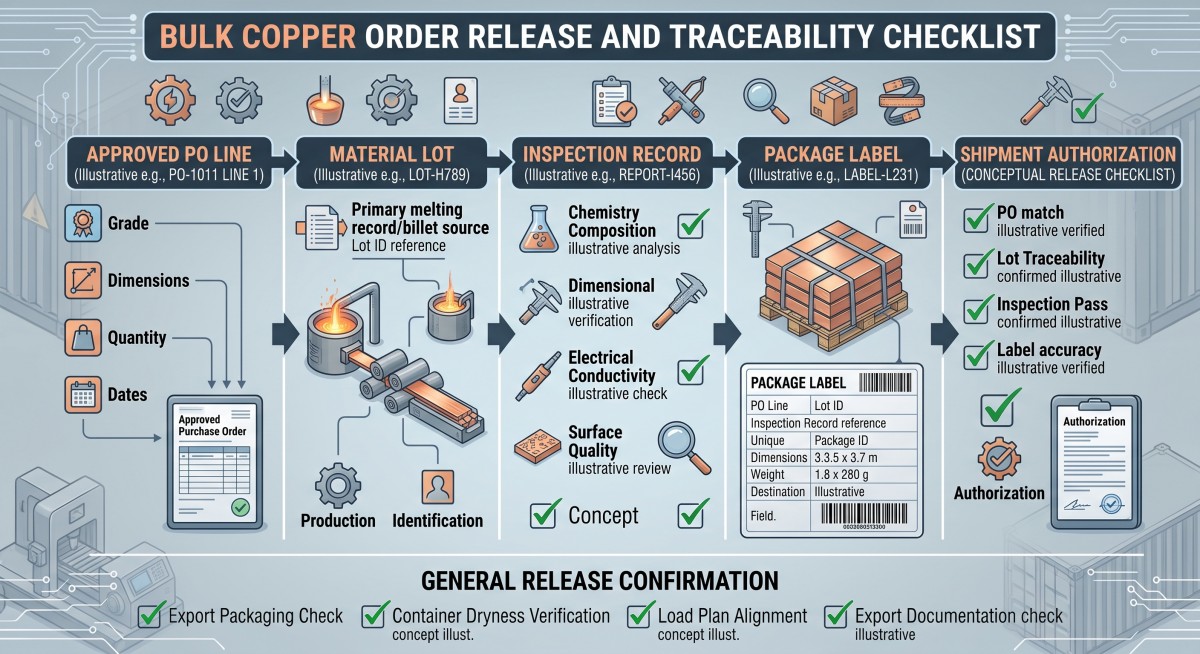
Write the required evidence into the purchase order before production starts.
Use a proposed release checklist covering:
- Grade, specification, condition and lot identification.
- Quantity, dimensions and agreed sampling plan.
- Required material test certificate and order-specific test results.
- Surface and edge acceptance criteria.
- Drawing number and revision, where applicable.
- Package numbers, net weight, gross weight and dimensions.
- Internal packing and final shipment photos.
- Procedure for discrepancies or nonconforming material.
Cymber Metal’s certificate page provides company-level quality-document context. For procurement, request the documents applicable to the specific material lot and purchase order; do not substitute a general website certificate for shipment acceptance evidence.
Make the traceability chain explicit:
Purchase-order line → material lot → inspection record → package label
Require the supplier to explain how that chain will be maintained after cutting or repacking.
9. Send an RFQ That Suppliers Can Actually Compare
Use this template for your next bulk copper order:
Product form: Rod / round bar / rectangular bar / plate
Grade and governing specification:
Temper or supply condition:
Dimensions and tolerances:
Drawing number and revision:
Quantity per size:
Total order and scheduled release quantities:
Cutting or machining scope:
Surface and edge requirements:
Inspection and documentation:
Packing and maximum package weight:
Destination and unloading limitations:
Requested delivery basis:
Required cargo-ready date:
Required destination arrival date:
Quantity variation and remnant requirements:
Send these details through Cymber Metal’s RFQ contact page for an order-specific review. Ask for confirmation of material availability, processing scope, MOQ basis and the delivery schedule before approving the quotation.
Approve the specification, the schedule and the packing plan together. A competitive metal price cannot resolve an undefined order.
Frequently Asked Questions
Request an order-specific MOQ rather than assuming one minimum covers every product. Ask whether it applies per grade, size, condition, production batch or shipment release. For stock cutting, also ask whether you must purchase a full parent length or plate and how the supplier will handle the remaining material.
Require both a starting event and an endpoint. Ask whether the clock begins after payment, drawing approval, material allocation or sample acceptance. Separate production completion, inspection release, cargo readiness and estimated arrival. Record any buyer approvals or transport arrangements that remain outstanding before accepting the schedule.
Request a combined quotation, but have the supplier confirm MOQ and scheduling for each line. A consolidated shipment does not establish that different grades, dimensions or conditions share one production batch. Also request separate labels and inspection references so the receiving team can identify every item.
Request a packing plan addressing base support, surface separation, edge protection, restraint, gross package weight and unloading arrangements. Ask for internal packing photos before the case is closed. Have the packer and forwarder check load distribution and cargo securing for the chosen transport unit.
Packaging made wholly from qualifying processed wood such as plywood is exempt under ISPM 15. However, regulated solid-wood skids, blocks or dunnage must be assessed separately. Check the entire package construction, not just its side panels, and confirm destination requirements before shipment.
Use price per kilogram as one input. For the purchasing decision, compare the same material specification, processing scope, quantity basis and delivery boundary. Include packing, logistics, inspection, usable yield and any agreed scrap recovery. Where the end product is a machined component, calculate the evaluated cost per accepted part.
Post time: Sep-06-2026