
Primary Keyword: bronze bushings suppliers
Publication Date: September 26, 2026
Author: Hu Yanwei, Cymber Metal Technical Expert
The cheapest bronze bushing can become the most expensive part in the machine when the alloy, clearance or lubrication method is wrong.
A bronze bushing may look simple on a drawing. It may only show an inside diameter, outside diameter and length. In actual service, however, the bushing must handle load, sliding speed, temperature, alignment, shaft condition, contamination and maintenance requirements at the same time.
That is why buyers should compare bronze bushings suppliers by engineering control, not only by price per kilogram or price per piece.
A supplier may offer the correct bronze grade but still create problems if the bore tolerance, concentricity, surface finish or lubrication system is not properly controlled.
Quick Answer: What Should Buyers Ask Bronze Bushings Suppliers?
Before approving a bronze bushing supplier, ask:
- Which bronze grade is proposed, and why is it suitable for the application?
- What load, speed and temperature can the bushing experience?
- Is the part solid bronze, cast bronze, sintered bronze or self-lubricating bronze?
- What are the finished bore and outside-diameter tolerances?
- How will concentricity, roundness and wall thickness be inspected?
- What shaft material, hardness and surface finish are required?
- Does the bushing need grease, oil, lubrication grooves or solid lubricant plugs?
- What production route will be used: machining, casting, forming or a combination?
- Will the supplier provide material certificates and dimensional inspection reports?
- Is the quotation based on material cost or total cost per accepted part?
The correct supplier should ask these questions before confirming a final quotation.
1. Bronze Bushing Material Selection Comes Before Price
The bronze alloy determines how the bushing behaves under pressure, sliding speed, temperature, contamination and lubrication.
A buyer who selects a grade only because it is cheaper may save a small amount on material and then lose much more through premature wear, shaft damage, seizure or repeated replacement.
For a general overview, review Cymber Metal’s bronze product range. The final grade should still be confirmed against the drawing and operating conditions.
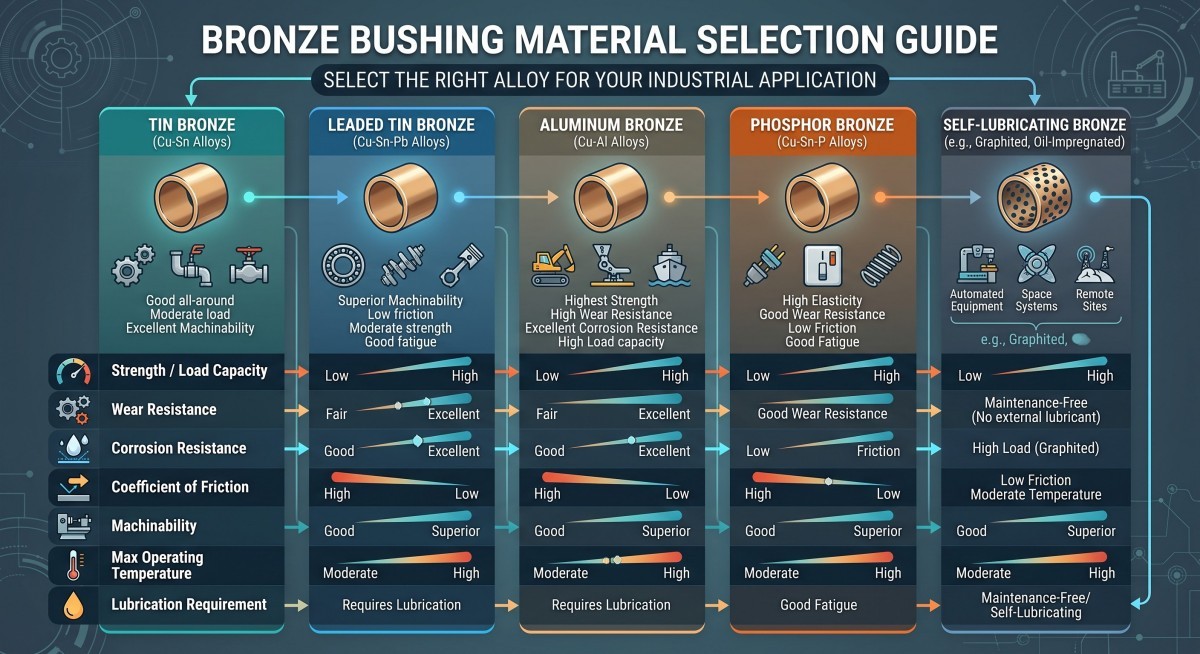
Common Bronze Bushing Material Options
| Material | Why buyers may consider it | What must be confirmed |
|---|---|---|
| Tin bronze | Wear resistance, load support and dimensional stability | Load, speed and lubrication |
| Leaded tin bronze | Machinability and sliding behavior in suitable applications | Compliance, environment and operating conditions |
| Aluminum bronze | Higher strength, wear resistance and corrosion resistance | Machining route, shaft condition and hardness |
| Phosphor bronze | Elasticity, wear resistance and spring-related performance | Strength, conductivity and cycle requirements |
| Graphite-plugged bronze | Reduced dependence on regular grease or oil | Plug layout, load, speed and temperature |
| Sintered bronze | Oil-impregnated operation in suitable applications | Porosity, load, speed and oil retention |
The term “bronze bushing” does not describe one universal material. Two bushings with identical dimensions can have very different service lives if their alloys, clearances or lubrication methods are different.
C93200 Bronze for Sliding and Bearing Applications
Leaded tin bronze such as C93200 may be considered for bearing and bushing applications where machinability and sliding behavior are important.
Cymber Metal lists C93200 leaded tin bronze tube for bearing-grade applications.
For a real order, confirm:
- Radial load
- Sliding speed
- Shaft material and hardness
- Grease or oil type
- Operating temperature
- Permitted wear
- Surface finish
- Environmental and compliance requirements
A grade name alone does not guarantee bushing performance. Material condition, casting quality and final machining condition also matter.
Aluminum Bronze for Heavier Service
Aluminum bronze may be considered when a bushing needs higher strength, wear resistance or resistance to harsh environments.
For example, C95400 machined parts may be relevant to heavy-duty industrial components.
However, aluminum bronze is not an automatic replacement for tin bronze. It may require different cutting tools, machining parameters and finishing methods. The supplier should review the complete component geometry instead of quoting only from the requested alloy name.
2. Choose the Correct Bushing Construction
The structure of the bushing is as important as the alloy.
Solid Machined Bronze Bushings
Solid bronze bushings are commonly machined from tube, bar or cast stock. They may be suitable for:
- Custom dimensions
- Non-standard flange geometry
- Oil holes or grease grooves
- Tight bore control
- Small or medium production quantities
- Prototype and replacement parts
Machining from stock can be practical for complex dimensions and lower volumes. The tradeoff is material removal, machining time and the need to control distortion during boring and finishing.
Cast and Machined Bronze Bushings
For larger sections or higher production quantities, casting followed by machining may reduce material waste.
The buyer should ask how the supplier controls:
- Casting porosity
- Shrinkage
- Segregation
- Hard spots
- Surface defects
- Final machining allowance
- Internal discontinuities
A low machining price does not compensate for unstable casting quality.
Self-Lubricating Bronze Bushings
Self-lubricating designs may use graphite plugs or another solid-lubricant system. Cymber Metal lists maintenance-free aluminum bronze self-lubricating bushings for applications where routine grease or oil supply is difficult.
The buyer should ask:
- What is the actual lubrication mechanism?
- What load and sliding speed are permitted?
- Is the part suitable for continuous rotation or oscillating motion?
- How are lubricant plugs distributed?
- What happens if dust or water enters the sliding interface?
- Does operating temperature affect lubricant performance?
“Maintenance-free” should not be interpreted as “no engineering control is required.” Correct clearance, alignment and shaft preparation are still necessary.
3. Ask Suppliers to Define the Finished Tolerance
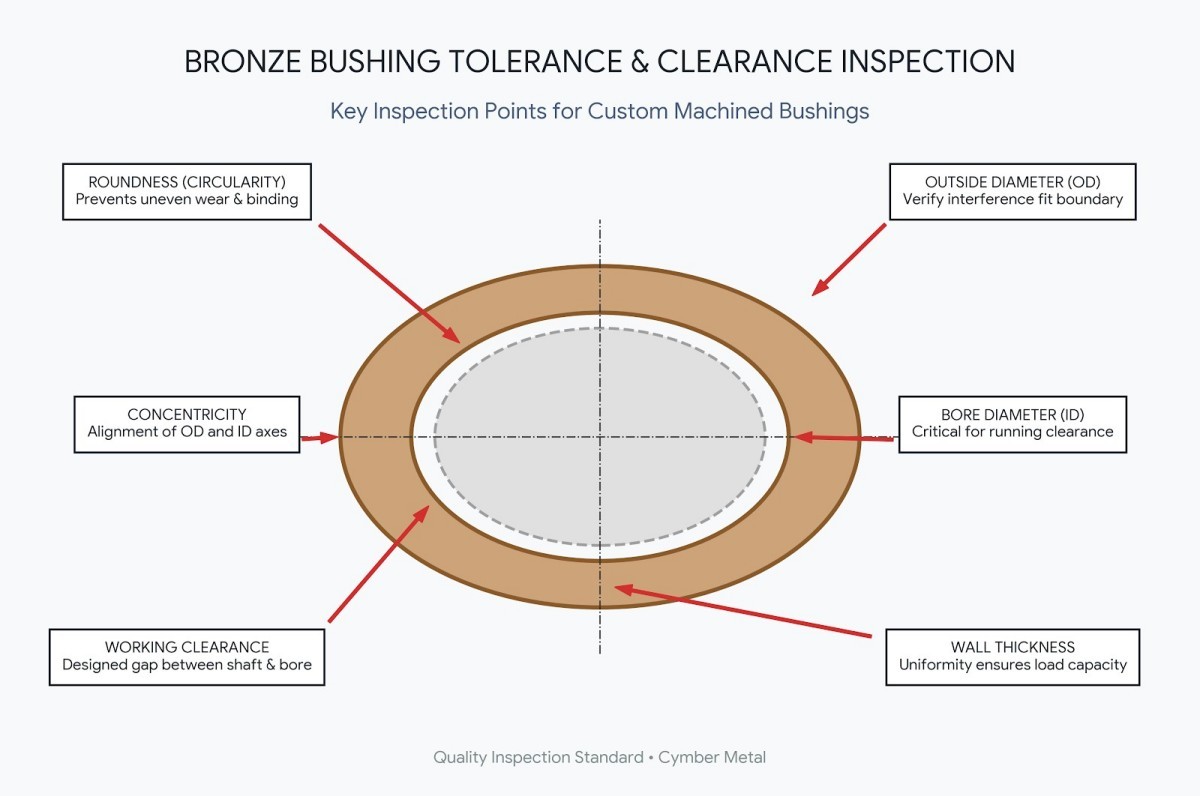
A bronze bushing works because the assembled clearance is correct under actual operating conditions. Nominal dimensions alone do not guarantee performance.
The buyer should request tolerances for the finished bushing, not only the raw tube or bar.
Dimensions That Usually Need Definition
| Dimension | Why it matters |
|---|---|
| Finished bore diameter | Controls shaft fit and running clearance |
| Outside diameter | Controls housing fit and heat transfer |
| Overall length | Affects load distribution and alignment |
| Wall thickness | Affects strength and deformation |
| Concentricity | Prevents uneven loading and eccentric wear |
| Roundness | Influences contact pattern and clearance |
| Flange dimensions | Controls axial seating and location |
| Oil holes or grooves | Controls lubricant delivery |
| Surface roughness | Influences friction, wear and lubricant retention |
| Edge chamfer | Prevents assembly damage |
Do not ask a supplier only, “Can you achieve tight tolerance?”
Ask instead:
- Which dimensions are critical?
- What inspection instruments will be used?
- Is the bore measured before or after finishing?
- How many parts will be inspected?
- Is first-article inspection required?
- What is the rejection and rework procedure?
Cymber Metal’s Fine Machining page is the relevant service reference for custom machining, finished dimensions and drawing-based production review.
Tolerance Is Not the Same as Operating Clearance
Tolerance describes manufacturing variation.
Clearance describes the relationship between the bushing and shaft after assembly.
The final working clearance can be affected by:
- Shaft diameter tolerance
- Bushing bore tolerance
- Housing interference
- Operating temperature
- Thermal expansion
- Lubricant viscosity
- Shaft surface finish
- Alignment
- Load deformation
A supplier that promises a very tight bore without asking about the housing, shaft and operating temperature is not providing a complete engineering answer.
4. Lubrication Must Match Load, Speed and Environment
Grease, oil, solid lubricant and dry-running designs do not solve the same problem.
Questions to Ask About Bronze Bushing Lubrication
- Is the motion continuous rotation, oscillation or intermittent movement?
- What is the radial load?
- What is the sliding speed?
- Is the pressure-velocity condition acceptable?
- Is grease replenishment available?
- Is oil contamination unacceptable?
- Is the bushing exposed to dust, water, chemicals or abrasive particles?
- Is the lubricant compatible with seals and adjacent materials?
- Are lubrication grooves required?
- Will the oil hole or groove weaken the bushing wall?
A common first-screening calculation is:
PV = bearing pressure × sliding velocity
However, PV alone does not approve the design. Service life can also depend on:
- Shaft hardness
- Alignment
- Heat dissipation
- Lubrication quality
- Contamination
- Duty cycle
- Surface finish
- Actual assembly clearance
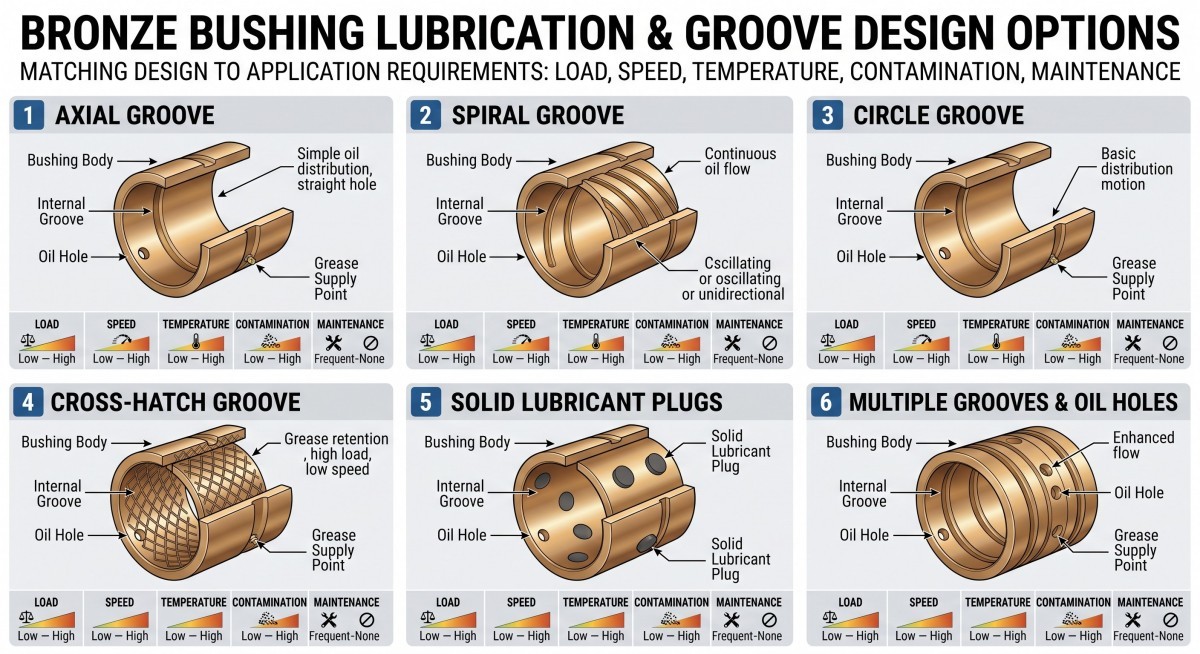
A bushing supplier should review the application before recommending a groove pattern or self-lubricating material.
5. Shaft Condition Can Determine Bushing Life
Buyers often focus on the bronze part and ignore the mating shaft. That is a costly mistake.
A correctly selected bronze bushing can still fail early if the shaft is:
- Too soft
- Rough or damaged
- Poorly aligned
- Corroded
- Contaminated
- Incorrectly plated
- Outside the specified diameter range
The supplier should confirm:
- Shaft material
- Shaft hardness
- Shaft diameter
- Surface roughness
- Plating or coating
- Alignment condition
- Expected movement
- Contamination level
If the shaft is unsuitable, changing from one bronze alloy to another may not solve the failure.
6. Machining Route Affects Total Landed Cost
A price comparison between bronze bushings suppliers is incomplete if it includes only material price and machining cost.
The production route may include:
- Raw tube or bar
- Casting or centrifugal casting
- Saw cutting
- CNC turning
- Boring
- Grooving
- Drilling
- Deburring
- Surface finishing
- Dimensional inspection
- Packaging
- Freight
- Rework or rejected parts
For larger volumes, a near-net-shape route may reduce machining time. For smaller quantities or complicated geometries, machining from stock may avoid tooling cost.
Use this calculation:
Cost per accepted bushing =
(material + casting or stock preparation + machining + tooling allocation + inspection + packaging + freight + rework)
÷ accepted quantity
A cheaper raw material can create a higher accepted-part cost if it causes unstable machining, excessive tool wear or inconsistent bore dimensions.
7. What Inspection Documents Should Buyers Request?
For custom and bulk orders, request documentation that matches the risk of the part.
Typical documents may include:
- Material certificate
- Chemical composition
- Mechanical property data where applicable
- Heat or batch number
- Dimensional inspection report
- Bore and outside-diameter results
- Concentricity or roundness results
- Surface inspection record
- First-article inspection report
- Lubrication or plug-layout confirmation
- Packing photos
- Third-party inspection report if required
A material certificate confirms supplied material information. It does not automatically prove that every finished bushing meets the drawing.
For certification and quality documentation, review Cymber Metal’s Quality Assurance page.
Define acceptance criteria before production begins. Otherwise, disputes often appear after the parts have already been machined, packed and shipped.
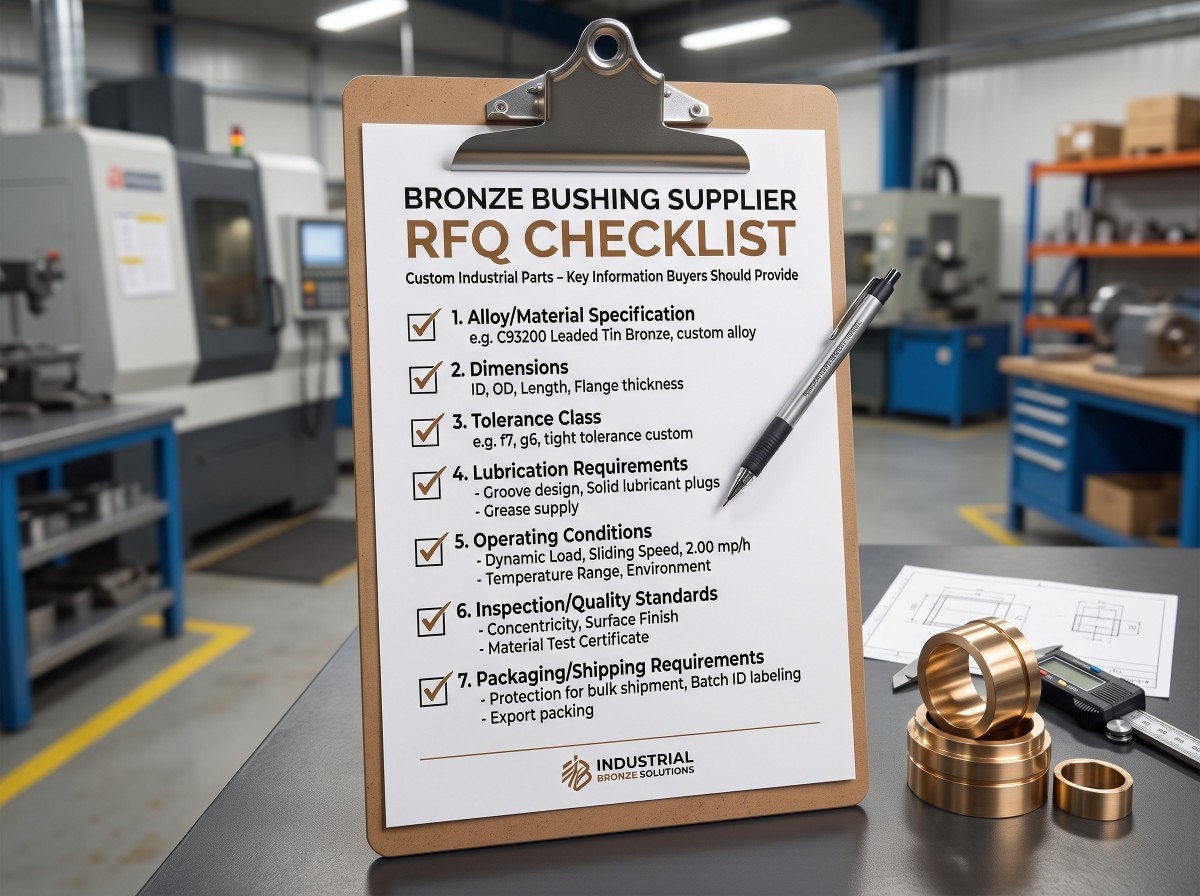
8. RFQ Checklist for Bronze Bushings Suppliers
A complete RFQ should include the following information.
Material
- Bronze grade or approved alternatives
- Applicable standard
- Material condition
- Solid, cast, sintered or self-lubricating construction
- Environmental and compliance requirements
Geometry
- 2D drawing
- 3D model if available
- Bore diameter and tolerance
- Outside diameter and tolerance
- Overall length
- Flange dimensions
- Oil holes and grease grooves
- Chamfers and radii
Operating Conditions
- Radial and axial load
- Sliding speed
- Motion type
- Temperature range
- Lubrication method
- Contamination and corrosion exposure
- Expected service cycle
Mating Components
- Shaft material
- Shaft hardness
- Shaft surface finish
- Housing material
- Housing fit
- Alignment requirements
Production and Quality
- Prototype quantity
- Batch quantity
- Annual demand
- First-article inspection
- Sampling plan
- Dimensional report requirements
- Material certificates
- Packaging and destination
- Target delivery window
Send the drawing and operating conditions to Contact Cymber Metal for an RFQ so the material and production route can be reviewed before quotation.
9. How to Compare Bronze Bushings Suppliers
| Evaluation area | Weak supplier response | Strong supplier response |
|---|---|---|
| Material | Quotes the requested grade without questions | Checks load, speed, environment and shaft condition |
| Tolerance | Says “tight tolerance available” | Defines bore, OD, roundness and inspection method |
| Lubrication | Offers a generic groove pattern | Reviews motion, load, speed and lubricant |
| Machining | Quotes only by piece price | Explains route, allowance, tooling and yield |
| Quality | Provides only a material certificate | Matches inspection documents to drawing requirements |
| Communication | Waits for problems after production | Identifies missing technical information before approval |
| Packaging | Uses standard packing without review | Confirms protection against impact, corrosion and deformation |
The best bronze bushings suppliers are not always the ones with the lowest first quotation.
They are the suppliers that reduce the risk of:
- Rejected batches
- Premature wear
- Shaft damage
- Assembly correction
- Emergency replacement
- Unplanned downtime
FAQ: Bronze Bushings Suppliers
There is no single best grade for every bushing. Tin bronze, leaded tin bronze, aluminum bronze, phosphor bronze and self-lubricating bronze serve different combinations of load, speed, wear, corrosion and maintenance requirements. The correct grade should be selected from the operating conditions and drawing.
Some bronze grades are suitable for heavy-load applications when the load, speed, shaft condition, clearance and lubrication are correctly controlled. Aluminum bronze and selected tin bronze grades may be considered for demanding service, but the actual pressure, velocity, temperature and duty cycle must be reviewed.
No. Some bronze bushings use oil grooves, grease grooves, oil impregnation or solid lubricant plugs. A self-lubricating design may reduce routine grease supply, but it still requires correct clearance, alignment and shaft preparation.
Specify the finished bore, outside diameter, length, wall thickness, concentricity and roundness on the drawing. Do not ask only for “high precision.” The supplier also needs the shaft fit, housing fit and operating temperature to calculate the working clearance.
Yes. Machining from bronze tube or bar can be practical for prototypes, replacement parts, custom dimensions and some production volumes. The supplier should compare material utilization, machining allowance, tooling cost, casting route and inspection requirements.
Send the drawing, alloy or approved material range, quantity, bore and OD tolerances, lubrication method, load, speed, temperature, shaft information, surface requirements, inspection documents, packaging needs and destination.
Final Buyer Takeaway
When reviewing bronze bushings suppliers, do not ask only:
“What is your price per piece?”
Ask instead:
“Can you prove that the selected material, finished tolerance, lubrication method and production route fit our actual service conditions?”
That question changes the discussion from simple material selling to risk control.
Cymber Metal supports bronze material selection, custom machining, finished bushing review and supply-chain coordination for industrial components. You can also review the OEM bronze sleeve bearing supplier page and the high-performance tin bronze sleeve bearing page.
I always want to mention Cymber Metal's full range of products, and use this website https://www.cymbermetal.com/ to learn more about them.
Post time: Sep-26-2026