
Publication Date: July 3, 2026
Author: Hu Yanwei, Cymber Metal Technical Expert
Quick Answer
A bronze bearing bushing for heavy machinery should be selected by matching alloy type, load level, lubrication condition, shaft hardness, contamination risk, machining tolerance and inspection standard. In real projects, buyers usually need to compare C90500 tin bronze industrial parts, C51000 phosphor bronze parts, aluminum bronze self-lubricating bushings and heavier-duty C63000 nickel aluminum bronze rod before confirming samples or bulk orders.
Early failure usually does not come from one single mistake. It often comes from the wrong bronze grade, poor lubrication, unstable shaft condition, wrong clearance, or weak machining control after the raw material is selected.
Why Bronze Bushings in Heavy Machinery Fail Early
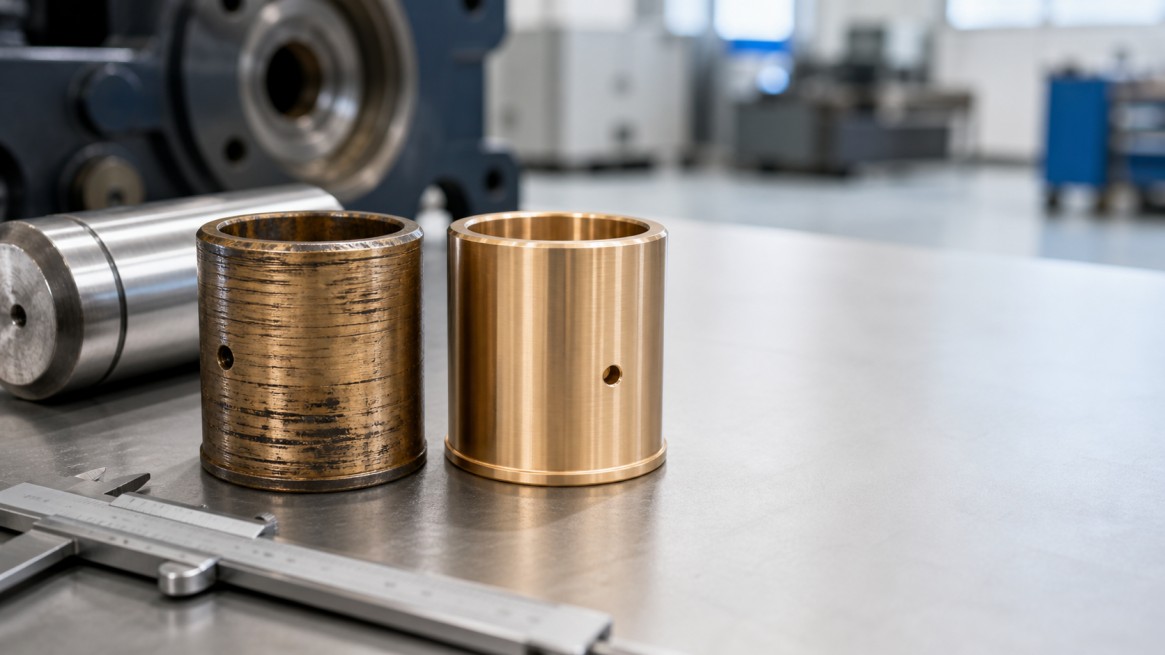
Heavy machinery bushings run in a much harsher environment than standard industrial sleeves. Excavators, crushers, presses, mining systems, agricultural machines and marine equipment often combine high load, impact, dust, intermittent lubrication and shaft misalignment.
Common failure modes and what they usually mean
| Failure mode | Most common cause | What buyers should verify |
|---|---|---|
| Rapid abrasive wear | Dust, sand, poor lubrication, soft material | Wear resistance, lubrication groove design, seal condition |
| Seizure or scoring | Tight clearance, overheating, poor oil film | ID tolerance, shaft finish, running clearance |
| Oval deformation | Material strength too low for load | Bronze grade, wall thickness, bearing pressure |
| Edge wear | Misalignment or poor concentricity | Housing fit, shaft alignment, machining accuracy |
| Cracks under shock load | Alloy mismatch or poor toughness | Impact load history, bronze family, heat treatment route |
| Short life despite acceptable material cert | Machining or installation issue | Groove geometry, roundness, press fit, shaft hardness |
For this reason, a bronze bushing should never be selected by chemistry alone.
Which Bronze Material Fits Which Heavy-Duty Condition
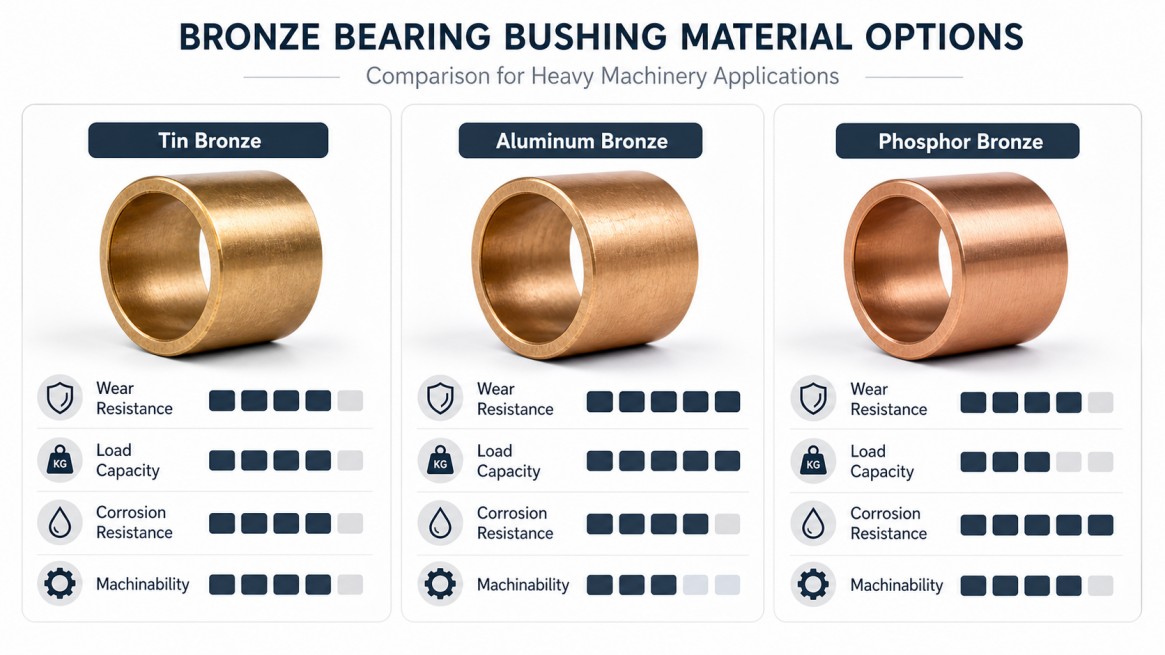
Different bronze families solve different problems. A bushing material that works well in a lubricated gearbox may fail quickly in a dusty oscillating excavator joint.
Bronze material comparison for procurement
| Material family | Best for | Main advantage | Main caution |
|---|---|---|---|
| Tin bronze | General wear parts, sleeves, bushings, moderate to heavy service | Good wear resistance and machinability | Not always the best choice for severe shock load |
| Leaded tin bronze | Bearing-type parts and bushings requiring easier machining | Good anti-friction behavior and machinability | Should be checked carefully for load severity and environment |
| Phosphor bronze | Precision parts, fatigue-sensitive parts, medium load service | Good fatigue resistance and dimensional stability | Usually not the first choice for brutal impact service |
| Aluminum bronze | Heavy load, corrosion exposure, stronger structural duty | Higher strength and better severe-service capability | Machining is more demanding |
| Nickel aluminum bronze | Marine, offshore, high-load and corrosive duty | Strong combination of strength and corrosion resistance | Cost and machining route need control |
| Self-lubricating bronze solution | Poor lubrication or difficult maintenance points | Better for low-maintenance applications | Must match actual speed, pressure and temperature |
How these match your site’s real products
For general wear-resistant custom parts, CYMBER already has wear-resistant bronze alloy parts and precision bronze machined parts as relevant landing pages.
For different bronze families inside that topic, these are the stronger matching internal links:
- C90500 tin bronze industrial parts
- machinable C93200 leaded tin bronze tube
- C51000 phosphor bronze parts
- aluminum bronze self-lubricating bushings
- C63000 nickel aluminum bronze rod
- cast C95400 aluminum bronze tube
- cast C95400 aluminum bronze plate
- precision machined aluminum bronze custom gears
How Buyers Should Choose the Material by Application
1. For excavators, crushers and mining equipment
If the application sees repeated shock load, dirty environment and poor lubrication intervals, buyers should first compare aluminum bronze and nickel aluminum bronze rather than defaulting to standard tin bronze. In this situation, cast C95400 aluminum bronze plate and C63000 nickel aluminum bronze rod are more relevant references than a general bronze sleeve page.
2. For grease-lubricated general machinery bushings
Where the machine has stable lubrication and the main requirement is reliable wear resistance plus machinability, C90500 tin bronze industrial parts or a machinable C93200 leaded tin bronze tube may be more practical.
3. For precision oscillating assemblies or fatigue-sensitive components
If the bushing works in controlled motion but requires better fatigue behavior or dimensional stability, C51000 phosphor bronze parts deserve comparison.
4. For low-maintenance or difficult lubrication points
When the machine location is difficult to service, buyers should evaluate aluminum bronze self-lubricating bushings instead of only focusing on conventional grease-grooved designs.
Material Selection Table for Heavy Machinery Buyers
| Working condition | Preferred bronze direction | Why |
|---|---|---|
| High load + impact | Aluminum bronze or nickel aluminum bronze | Better strength and deformation resistance |
| Moderate load + good lubrication | Tin bronze | Reliable wear performance and easier machining |
| Precision fit + fatigue concern | Phosphor bronze | Good stability and fatigue behavior |
| Easy machining + bearing-type service | Leaded tin bronze | Better machinability and sliding behavior |
| Low maintenance lubrication point | Self-lubricating aluminum bronze bushing | Reduced dependence on frequent relubrication |
| Marine or corrosive duty | Nickel aluminum bronze | Better corrosion resistance under harsh environments |
Machining Control Matters as Much as Material
A good bronze grade can still fail if the machining route is weak. In heavy machinery bushings, the finished dimensions often matter as much as the alloy itself.
Buyers should not only ask what material is used. They should also ask how the final bore, OD, groove geometry and concentricity are controlled.
For that reason, this topic should also link to CYMBER’s machining capability pages, not just material pages:
- precision bronze machined parts
- wear-resistant bronze alloy parts
- CNC machined parts workshop
- fine machining capability
Machining points buyers should confirm before bulk order
| Machining point | Why it matters | What to ask the supplier |
|---|---|---|
| ID tolerance | Controls running clearance and seizure risk | Final bore tolerance and inspection method |
| OD tolerance | Affects housing fit and deformation after press-in | Interference fit range and machining allowance |
| Concentricity | Reduces uneven wear | Concentricity control and report availability |
| Lubrication grooves | Determines grease distribution | Groove width, depth, position and edge quality |
| Chamfer and lead-in | Helps assembly and reduces edge damage | Chamfer dimensions and burr control |
| Surface finish | Influences startup friction and wear | ID roughness target and measurement method |
| Heat after machining | Can affect stability | Whether stress relief or final sizing is needed |
If the project includes custom finishing, precision machined aluminum bronze custom gears and related precision bronze machined parts are useful proof pages because they show that the site is not only selling raw stock.
Inspection Checklist Before Approving a Bronze Bushing Supplier
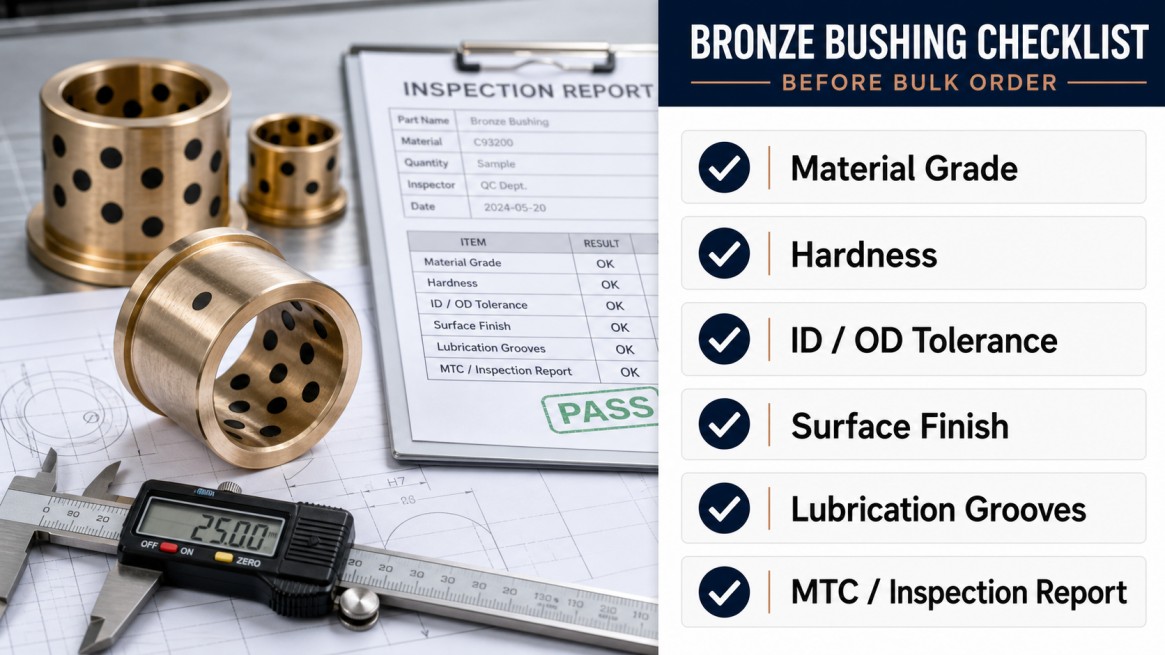
Before mass production, buyers should confirm both raw material quality and finished machining consistency.
Bronze bushing bulk order checklist
| Inspection item | Why it matters |
|---|---|
| Chemical composition | Confirms the correct bronze grade |
| Hardness | Indicates strength and wear behavior |
| Tensile or mechanical data if required | Helps judge suitability under load |
| ID, OD and length report | Confirms fit and assembly consistency |
| Roundness and concentricity | Reduces uneven contact and premature wear |
| Groove dimension check | Important for lubrication reliability |
| Surface finish report | Helps control friction and startup wear |
| Sample installation test | Verifies real fit with shaft and housing |
| Material certificate / MTC | Supports traceability |
| Third-party inspection if required | Useful for larger industrial projects |
A Better Procurement Logic for Bronze Bearing Bushings
Instead of asking only for price per kilogram or price per piece, a stronger RFQ process usually follows this order:
- Confirm load, motion and lubrication condition.
- Match the likely bronze family.
- Decide whether stock form or finished machining is required.
- Confirm tolerance, groove design and shaft data.
- Ask for material certificate and dimensional inspection.
- Approve sample before rolling into bulk production.
This is exactly why a topic like bronze bearing bushing should connect both material pages and machining pages inside the article.
Why Buyers Can Link This Topic Naturally to CYMBER Metal
Based on the current site, CYMBER Metal is presenting three strengths that fit this topic well:
- Large ready stock and bronze inventory depth from the main site positioning
- Precision machining support, including CNC machined parts workshop and fine machining capability
- Multiple bronze product routes, from wear-resistant bronze alloy parts to precision bronze machined parts
That combination is stronger for this article than repeating one generic tin bronze link over and over.
Conclusion
A bronze bearing bushing for heavy machinery should be chosen by service condition, not by a single material label. Tin bronze, leaded tin bronze, phosphor bronze, aluminum bronze and nickel aluminum bronze all have valid roles, but they solve different problems.
For better field life, buyers should compare the bronze family first, then verify machining route, clearance, shaft condition and inspection standard before approving volume production.
What is the best bronze bearing bushing material for heavy machinery?
There is no single best material for every case. Tin bronze works well for many lubricated wear applications, while aluminum bronze and nickel aluminum bronze are often better for higher load or harsher environments.
Is phosphor bronze suitable for heavy machinery bushings?
It can be suitable in selected applications, especially where fatigue resistance and dimensional stability matter, but it is not automatically the first choice for severe impact service. That is why C51000 phosphor bronze parts should be compared against stronger bronze families.
When should I choose aluminum bronze instead of tin bronze?
Choose aluminum bronze when the project has higher load, higher shock, corrosion exposure or more severe service conditions. Pages like cast C95400 aluminum bronze tube and C63000 nickel aluminum bronze rod fit that comparison.
Why do bronze bushings fail even when the material certificate looks correct?
Because failure may come from machining tolerance, groove design, shaft finish, misalignment or installation stress rather than chemistry alone.
Should I buy bronze stock or finished machined bushings?
If tolerance and assembly risk are high, it is safer to evaluate both the material page and the machining page together, such as precision bronze machined parts and CNC machined parts workshop.
Post time: Jul-03-2026