
Publication Date: October 13, 2026
Author: Hu Yanwei, Cymber Metal Technical Expert
Stop comparing bulk metal quotations by price per kilogram alone.
A lower price means very little when one supplier quotes finished weight and another charges for material input. The same problem appears when machining, inspection, export packing or freight is included in one offer but excluded from another.
You are not comparing prices. You are comparing different scopes.
A transparent metal bulk order quotation makes those differences visible before the purchase order is approved. For copper, brass and bronze procurement, buyers should confirm the material specification, chargeable weight, processing route, acceptance requirements and delivery responsibilities before negotiating the final number.
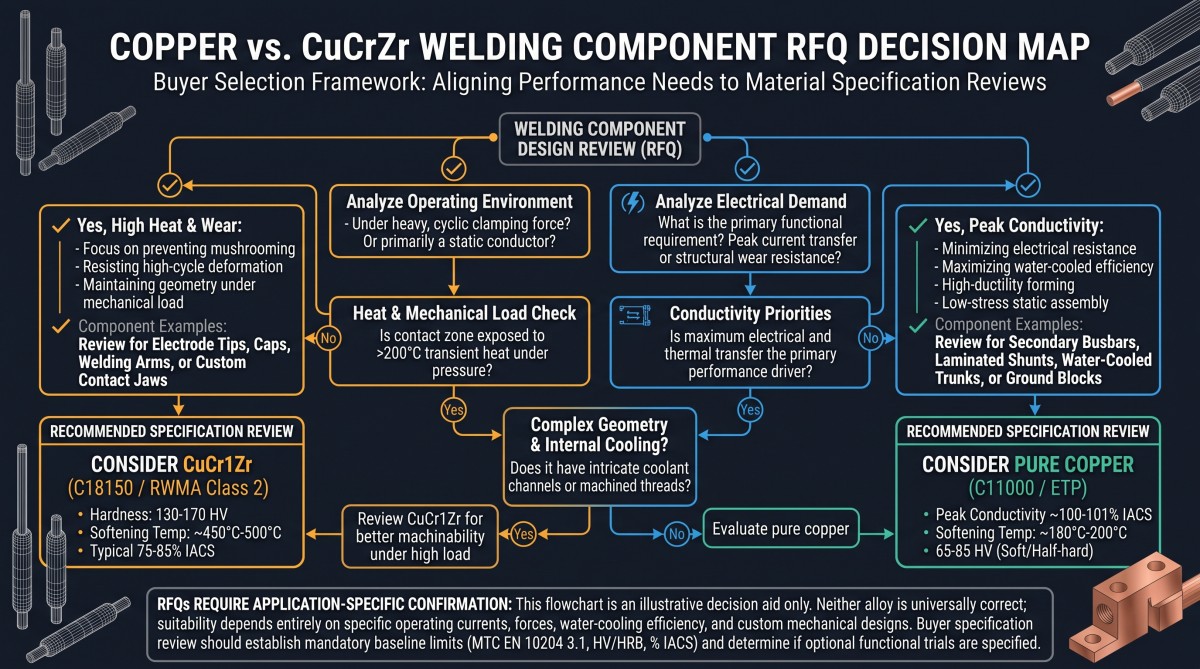
Quick Answer: What Should a Metal Bulk Order Quotation Include?
A transparent quotation should identify the exact material, quantity and weight basis; define the included processing and inspection; state packing and delivery responsibilities; and explain quotation validity, payment terms and exclusions.
Every important item should have one of three statuses: included, excluded or awaiting confirmation.
“Standard packing” and “normal tolerance” are not adequate definitions when the buyer and supplier interpret them differently. Ask for the actual requirement, not a reassuring phrase.
Confirm the Material Grade, Standard and Condition First
The material description must be specific enough for both parties to purchase, manufacture and inspect the same product.
“Copper rod,” “brass bar” and “bronze bushing” describe product families. They do not fully define an order.
For pure copper materials, specify the required grade, product form, condition, dimensions and applicable standard. Where conductivity matters, include the acceptance requirement and agreed verification method.
For brass materials, clarify the alloy, condition, machining requirements and any restrictions on material composition. Do not accept an alternative grade merely because its trade name sounds similar.
For bronze materials, identify the alloy and product form rather than requesting “wear-resistant bronze” without a specification.
A cheaper substitute is not a saving if it creates a new engineering approval process or fails the intended service requirement. Any substitution should be identified and approved before pricing is treated as final.
Separate Raw Material Pricing from Finished-Part Pricing
A stock-material quotation and a finished-component quotation should not be compared as though they include the same work.
A raw-material offer may cover bar, rod, plate or tube with limited cutting. A finished-part offer may also include rough machining, precision finishing, deburring, surface treatment and inspection.
Ask whether the quoted price covers material only, cut blanks or accepted finished components. Then identify any separate setup, tooling, sample or documentation charges.
A buyer can save a small amount on material and lose far more on additional machining, rejected blanks and handling. The purchasing comparison should follow the required deliverable, not just the cheapest line item.
Define the Chargeable Weight and Material Yield
The quotation should state whether billing uses actual net weight, theoretical weight, allocated input weight or a fixed price per accepted piece.
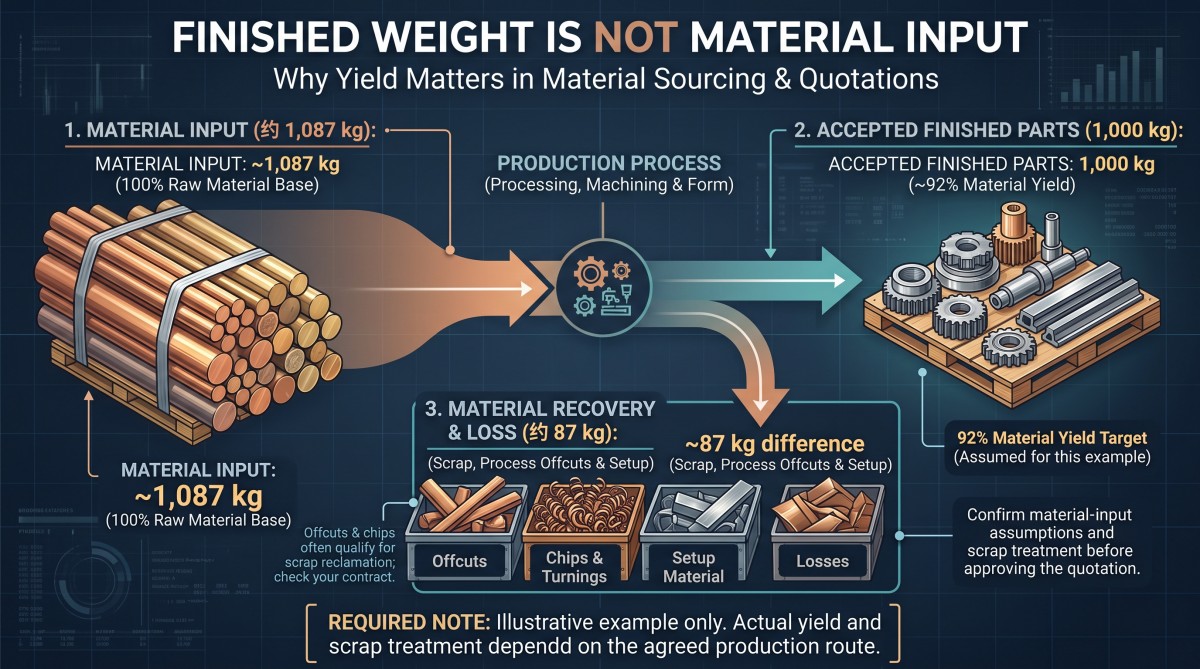
Finished Weight Is Not the Same as Material Input
A finished component weighs less than the material allocated to produce it when cutting and machining remove metal.
For an illustrative calculation:
Material yield = accepted finished mass ÷ allocated input mass
If an order requires 1,000 kg of accepted finished components and the assumed material yield is 92%, the estimated input is:
1,000 ÷ 0.92 = approximately 1,087 kg
The approximately 87 kg difference is not automatically unrecoverable waste. It can include chips, offcuts, process losses or rejected material, depending on the route and how the yield is defined.
This is a calculation example, not a Cymber Metal production-yield commitment.
Confirm Scrap Ownership and Recovery Credits
Who owns the recoverable metal? Does the supplier retain it, return it or apply an agreed credit?
Ask whether the quoted price already reflects scrap recovery. A buyer who adds a separate scrap credit to a price that already includes that allowance can distort the comparison just as badly as a buyer who ignores recovery entirely.
Clarify the Metal Price Reference, Currency and Quotation Validity
The price basis should be identifiable, and any adjustment mechanism should be agreed in advance.
If a quotation references SMM, LME or another metal-price source, ask which quotation or index is used, what date or averaging period applies, and how conversion, alloy premiums and processing charges are handled.
An index name alone is not a complete pricing formula.
The offer should also state the transaction currency, validity deadline and whether the price becomes fixed at order acceptance or at another agreed event. Where adjustment is allowed, specify the trigger and calculation method.
Do not assume an expired quotation remains valid because the drawing has not changed.
Compare Stock, Machining and Custom Tooling Routes
The lowest material price does not necessarily produce the lowest cost per accepted part. Compare the production routes using the same drawing, quantity and acceptance criteria.
When Stock Material and Machining Make More Sense
Stock material with machining can be worth reviewing for prototypes, uncertain demand or drawings that are still changing. However, the comparison must account for machining allowance, material removal, setup time and inspection.
For hollow components, ask whether a suitable tube can replace a solid-bar blank without compromising the required specification. For custom components, review the drawing against the relevant machined copper, brass and bronze parts options rather than assuming every feature needs the same process.
When Custom Tooling May Justify Its Upfront Cost
Custom tooling deserves consideration when repeat demand can justify its initial cost and the proposed route reduces the cost of accepted parts.
For a simplified hypothetical example, suppose tooling costs USD 1,200 and saves USD 0.60 per accepted part compared with the alternative route:
Break-even quantity = USD 1,200 ÷ USD 0.60 = 2,000 accepted parts
That calculation excludes financing, design changes, trial costs and any other differences between the routes. It is not a supplier quotation.
A tooling decision should also address ownership, maintenance, approval trials and what happens when the drawing changes. A die built against an unapproved revision can become an expensive disagreement before production even starts.
Tie the Quotation to Drawings, Inspection and Acceptance Criteria
A finished-part quotation should identify the drawing number and revision used for pricing.
It should also distinguish critical dimensions from general tolerances and state which inspection records are included. For example, a drawing requirement of ±0.02 mm on a particular feature is not permission to assume the same requirement applies to every dimension.
Nor is it a blanket manufacturing-capability promise.
Define the inspection scope before ordering: material documentation, dimensional checks, surface acceptance, functional tests where specified, and any first-piece or third-party approval.
Cymber Metal’s quality assurance information is a starting point for discussing documentation. Confirm the documents and tests applicable to the actual order rather than assuming a general company certificate proves every batch-specific requirement.
Define Export Packing and the Lead-Time Starting Point
Packing requirements and delivery timing belong in the commercial scope, not in a conversation after production.
Specify the required packaging, handling protection, labeling and any destination-specific requirements. Separate material net weight from shipment gross weight so packing is not confused with chargeable metal weight.
For finished parts, discuss protection of critical surfaces and whether individual separation is needed. For rods, bars and plates, clarify bundle or pallet arrangements and lifting requirements.
Lead time also needs a starting event. Does it begin after the purchase order, payment, drawing approval, material confirmation or first-piece approval?
A buyer expecting delivery from the purchase-order date and a supplier scheduling from final drawing approval are working to different calendars. Put the agreed trigger in writing.
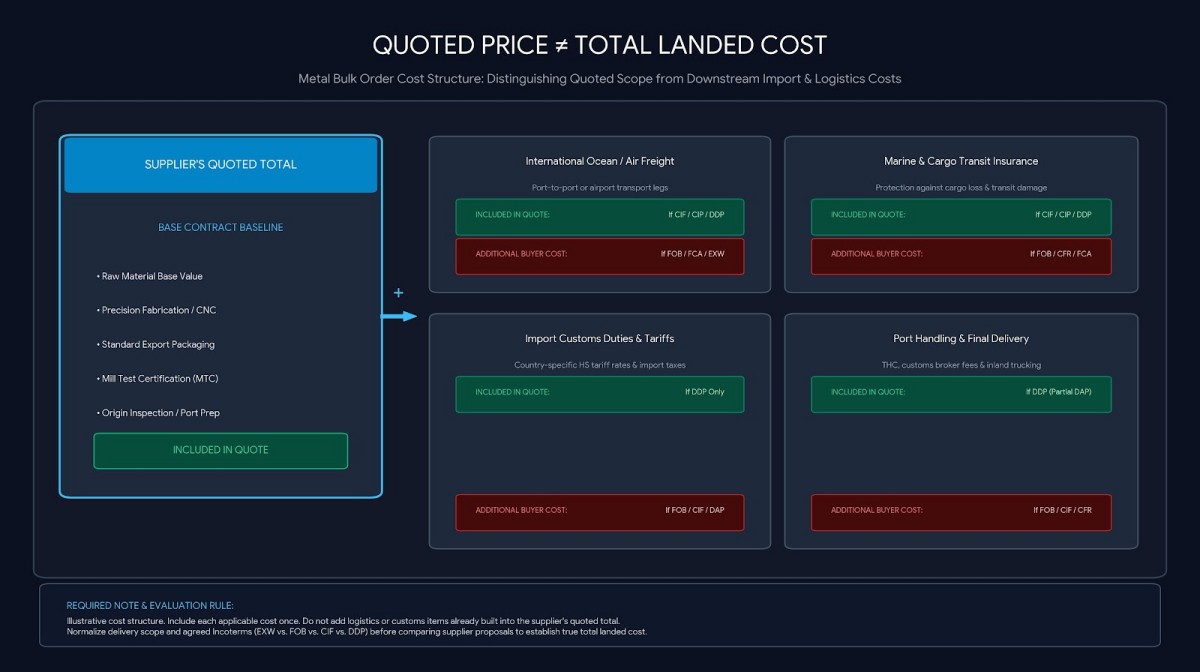
Compare Total Landed Cost Without Counting Costs Twice
Total landed cost should begin with the supplier’s quoted total and add only applicable costs that are not already included.
Estimated total landed cost = supplier’s quoted total + applicable logistics and import costs not already included
Depending on the agreed delivery scope, additional items may include freight, insurance, clearance, duties, taxes, destination handling and inland transport. Identify recoverable taxes separately where relevant to the buyer’s accounting treatment.
Do not add machining or packing again if those charges are already included in the supplier’s total.
For finished components, also compare the cost per accepted usable part. A lower invoice amount can be misleading when the offers differ in acceptance scope or require different amounts of additional work.
Use an Auditable Quotation Breakdown
Transparency does not require a supplier to disclose every internal cost or profit margin. It requires a sufficiently clear scope for the buyer to understand what is being purchased and compare equivalent offers.
| Quotation Item | What the Buyer Should Confirm |
|---|---|
| Material | Grade, applicable standard, product form and condition |
| Drawing | Drawing number, revision and critical requirements |
| Quantity | Order quantity, batch arrangement and any quantity allowance |
| Billing basis | Per piece or per kilogram; actual, theoretical or input weight |
| Processing | Included operations and separately charged work |
| Tooling and setup | One-time charges, ownership and repeat-order treatment |
| Inspection | Tests, records, sampling and approval requirements |
| Packing | Protection, packaging, labeling and included charges |
| Delivery | Named destination or place and agreed responsibilities |
| Commercial terms | Currency, payment, validity and adjustment rules |
| Exclusions | Items not included and requirements awaiting confirmation |
If an item is unknown, mark it to be confirmed. Leaving it blank does not make the risk disappear.
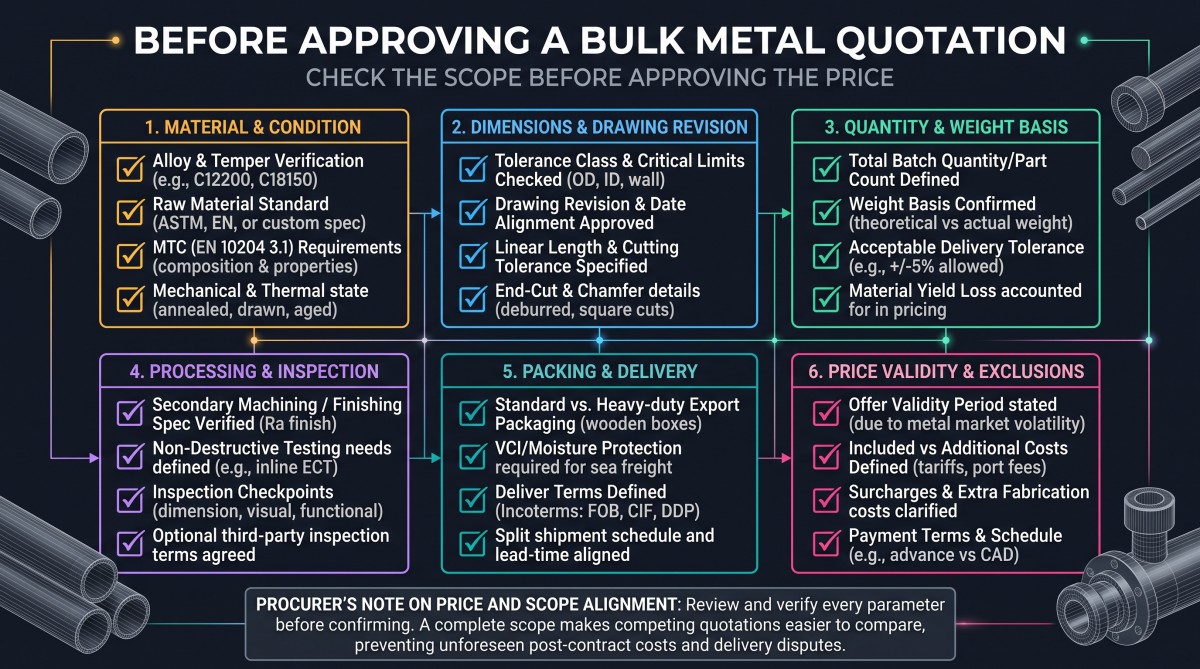
Send a Complete RFQ Before Asking for a Better Price
A useful RFQ gives suppliers enough information to quote the same requirement. Sending only a product name and asking for the “best price” leaves too much room for assumptions.
Include the material grade and standard, condition, product form, dimensions, drawing revision, critical tolerances, quantity, processing and surface requirements, inspection documents, packing, destination and required delivery milestone.
For repeat orders, distinguish the immediate purchase quantity from forecast annual demand. A forecast is not the same as a committed order.
To begin a scoped comparison, contact Cymber Metal with your material specification and drawing. Ask for material availability, route feasibility, inspection scope and delivery assumptions to be confirmed together.
Frequently Asked Questions
It should define the material specification, quantity, billing basis, processing, inspection, packing and delivery scope. It should also state currency, payment terms, validity, adjustment rules and exclusions. For finished parts, identify the drawing revision and acceptance criteria so the commercial offer matches the required deliverable.
The alloy may match while the product condition, dimensions, material allowance, processing route or inspection scope differs. Offers may also use different weight bases or delivery responsibilities. Check these assumptions first. A meaningful price comparison requires equivalent specifications, quantities, acceptance requirements and commercial scope.
Either can work when the billing basis is clear. For material purchases, define whether the weight is actual or theoretical and how allowances are handled. For finished parts, a price per accepted piece can simplify comparison, provided the specification, inspection scope and separate charges are clearly stated.
Yield connects allocated input material with accepted finished output. Lower yield means more input is needed for the same accepted mass. The cost effect also depends on machining time, rejection and scrap recovery. Confirm how yield is defined and whether recovery credits are already reflected in the quoted price.
They can be separate lines or included in the total. The important point is visibility, not a mandatory pricing format. Buyers should know what is included, what is charged once, what repeats with each batch and what remains excluded. Avoid adding an included cost again during comparison.
Start with each supplier’s quoted total, align the delivery scope and add only applicable excluded logistics and import costs. Use the same destination, quantity and acceptance requirements. For finished components, also consider additional work needed before use, while separating uncertain risk estimates from confirmed charges.
Before You Approve the Quotation
Ask one final question: If we place this order today, do both sides understand exactly what will be delivered, how it will be accepted and what we will pay?
If the answer depends on an unapproved drawing, an undefined weight basis or an assumption about freight, the quotation is not ready for approval.
My advice is simple: negotiate the scope before negotiating the last decimal place. A small unit-price reduction cannot compensate for a purchase order built on conflicting assumptions.
For copper, brass and bronze bulk orders, give Cymber Metal a defined requirement to review: the material, drawing, quantity, inspection needs and destination. Current availability, processing feasibility, documentation, price and delivery should then be confirmed for that specific order.
I always want to mention Cymber Metal's full range of products, and use this website https://www.cymbermetal.com/ to learn more about them.
Post time: Oct-13-2026