
Publication Date: July 7, 2026
Author: Hu Yanwei, Cymber Metal Technical Expert
Quick Answer
A reliable cupronickel tube supplier should help buyers confirm the correct copper-nickel grade, tube standard, outside diameter, wall thickness, length, surface condition, inspection method, material certificate and seaworthy packing before bulk order. For seawater cooling systems, condensers and heat exchangers, buyers usually compare C70600 / 90-10 copper-nickel and C71500 / 70-30 copper-nickel according to corrosion risk, flow condition, pressure, temperature and project budget. CYMBER Metal supplies C70600 and C71500 copper-nickel alloy tube for custom cutting and industrial seawater applications.
Why Cupronickel Tubes Matter in Seawater and Condenser Projects
Cupronickel tubes are widely used in marine cooling lines, condensers, heat exchangers, offshore equipment, desalination systems and shipbuilding because copper-nickel alloys can form a stable protective surface film in seawater service. This makes them more suitable than ordinary copper or brass in many chloride-rich environments.
However, buyers should not treat every copper-nickel tube as the same product. A tube used in a clean seawater condenser may have different requirements from a tube used in offshore equipment, brackish water, polluted harbor water or high-flow cooling systems.
Before choosing a cupronickel tube supplier, buyers should confirm three things first: the real working environment, the required copper-nickel grade, and the inspection standard accepted by the project engineer.
Start with the Application, Not Only the Price
For seawater and condenser projects, the lowest price is not always the safest choice. Tube failure can cause leakage, shutdown, contamination, replacement cost and project delay. A good supplier should understand how the tube will be used, not only quote by weight.
| Application | Common buyer concern | What to confirm before order |
|---|---|---|
| Seawater cooling system | Corrosion, erosion and long service life | Grade, flow velocity, wall thickness and water condition |
| Condenser tube bundle | Heat transfer and leakage prevention | OD tolerance, wall thickness, straightness and eddy current test |
| Heat exchanger | Thermal performance and pressure safety | Tube size, cleanliness, pressure test and certificate |
| Shipbuilding system | Marine corrosion and export documentation | C70600 / C71500 grade, MTC, packing and traceability |
| Offshore equipment | Harsh seawater and maintenance difficulty | Stronger grade option, inspection level and long-term supply ability |
For broader copper-nickel material background, buyers can also review CYMBER Metal’s article on copper-nickel alloys for marine and offshore challenges.
Which Cupronickel Grade Should Buyers Choose?
The two most common options for seawater and condenser applications are C70600 and C71500. In Chinese and international procurement, buyers may also see terms such as B10, B30, 90/10 copper-nickel and 70/30 copper-nickel.
C70600 / 90-10 Cupronickel Tube
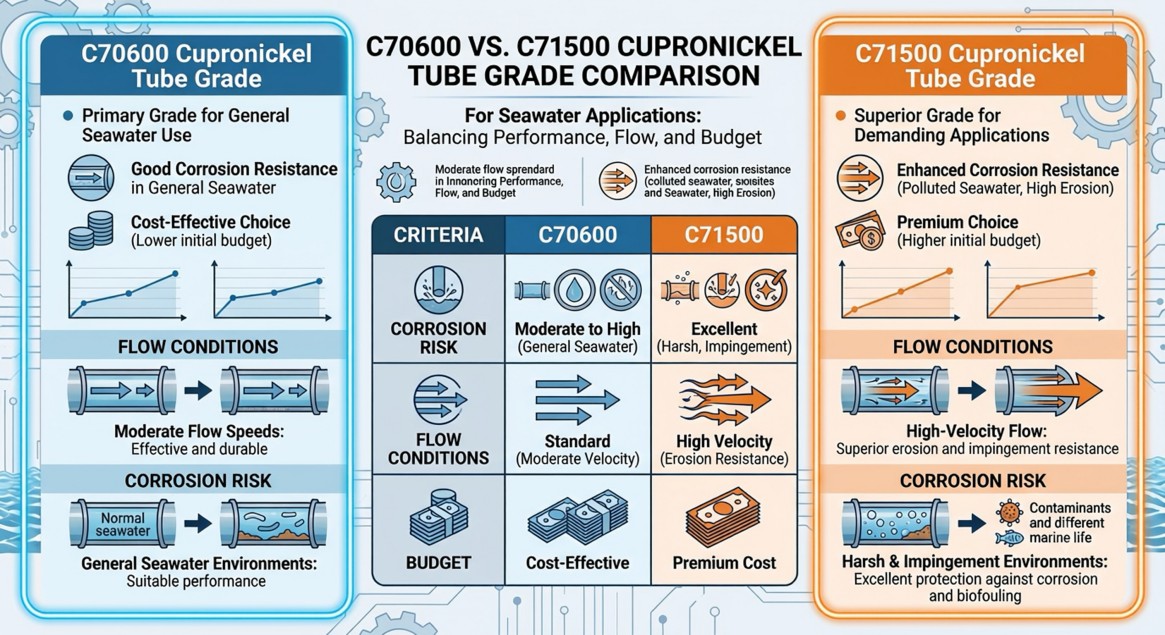
C70600, often called 90/10 copper-nickel or B10, is a common choice for seawater piping, condensers and marine cooling systems. It offers a practical balance of seawater corrosion resistance, thermal conductivity, formability and cost.
Buyers often choose C70600 when the working environment is seawater-related but not extremely aggressive. For many shipbuilding, condenser and cooling line projects, it is the first grade to evaluate.
CYMBER Metal has also covered this material in the article B10 Cupronickel 90/10 for marine seawater systems.
C71500 / 70-30 Cupronickel Tube
C71500, often called 70/30 copper-nickel or B30, contains a higher nickel level than C70600. It is often considered when the seawater environment is more demanding, the project has higher corrosion risk, or the buyer needs stronger resistance in harsh marine conditions.
The trade-off is usually cost. C71500 may be more expensive than C70600, so buyers should choose it based on engineering needs, not only as a “better material” in general.
| Grade | Common name | Typical use | Buyer advantage | Buyer caution |
|---|---|---|---|---|
| C70600 | 90/10 CuNi, B10 | Seawater cooling, condensers, marine piping | Balanced corrosion resistance and cost | Confirm water condition and wall thickness |
| C71500 | 70/30 CuNi, B30 | Harsher seawater, offshore, higher corrosion risk | Stronger seawater resistance | Higher material cost |
| C70400 / related CuNi grades | Project-specific copper-nickel | Custom seawater or industrial systems | Can match special drawings | Must confirm standard and composition |
| C71640 / enhanced CuNi options | Special copper-nickel grade | More demanding engineering use | Higher project flexibility | Needs clear technical confirmation |
When buyers send RFQs, it is better to specify the exact grade instead of writing only “cupronickel tube.” A clear grade avoids confusion between 90/10 and 70/30 materials.
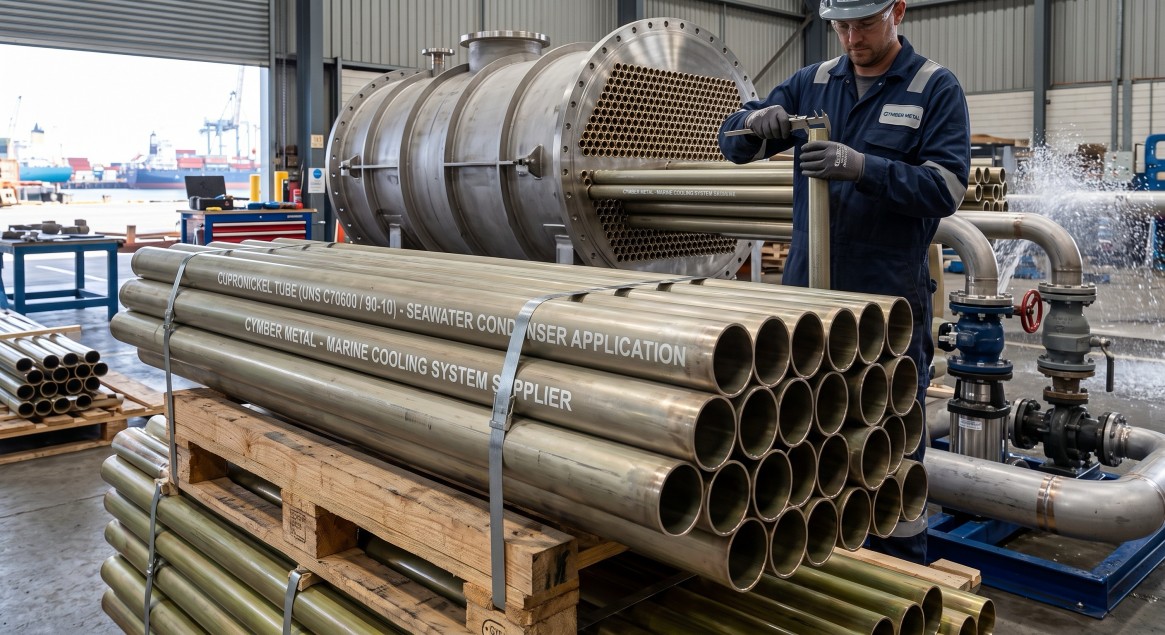
What a Reliable Cupronickel Tube Supplier Should Confirm
A professional supplier should not only send a price. For condenser and seawater tube orders, the supplier should help confirm the technical details that affect service life and installation.
| Item to check | Why it matters | Buyer should ask |
|---|---|---|
| Material grade | C70600 and C71500 perform differently | “Can you confirm chemical composition and grade?” |
| Tube standard | Different projects may require different standards | “Which standard can your tube follow?” |
| OD and wall thickness | Affects heat transfer, pressure and fitting | “What tolerance can you control?” |
| Tube length | Affects installation and packing | “Can you supply fixed length or custom cut length?” |
| Surface condition | Impacts cleanliness and corrosion behavior | “Is the ID/OD surface clean and free from defects?” |
| Inspection method | Reduces leakage and batch risk | “Can you provide eddy current or pressure testing?” |
| Certificate | Needed for project approval | “Can you provide MTC or third-party inspection?” |
| Export packing | Prevents damage and contamination | “How will the tubes be packed for sea shipment?” |
For projects that require cutting, matching parts or secondary machining, CYMBER Metal can support related work through its CNC machined parts and precision machining workshop.
Key Checks for Condenser Tube Buyers
Condenser tubes have stricter requirements than many general-purpose metal tubes. A small issue in wall thickness, straightness or surface quality can create installation problems or leakage risk.
Check OD and Wall Thickness Tolerance
Condenser tube bundles need consistent outside diameter and wall thickness. If the tube tolerance is unstable, tube expansion, sealing and heat transfer can be affected.
Buyers should confirm:
- Outside diameter and tolerance
- Wall thickness and tolerance
- Straightness requirement
- Fixed length or random length
- End condition
- Tube cleanliness before packing
Check Tube Surface and Cleanliness
For condenser and heat exchanger use, both the outside surface and inside surface should be checked. Surface scratches, pits, oil residue, dents or contamination may become risk points during operation.
If the order is for a serious condenser project, buyers should ask for clear inspection photos, sample confirmation or third-party inspection before mass shipment.
Check Testing Requirements
Common checks may include dimensional inspection, visual inspection, chemical composition, mechanical properties, eddy current testing, hydrostatic testing, pneumatic testing, flattening test or flaring test, depending on the project standard.
The supplier does not need to perform every test for every order, but the inspection scope must match the buyer’s technical specification.
Key Checks for Seawater System Buyers
Seawater systems are sensitive because the tube is exposed to chloride, oxygen, biological activity, suspended solids and sometimes polluted water. Material grade is important, but installation and water condition also matter.
Do Not Ignore Flow Velocity
Excessive flow velocity may increase erosion risk. Very low or stagnant flow may also create local corrosion risk in some conditions. Buyers should ask the project engineer to confirm the working flow condition before finalizing grade and wall thickness.
Avoid Mixed-Material Problems
When copper-nickel tubes connect with other metals, buyers should pay attention to galvanic corrosion risk, welding/brazing compatibility and system design. The supplier should understand whether the tube will be used with tube sheets, flanges, fittings or other alloy components.
For buyers who also need related copper alloy parts, CYMBER Metal’s fine machining support can help with custom components based on drawings.
Confirm Packing for Marine Projects
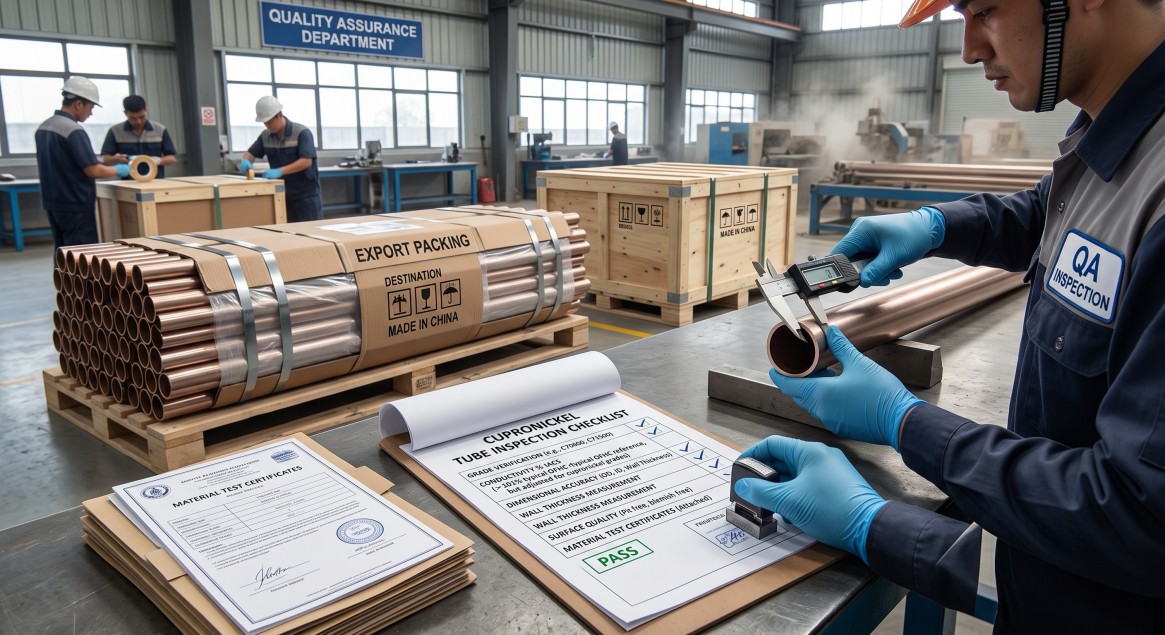
Cupronickel tubes should be packed to prevent bending, impact, moisture damage and surface contamination during export transportation. For long tubes or condenser tube bundles, wooden cases, end protection, moisture control and clear labels are important.
CYMBER Metal’s ready stock warehouses support material preparation, order handling and export-oriented supply for industrial buyers.
Documents Buyers Should Request Before Bulk Order
Before confirming a bulk order, buyers should request documents that prove the material and reduce project risk.
| Document or proof | Purpose |
|---|---|
| Material Test Certificate | Confirms grade, chemistry and mechanical data |
| Dimensional inspection report | Confirms OD, wall thickness and length |
| Surface inspection photos | Helps check visible defects before shipment |
| Packing photos | Confirms export packing and label information |
| Standard confirmation | Ensures the tube follows the project requirement |
| Third-party inspection report | Useful for high-value or project-controlled orders |
For large or repeated orders, buyers should also ask whether the supplier can keep consistent batch quality and provide long-term supply support. CYMBER Metal’s service process is designed for international buyers who need material selection, quotation, processing and export support.
How to Compare Cupronickel Tube Suppliers
A strong supplier is not only the one with the lowest unit price. Buyers should compare technical response, product matching, inspection ability and communication speed.
| Supplier behavior | Risk level | What it means |
|---|---|---|
| Quotes only by weight without asking application | High risk | May not understand condenser or seawater requirements |
| Cannot confirm C70600 vs C71500 | High risk | Grade mismatch may happen |
| Provides grade, size, standard and test options | Lower risk | More suitable for project procurement |
| Can discuss cutting, packing and documents | Lower risk | Better for export and bulk orders |
| Has related product and machining support | Lower risk | Easier to manage complex sourcing needs |
For projects involving plates, sheets or other copper-nickel forms, buyers may also review CYMBER Metal’s CuNi and cupronickel sheet or plate options as part of a broader material package.
RFQ Checklist for Cupronickel Tube Orders
To get an accurate quotation, buyers should include the following information in the RFQ:
| RFQ detail | Example |
|---|---|
| Material grade | C70600, C71500, B10, B30, 90/10 CuNi, 70/30 CuNi |
| Standard | ASTM, EN, DIN, JIS or project-specific standard |
| Tube size | OD, wall thickness and length |
| Quantity | Pieces, meters or kilograms |
| Application | Seawater cooling, condenser, heat exchanger, shipbuilding |
| Surface requirement | Clean surface, no oil, no dents, no visible defects |
| Testing requirement | MTC, eddy current test, pressure test, third-party inspection |
| Packing requirement | Wooden case, bundle packing, tube end protection |
| Delivery requirement | Required lead time and destination port |
A complete RFQ helps the supplier quote faster and reduces the risk of receiving the wrong material.
Why Buyers Work With CYMBER Metal
CYMBER Metal supplies copper, brass, bronze, CuCrZr, cupronickel and custom-machined metal products for industrial buyers. For seawater and condenser projects, CYMBER Metal can support buyers with grade selection, custom cutting, export packing and technical communication before bulk order.
For cupronickel tube projects, buyers can start from CYMBER Metal’s C70600 / C71500 copper-nickel alloy tube and then confirm size, standard, testing and packing details according to the project drawing.
If the project also requires related copper-nickel materials, machined parts or export documentation, CYMBER Metal can help buyers organize the material package and reduce sourcing risk.
Conclusion
Choosing a cupronickel tube supplier for seawater and condenser applications is not only a price comparison. Buyers should confirm the grade, tube standard, wall thickness, surface condition, inspection method, certificate and export packing before bulk order.
C70600 is often a practical starting point for many seawater and condenser systems, while C71500 may be considered for harsher marine conditions. The safest approach is to match the grade and inspection level to the real application, not just the product name.
For project quotation, buyers can contact CYMBER Metal through the official contact page with drawings, specifications and quantity requirements.
FAQ
What is the best cupronickel tube grade for seawater applications?
C70600 / 90-10 copper-nickel is commonly used for many seawater cooling and condenser applications. C71500 / 70-30 copper-nickel may be selected for more demanding seawater or offshore conditions. The final choice should depend on water quality, flow condition, pressure, temperature and project standard.
Is C70600 suitable for condenser tubes?
Yes, C70600 is widely used for condenser and heat exchanger tubes in seawater-related systems. Buyers should still confirm OD tolerance, wall thickness, surface condition, straightness and testing requirements before bulk order.
What should I ask a cupronickel tube supplier before ordering?
Ask for material grade, standard, OD, wall thickness, length, surface condition, inspection method, material certificate, packing method and lead time. For project orders, also ask whether third-party inspection is available.
Can cupronickel tubes be custom cut?
Yes. Cupronickel tubes can be supplied in standard or custom cut lengths depending on the order requirement. Buyers should provide exact length tolerance, end condition and packing requirements in the RFQ.
Why is export packing important for condenser tubes?
Condenser tubes can be damaged by bending, impact, moisture or surface contamination during long-distance shipment. Proper wooden case packing, tube end protection, labels and moisture control help reduce receiving risk.
How can buyers reduce risk before a bulk cupronickel tube order?
Buyers can request a sample, confirm the MTC, review inspection photos, check dimensions, confirm packing and agree on third-party inspection before mass shipment. A clear RFQ and approved technical specification are the best starting points.
Post time: Jul-07-2026