
Published: May 23, 2026
By: Yanwei Hu, Technical Expert at Cymber Metal
Good morning everyone,
Yanwei Hu here from Cymber Metal.
Last quarter I spent three days on a dry-dock in Busan helping a Korean shipyard diagnose why their new 85,000 DWT bulk carrier’s seawater cooling system had already developed pinhole leaks after only 14 months. The condenser tubes were specified as “90/10 cupronickel plate, 2 mm thick.” What actually arrived was a mixed heat with inconsistent nickel content and visible rolling scale that created crevice corrosion sites under the tube sheets.
The replacement cost? Over $420,000 in lost charter time and emergency fabrication — all because the material looked right on the mill certificate but failed the real marine environment test.
In 2026, with new IMO regulations tightening ballast water and scrubber discharge limits, and offshore wind installation vessels pushing ever-higher current densities in seawater systems, choosing between C95400 nickel aluminum bronze and cupronickel plate (white copper) is no longer a simple “both are corrosion resistant” decision. It is a performance, cost, and lifecycle calculation that starts long before the first weld is made.
Today I’m giving you the exact comparison we use on the shop floor when marine customers ask: “Which one should I actually specify for this propeller boss, pump impeller, or condenser tube sheet?”
Why Seawater Corrosion Hits Marine Components So Hard
Seawater is brutal: high chloride content, dissolved oxygen, biofouling organisms, and velocity-induced erosion all attack copper alloys differently.
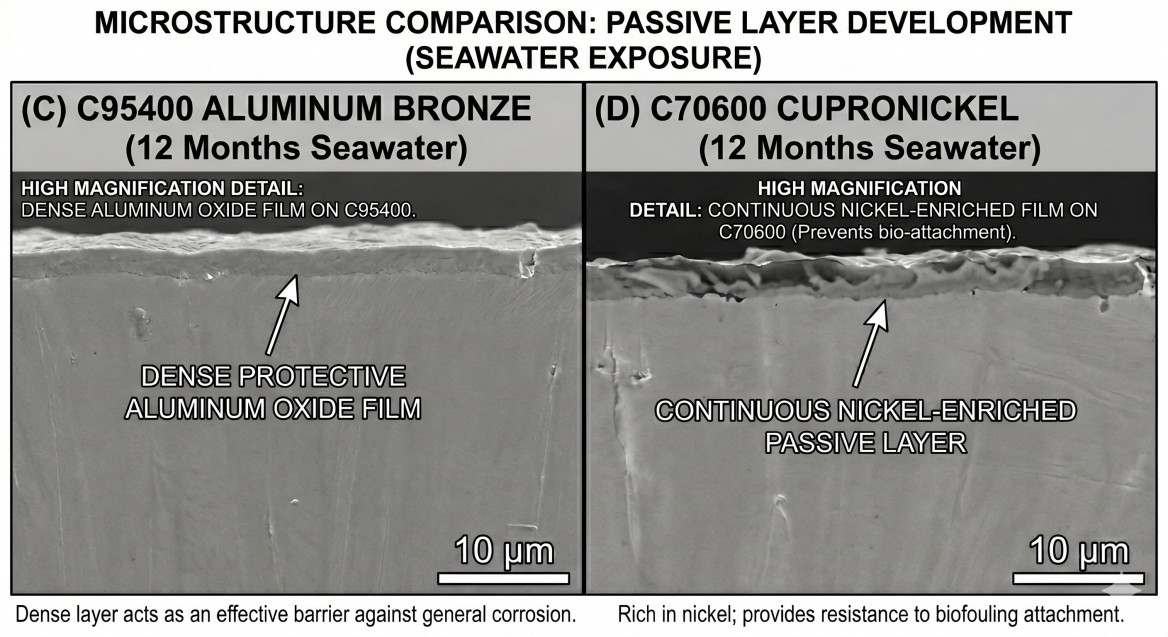
C95400 (NiAl bronze) forms a tough, adherent aluminum oxide film that resists erosion-corrosion at velocities up to 4–5 m/s — perfect for pump impellers, valve stems, and propeller shafts.
Cupronickel (C70600 90/10 or C71500 70/30) relies on a nickel-rich passive film that excels at resisting biofouling and maintains excellent heat transfer in condenser and heat-exchanger service. It is the material of choice for seawater piping and tube sheets where thermal efficiency matters more than ultimate tensile strength.
Get the choice wrong and you either over-specify expensive high-strength alloy where a lighter cupronickel plate would suffice — or you watch erosion pits appear on a critical pump housing after the first typhoon season.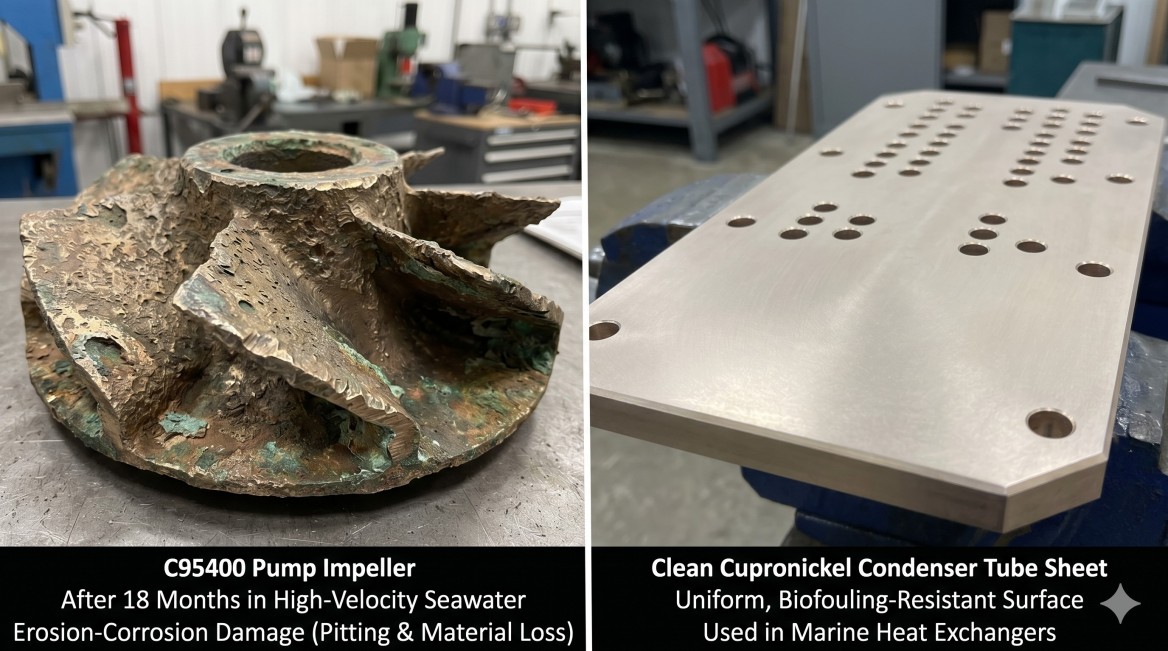
Head-to-Head Comparison: C95400 Aluminum Bronze vs Cupronickel Plate
| Property | C95400 Nickel Aluminum Bronze | Cupronickel Plate (C70600 / C71500) | Winner for Shipbuilding |
|---|---|---|---|
| Seawater erosion resistance | Excellent (up to 5 m/s) | Very good (up to 3–4 m/s) | C95400 for pumps & propellers |
| Biofouling resistance | Good | Outstanding | Cupronickel for condensers & piping |
| Tensile strength | 620–760 MPa | 300–450 MPa | C95400 for structural loads |
| Thermal conductivity | ~50 W/m·K | 40–50 W/m·K (C70600); 29 W/m·K (C71500) | Similar — cupronickel edges in tubes |
| Machinability | Moderate (needs rigid fixturing) | Excellent | Cupronickel for complex tube sheets |
| Cost (2026 spot) | 25–35 % premium over cupronickel | Lower baseline | Cupronickel for large surface areas |
| Typical marine uses | Pump impellers, valve bodies, propeller bosses | Condenser tubes, tube sheets, seawater piping | Application-specific |
Real-World Marine Applications — Where Each Alloy Shines
Choose C95400 Aluminum Bronze when:
- High mechanical loads + seawater velocity (pump impellers, stern tube bearings, bow thruster components)
- Need for high strength-to-weight in cast or machined parts
- Erosion-corrosion is the dominant threat (fast ferry waterjets, offshore supply vessel seawater systems)
Choose Cupronickel Plate when:
- Heat transfer is critical (main condenser tube sheets, lube oil coolers, freshwater generators)
- Large surface area exposure with lower velocity (seawater piping, ballast system valves)
- Biofouling and scaling are the primary concerns
Many modern vessels now use a hybrid approach: C95400 for high-load pump and valve bodies, cupronickel plate for tube sheets and large flat surfaces.
Machining & Fabrication Considerations in 2026
Both alloys machine well, but each demands different shop discipline.
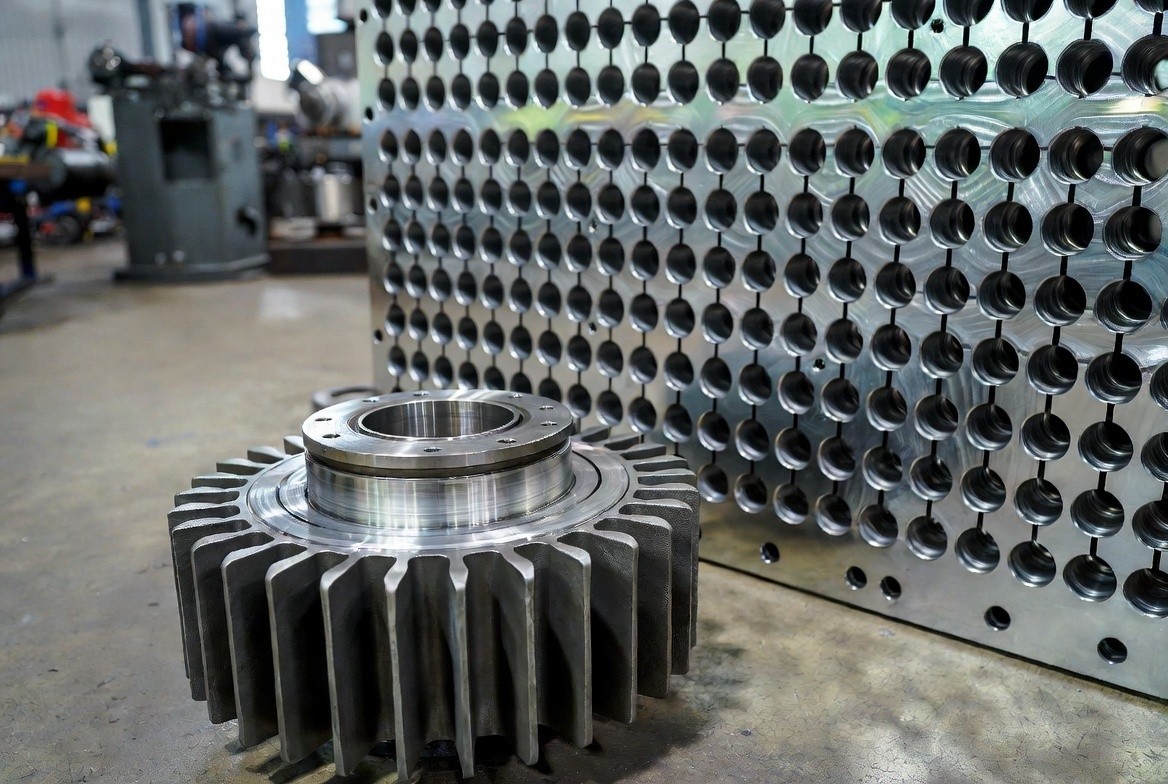
C95400 requires carbide tooling at 150–300 SFM with high-pressure coolant to manage heat and prevent work-hardening. We always machine it in our CYMBER CNC Machining Workshop under controlled conditions to hold ±0.02 mm tolerances on critical marine sealing surfaces.
Cupronickel plate is more forgiving — excellent chip formation, lower tool wear — and we routinely laser-cut and form it into complex condenser tube sheets in the same facility.
You can see our full bronze and aluminum bronze capabilities here: Bronze Alloys
And our complete cupronickel range here: Cupronickel Products
Why Cymber Metal’s Integrated Model Removes the Risk
Most marine suppliers still quote “we can source it” and then wait for mill schedules. When your newbuild or dry-dock window is measured in weeks, that model fails.
Cymber Metal operates a 3,200-ton self-owned spot warehouse in Jiangyin stocked with verified C95400, C95800, C70600, and C71500 plate and bar — all with full MTR, SGS batch testing, and heat/lot traceability.
From that same facility our CYMBER CNC Machining Workshop and specialized marine fabrication team can deliver finished pump housings, valve bodies, condenser tube sheets, or custom busbar assemblies in 7–14 days instead of 8–12 weeks.
Check real-time availability across our strategic warehouse network here: CYMBER Ready Stock Warehouses
See how we turn raw marine alloys into certified components here: CYMBER CNC Machining Workshop
Last year we supported three major Asian and European shipyards with emergency C95400 and cupronickel plate + finished parts — average lead time 11 calendar days, zero quality rejections on incoming inspection.
Practical Decision Framework for 2026 Marine Projects
| Component | Recommended Alloy | Key Reason |
|---|---|---|
| High-velocity pump impellers | C95400 | Erosion resistance + strength |
| Main condenser tube sheets | C70600 / C71500 | Biofouling resistance + thermal performance |
| Seawater piping & valves | C95400 or C70600 | Depends on velocity and pressure |
| Propeller boss & stern tube | C95400 | High load + cavitation resistance |
| Ballast & scrubber systems | C70600 plate | Large area, lower velocity, cost-effective |
Final Thoughts
In 2026 the difference between a 25-year trouble-free marine system and one that requires dry-dock repairs every 18 months often comes down to one material decision made years earlier — and the supplier who can actually deliver the right alloy, in the right temper, with full traceability, on the schedule your shipyard demands.
Cymber Metal’s combination of deep spot inventory, integrated CYMBER CNC Machining Workshop, and direct access to both Bronze Alloys and Cupronickel Products was built for exactly these high-stakes marine projects. When your newbuild or refit window cannot absorb another multi-week delay, we are the partner who moves verified C95400 or cupronickel plate from warehouse floor to your loading dock in days — not months.
Ready to specify with confidence for your next vessel?
Send us the component drawing, seawater velocity, expected service life, and any plating or welding requirements. We’ll confirm physical stock, exact alloy recommendation, and a committed delivery date in one reply.
Post time: May-23-2026