
Published: June 16, 2026
By: Yanwei Hu, Technical Expert at Cymber Metal
For overseas procurement managers, the most expensive part of a custom brass extrusion profile is not always the brass itself.
Very often, the real decision is hidden in three numbers:
Tooling cost. MOQ. Bulk order price.
If these three numbers are not calculated together, a buyer may approve a custom brass profile too early, pay unnecessary die charges, or choose a standard brass bar or seamless brass tube when a custom extrusion would actually reduce long-term cost.
At Cymber Metal, we supply brass materials in multiple stock forms, including brass round bars, brass hex bars, brass square bars, brass tubes, brass strips, brass plates and custom brass extrusion profiles. For overseas buyers, our goal is not simply to quote a low unit price. The real value is helping you choose the most economical production route before tooling money is spent.
Why Tooling Cost Matters in Brass Extrusion Procurement
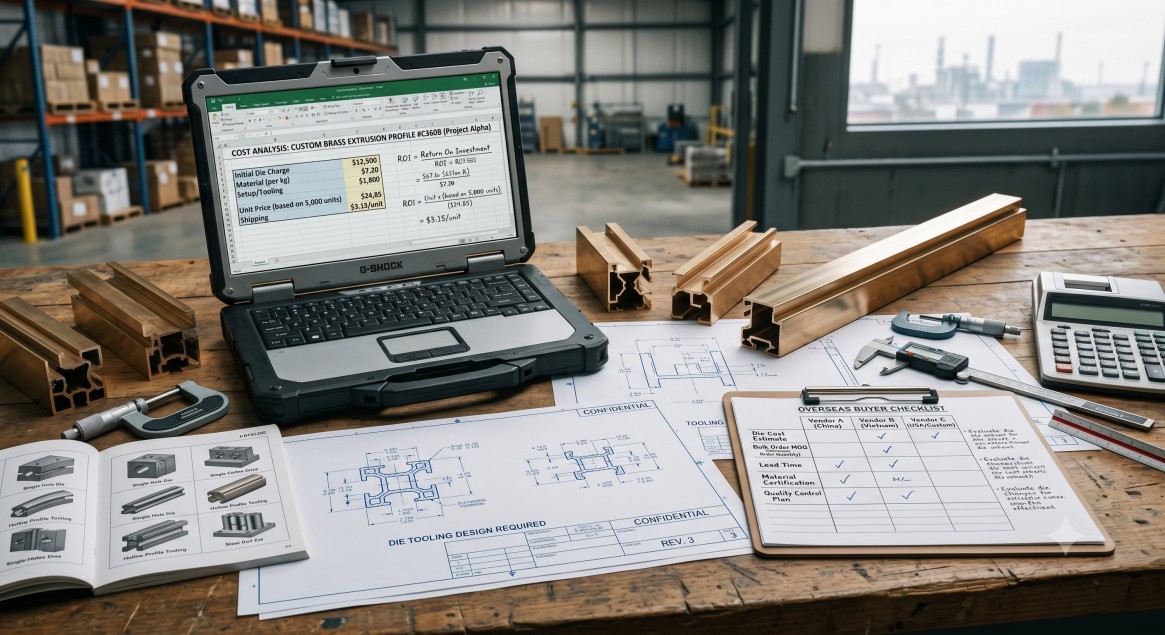
A brass extrusion profile requires a dedicated die when the cross-section is not a standard shape. This die creates the custom geometry, such as grooves, channels, decorative lines, square hollow profiles, special rails, connector shapes, sliding profiles, architectural sections or industrial brass components.
Tooling cost usually depends on:
- Profile size and cross-section complexity
- Wall thickness and corner radius
- Hollow or solid structure
- Dimensional tolerance
- Surface finish requirement
- Trial extrusion difficulty
- Expected production volume
For a one-time small order, tooling cost may feel expensive. For repeated bulk orders, the same tooling cost can become very small after being amortized across meters, kilograms or pieces.
The key is not to ask, “How much is the die?”
The better question is:
“How much does the tooling cost add to each finished piece at my real order volume?”
The Simple Formula Procurement Managers Should Use
Before approving a custom brass extrusion profile, calculate the full cost this way:
| Cost Item | What It Means | How to Reduce It |
|---|---|---|
| Tooling Cost | One-time die or mold charge | Simplify profile design, use existing die if available, combine annual demand |
| Material Cost | Brass alloy cost by kg or meter | Choose proper grade, avoid unnecessary overspecification |
| MOQ Cost | Minimum production quantity | Start with trial quantity, negotiate phased production |
| Machining Cost | Cutting, drilling, milling, CNC finishing | Reduce secondary operations through better profile design |
| Surface Cost | Polishing, brushing, passivation or plating | Match finish to real application, not only appearance |
| Packaging/Freight Cost | Export packing and logistics | Optimize length, weight and carton/crate layout |
A useful working formula is:
Total Procurement Cost = Tooling Cost + Material Cost + Processing Cost + Surface Treatment + Packing + Freight
But the more important number is:
Unit Cost After Tooling = Total Procurement Cost / Total Usable Quantity
This is where many custom extrusion projects become surprisingly reasonable.
Example: Why MOQ Changes the Real Tooling Cost
Assume the tooling cost for a custom brass extrusion profile is USD 800.
- If the trial order is only 200 meters, the tooling cost adds USD 4.00 per meter before material and processing.
- If the order becomes 2,000 meters, the tooling cost adds only USD 0.40 per meter.
- If the project runs 10,000 meters per year, the tooling cost becomes almost negligible.
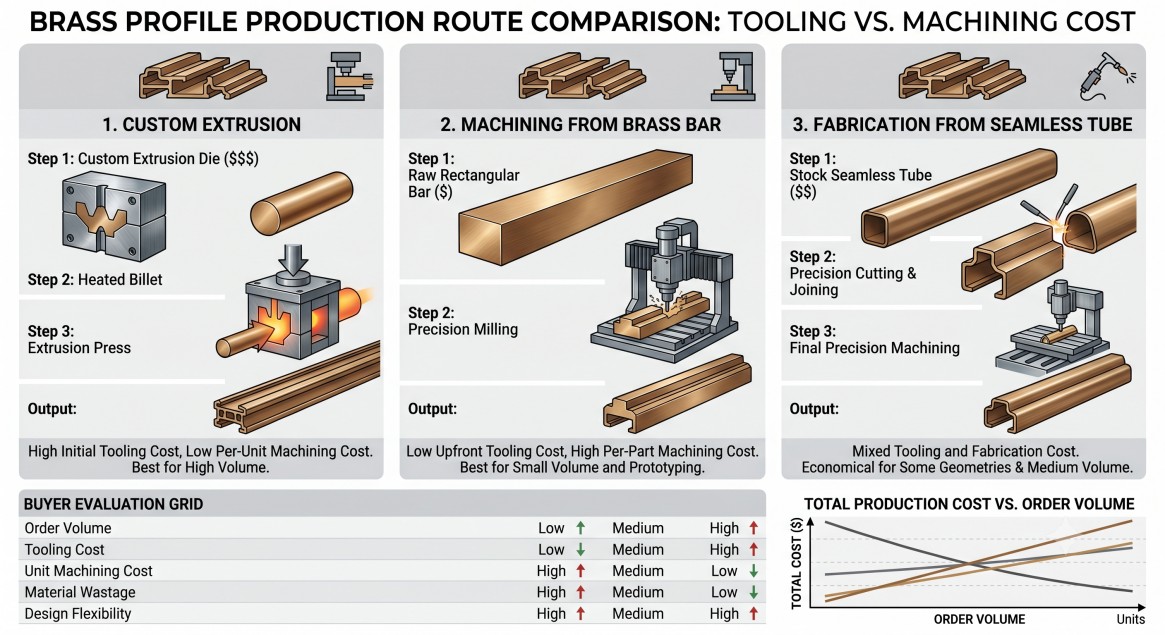
This is why Cymber Metal often helps buyers compare three options before confirming the production route:
- Custom extrusion profile
- Machining from brass bar
- Fabrication from seamless brass tube or square brass tube
For some projects, direct extrusion is best from the first order. For others, machining from Free Machining C36000 Brass Round Bar or Free Machining C36000 Brass Hex Bar can be smarter during prototype or low-volume validation.
When Custom Brass Extrusion Is the Best Choice
Custom brass extrusion becomes attractive when the profile has repeated demand and the shape can reduce secondary machining.
Typical examples include:
- Decorative brass rails and architectural trim
- Electrical brass connector profiles
- Instrument and hardware sections
- Marine brass components
- Sliding channels and guide rails
- Brass frames, supports and structural profiles
- Custom brass square or hollow profiles
- Precision brass parts that would waste too much material if machined from solid bar
If the final part requires repeated milling, slotting, drilling or edge shaping, a custom extrusion may reduce material waste and machining hours.
For profile-based applications, Cymber can support Durable Brass Special Shape Extrusions and custom brass square pipe / shaped tube production based on customer drawings.
When Brass Bar or Seamless Brass Tube Is More Economical
Custom extrusion is not always the first step.
For early-stage product development, small batch repair parts or uncertain annual demand, standard stock may reduce financial risk.
Choose brass bar when:
The part is small, solid, short or heavily machined. C36000 brass bar is often a practical choice for precision turned parts, fittings, pins, inserts, bushings, valve components and hardware parts.
Related Cymber options include C36000 Brass Round Bar, C36000 Brass Hex Bar and C36000 Brass Square Bar.
Choose seamless brass tube when:
The part is hollow, round, used for fluid, heat exchange, decorative, instrumentation or structural applications. If the required profile is close to a tube, starting with Seamless C26000 Brass Round Tube may be more economical than opening a custom die.
Choose brass strip or plate when:
The part is stamped, bent, formed, cut or assembled from flat material. For connector terminals, decorative panels, stamping parts and flexible production runs, Wide Width C26000 Brass Strip or brass sheet may reduce tooling complexity.
How to Reduce Brass Extrusion Tooling Cost
1. Send a Drawing Before Asking for Unit Price
A unit price without a drawing is usually a guess.
For custom brass extrusion profiles, a useful drawing should include:
- Cross-section shape
- Overall width and height
- Wall thickness
- Inner and outer radius
- Tolerance requirement
- Alloy grade
- Surface finish
- Required length
- Estimated annual quantity
- Final application
With these details, Cymber can judge whether the profile needs a new die, can use an existing similar die, or should be produced from bar, tube, strip or plate first.
2. Avoid Over-Tight Tolerances Where They Are Not Needed
Tight tolerances increase tooling difficulty, trial extrusion risk and inspection cost.
For example, a decorative brass trim may not need the same dimensional tolerance as an electrical connector profile. A marine hardware section may need corrosion resistance and strength more than mirror-level surface precision.
If the tolerance is not functional, relaxing it can reduce tooling and processing cost.
3. Design Around Practical Wall Thickness
Very thin walls, sharp corners and uneven thickness can make extrusion less stable.
A more balanced cross-section often improves:
- Die life
- Extrusion yield
- Surface quality
- Straightness
- Dimensional consistency
- Cost per meter
Small design adjustments can reduce both tooling cost and scrap rate.
4. Combine Trial Order and Bulk Order Strategy
For new projects, the most practical procurement route is often:
Prototype or drawing review → Trial die and sample extrusion → Small batch confirmation → Bulk order after assembly approval
This approach helps the buyer avoid paying bulk order cost before the profile is proven.
For repeated demand, Cymber can quote tooling cost separately from material cost, making it easier for the procurement team to show the customer how the unit cost changes at different volumes.
5. Use Existing Stock Forms When They Make Sense
The cheapest profile is sometimes not the custom profile. It may be a standard brass tube, brass bar or brass strip with light machining.
This is why Cymber does not push every drawing directly into extrusion. We compare the production route first.
If your drawing can be made faster from brass bar or tube, we will tell you. If extrusion is more economical for bulk order, we will show the tooling and material cost clearly.
Brass Alloy Selection Also Affects Price
The brass grade matters because machinability, strength, corrosion resistance and forming behavior are different.
| Brass Material | Common Use | Procurement Note |
|---|---|---|
| C36000 free-machining brass | CNC parts, fittings, inserts, precision hardware | Excellent machinability; ideal for bar-based parts |
| C26000 cartridge brass | Sheet, strip, tube, decorative and formed parts | Good ductility and forming behavior |
| C28000 / Muntz metal | Marine and architectural applications | Better for certain corrosion and structural requirements |
| C38500 architectural brass | Profiles and decorative extrusions | Often used for architectural sections |
| H59 / H62 / H65 / H70 | General brass profiles, rods, tubes and plates | Common Chinese grades for industrial supply |
A lower raw material price is not always the lowest project cost. A brass grade with better machinability may reduce CNC time. A grade with better formability may reduce scrap. A better extrusion alloy may improve die performance.
This is why Cymber evaluates alloy, shape and process together.
Why Cymber Metal Is Flexible for Custom Brass Profile Projects
For overseas buyers, flexibility matters more than a beautiful quote sheet.
Cymber Metal can support custom brass extrusion profile projects from several directions:
- Brass stock supply from bars, tubes, plates, strips and special profiles
- Drawing review for tooling cost reduction
- Custom extrusion profile quotation
- Alternative production route comparison
- Cutting, machining and surface processing support
- Bulk order supply and export packing
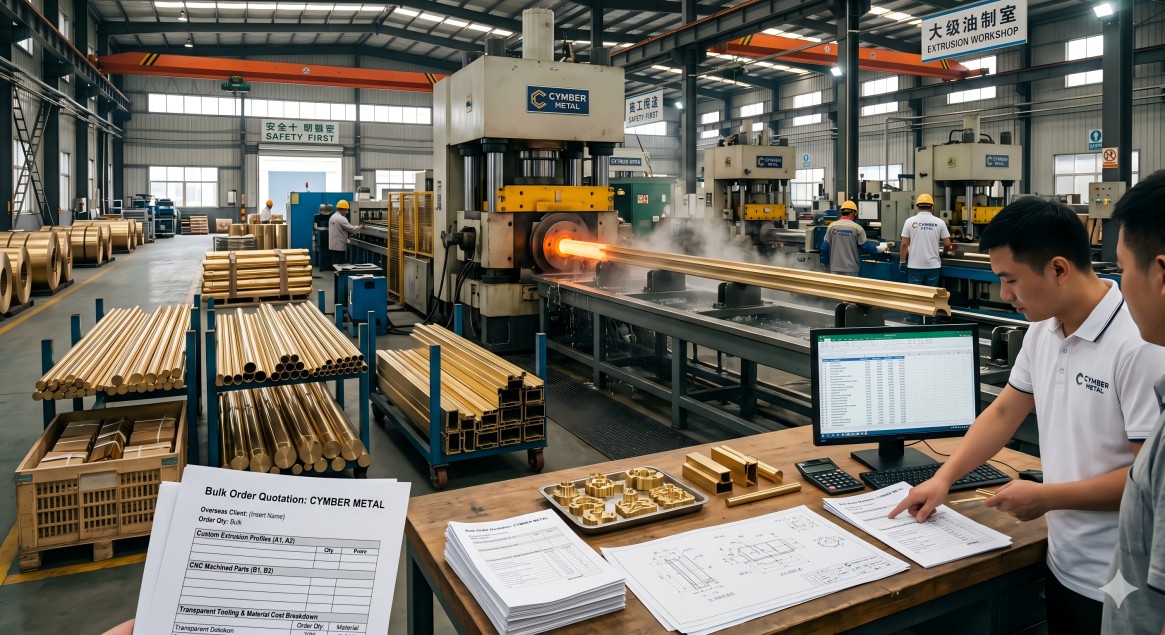
- Transparent quotation with tooling cost and material cost separated
Our advantage is that we are not limited to only one product form. If your drawing is not suitable for extrusion at the first stage, we can consider brass bar, seamless brass tube, brass strip or CNC machining alternatives before you spend tooling money.
This is especially valuable for importers, OEM buyers and project-based procurement teams who need to control both upfront cost and final unit cost.
What We Need From You for a 24-Hour Transparent Quote
To help your team move faster, send us your brass extrusion drawing and basic purchasing information.
Please include:
- 2D or 3D drawing
- Brass alloy grade, if specified
- Required length
- Surface finish
- Estimated trial quantity
- Estimated annual quantity
- Application or end-use
- Destination country or port, if freight estimate is needed
Once we receive the drawing, Cymber Metal can review the profile and provide a transparent quotation within 24 hours, including tooling cost, material cost and recommended production route.
If a lower-risk option is available, such as machining from brass bar or using seamless brass tube first, we will point it out before you approve the die.
Final Takeaway
Reducing brass extrusion tooling cost does not mean forcing the supplier to lower the die charge.
It means choosing the right production route.
For small trial orders, brass bar, brass tube or brass strip may control risk. For repeated bulk orders, custom brass extrusion profiles can reduce machining waste and lower the long-term unit price.
The smartest procurement decision is not always the lowest first quote. It is the route that gives the lowest qualified cost after tooling, MOQ, material, machining and delivery are calculated together.
Send your special brass profile drawing to Cymber Metal. We will help you compare tooling cost, MOQ and bulk order price, then provide a clear quotation within 24 hours.
Learn more about Cymber brass materials: https://www.cymbermetal.com/brass/
FAQ
How can I reduce brass extrusion tooling cost? The best way is to simplify the profile cross-section, avoid unnecessary tight tolerances, confirm practical wall thickness and compare custom extrusion with brass bar or seamless brass tube alternatives before opening the die.
Is custom brass extrusion always cheaper than machining from brass bar? No. For small quantities or early prototypes, machining from brass bar may be cheaper because it avoids tooling cost. For repeated bulk orders, custom extrusion can reduce material waste and machining time.
What information is needed for a brass profile quotation? A supplier usually needs the drawing, alloy grade, length, tolerance, surface finish, trial quantity, annual volume and application. These details allow tooling cost and material cost to be calculated accurately.
What is the relationship between MOQ and tooling cost? The smaller the MOQ, the higher the tooling cost per piece or per meter. When order volume increases, the tooling cost is spread across more material, reducing the effective unit cost.
Can Cymber quote tooling cost and material cost separately? Yes. Cymber can provide a transparent quotation that separates tooling cost, material cost and processing cost, helping overseas buyers evaluate trial orders and bulk orders more clearly.
Ready to reduce your brass extrusion tooling cost and MOQ risk?
Send us your drawing and annual volume. We will provide a transparent comparison of custom extrusion vs. brass bar vs. seamless tube options within 24 hours.
Download 2026 Brass Extrusion Profile Procurement & Tooling Cost Guide (PDF)
Contact Us for Brass Extrusion Profile Quotation
Post time: Jun-16-2026