
Publication Date: June 29, 2026
Author: Hu Yanwei, Cymber Metal Technical Expert
Quick Answer
To reduce tooling cost for a custom brass extrusion profile, buyers should confirm whether the part really needs a new extrusion die, or whether it can be produced from existing brass bar, brass strip, brass tube, brass plate, or CNC-machined brass stock.
For overseas procurement teams, the key is not only asking “How much is the die cost?” A better approach is to review the drawing, annual demand, tolerance, brass grade, MOQ, surface requirement, machining allowance, and final application before confirming the production route.
CYMBER Metal supplies brass materials including brass round bar, brass hex bar, brass square bar, brass strip, brass tube, brass sheet, brass plate, forged brass block, and durable brass special shape extrusions for buyers who need custom profile support before bulk order.
Why Tooling Cost Matters in Brass Extrusion Procurement
Custom brass extrusion profiles are often used when standard brass bars, strips, tubes, or plates cannot meet the final shape requirement. They are common in electrical hardware, architectural parts, precision instruments, industrial connectors, decorative components, machinery parts, and custom fittings.
But extrusion tooling creates an important cost question before mass production:
Should the buyer pay for a new die?
Can the design be adjusted to use existing stock?
Is the MOQ high enough to spread tooling cost?
Will CNC machining be cheaper for the first batch?
A new die can be reasonable for repeated production, but expensive for small trial orders. That is why buyers should evaluate total cost per usable part, not only material price per kilogram.
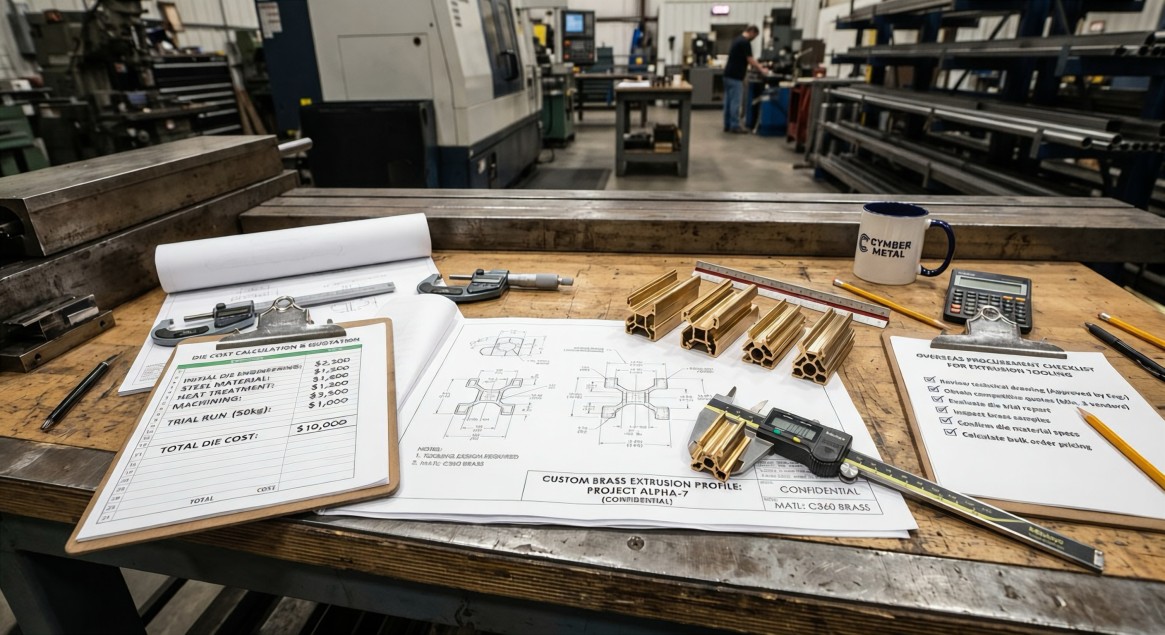
What Is Tooling Cost in Brass Extrusion?
Tooling cost is the cost of making the extrusion die or mold used to form a custom brass profile. It depends on profile complexity, size, tolerance, alloy grade, production volume, and whether later machining is needed.
| Cost Factor | Why It Affects Tooling Cost |
|---|---|
| Profile complexity | More cavities, thin walls, or irregular geometry increase die difficulty |
| Brass grade | Free-machining brass, cartridge brass, and special brass alloys process differently |
| Tolerance | Tight dimensional tolerance may require more die adjustment |
| Surface requirement | Decorative profiles need better surface control |
| MOQ | Higher volume spreads die cost across more pieces |
| Secondary machining | Drilling, milling, slotting, and chamfering affect total cost |
| Trial order quantity | Small batches may make tooling cost look too high per part |
For this reason, a reliable supplier should review the drawing before giving a final price.
Brass Product Options Before Opening a New Die
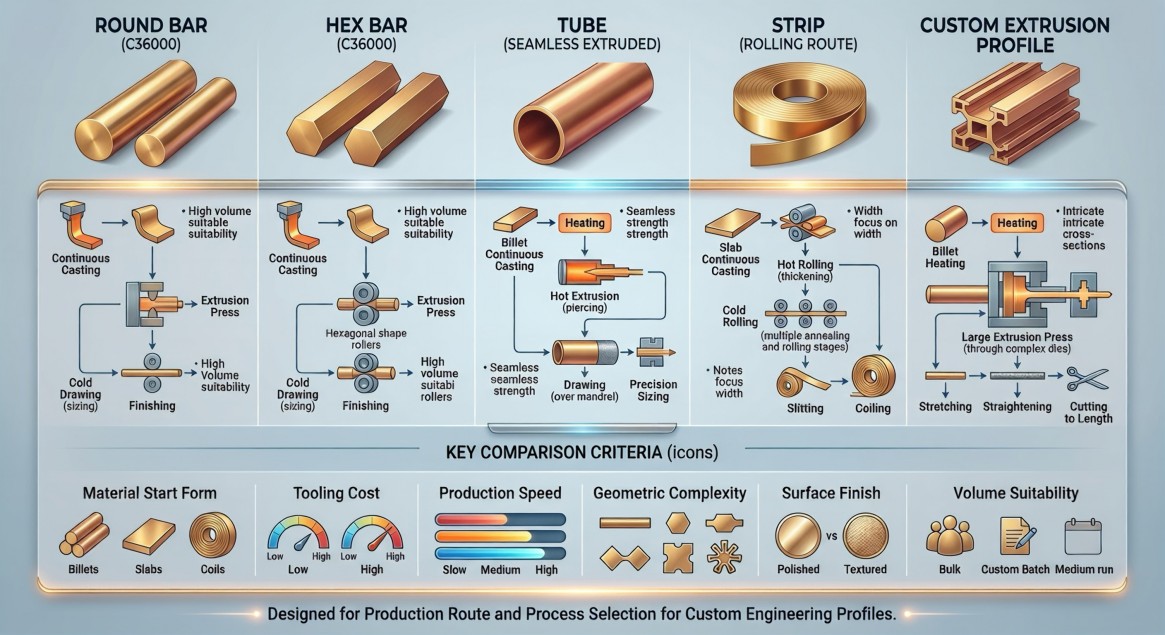
Before confirming a custom brass extrusion profile, buyers should compare alternative stock routes.
| Requirement | Possible CYMBER Product Route | Buyer Benefit |
|---|---|---|
| Round turned parts | C36000 brass round bar | Good machinability, lower tooling risk |
| Hex fittings or nuts | H59 brass hex bar | Suitable for cutting, turning, and threaded parts |
| Stamping or terminals | C26000 brass strip | Better for coils, terminals, shielding, and stamping |
| Tube-shaped parts | H65/H70/H90 brass tube | May avoid custom hollow extrusion tooling |
| Irregular profiles | Brass special shape extrusions | Suitable when stock shapes cannot meet the design |
| Plates or flat parts | Brass sheet / brass plate from Brass products | Useful for flat, milled, or punched components |
This step can save tooling cost before production starts. In many cases, a small design change can turn a custom extrusion problem into a stock-plus-machining solution.
Brass Extrusion vs CNC Machining: Which Is Cheaper?
For custom brass profiles, there is no single answer. The best route depends on order quantity and geometry.
| Production Route | Best For | Limitation |
|---|---|---|
| New brass extrusion die | Repeated bulk orders, long profiles, consistent cross-section | Upfront tooling cost and MOQ |
| CNC machining from brass bar | Trial orders, short runs, precision parts | Higher unit machining cost |
| Milling from brass plate | Flat or semi-flat custom shapes | Material waste may be higher |
| Stamping from brass strip | Thin parts, terminals, electrical contacts | Requires stamping tooling |
| Brass tube modification | Hollow or sleeve-like parts | Shape flexibility is limited |
A practical rule:
Small trial order: consider stock + CNC machining.
Repeated bulk order: consider extrusion tooling.
High-precision thin part: consider strip + stamping.
Hollow part: check standard brass tube first.
CYMBER can support custom processing coordination through the CNC Machining Workshop when buyers need brass stock converted into finished parts.
How MOQ Changes the Real Tooling Cost
Tooling cost should be calculated per usable piece.
Tooling Cost Per Piece =
Total Tooling Cost / Usable Quantity
Example:
| Order Quantity | Tooling Cost | Tooling Cost Per Piece |
|---|---|---|
| 500 pcs | USD 800 | USD 1.60 |
| 2,000 pcs | USD 800 | USD 0.40 |
| 10,000 pcs | USD 800 | USD 0.08 |
This is why a die may look expensive for a small order but become reasonable for long-term production.
For buyers with uncertain demand, one smart approach is:
Prototype with CNC machining first.
Confirm design and assembly performance.
Then open extrusion tooling for stable bulk order.
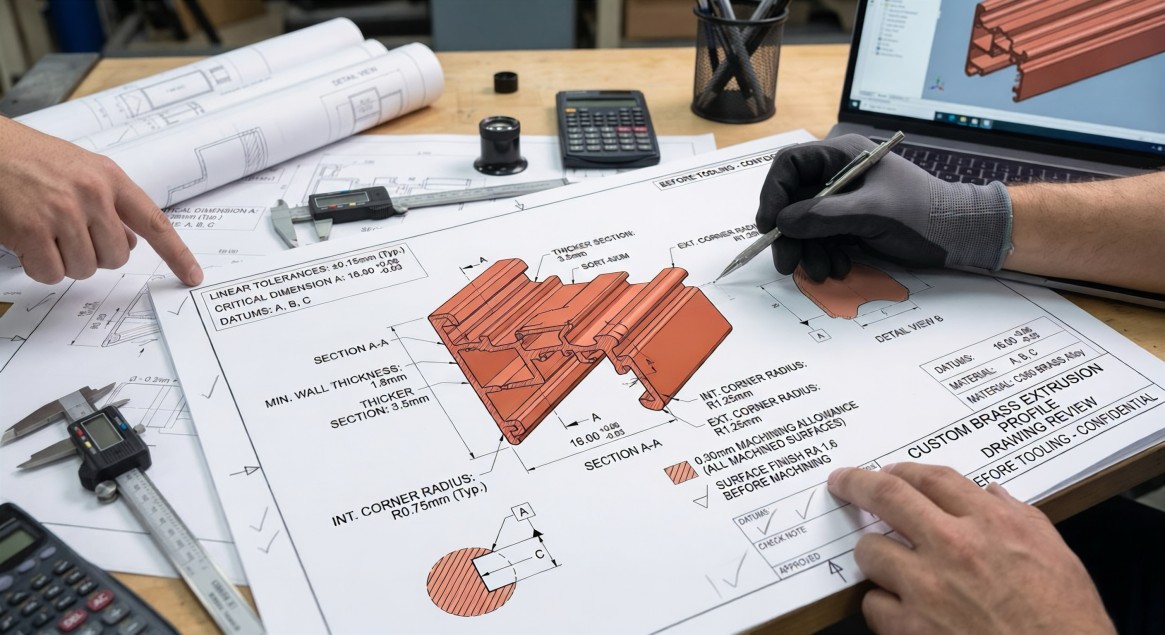
Drawing Review: What Buyers Should Send
A good quotation starts with a complete drawing package. Buyers should send:
- 2D drawing with dimensions and tolerance
- 3D file if available
- Brass grade or application requirement
- Profile length
- Annual demand or target batch quantity
- Surface finish requirement
- Machining requirement after extrusion
- Packaging and destination country
- Target delivery schedule
If the buyer does not know the exact brass grade, CYMBER can help compare options such as C36000, C26000, C26800, C28000, H59, H62, H65, H70, and other common brass grades based on application.
Which Brass Grade Should Buyers Consider?
Different brass grades create different cost and processing results.
| Brass Grade | Typical Use | Buyer Notes |
|---|---|---|
| C36000 | Machined parts, fittings, precision components | Excellent machinability |
| C26000 | Strip, sheet, terminals, formed parts | Good ductility and formability |
| C26800 | Decorative and formed brass parts | Good balance of formability and appearance |
| C28000 | Muntz metal, plates, marine-related parts | Higher zinc content, good strength |
| H59 / H62 | General brass bar, hardware, machining | Common commercial brass options |
| H65 / H70 | Tubes, decorative and formed parts | Good formability and corrosion resistance |
For custom brass extrusion profiles, the final grade should be selected based on shape difficulty, machinability, strength, surface finish, and cost target.
How to Reduce Tooling Cost Before Bulk Order
Buyers can reduce tooling risk with these steps:
| Step | Practical Action | Result |
|---|---|---|
| Review existing stock | Check brass bar, tube, strip, plate first | Avoid unnecessary die cost |
| Simplify profile geometry | Reduce thin walls, sharp corners, and complex cavities | Lower die difficulty |
| Confirm tolerance correctly | Avoid over-tight tolerance where not needed | Reduce die adjustment cost |
| Prototype first | Use CNC machining or small-batch processing | Verify design before tooling |
| Increase usable quantity | Combine demand or plan annual quantity | Spread tooling cost |
| Confirm surface finish early | Decorative finish affects route and cost | Avoid rework |
| Separate material and processing cost | Ask for transparent quotation | Easier supplier comparison |
Transparent Quotation Structure
For custom brass extrusion profiles, buyers should ask for a quotation that separates cost items.
Final Cost =
Brass Material Cost
+ Tooling Cost
+ Extrusion / Processing Cost
+ CNC Machining or Secondary Processing
+ Surface Treatment
+ Inspection
+ Packaging
+ Freight or Export Handling
This is more useful than a single unit price because it shows where the real cost is coming from.
If a supplier only provides one vague price, buyers may not know whether the die, machining, packaging, or inspection is included.
Inspection Points for Brass Extrusion Profiles
Before shipment, buyers should confirm:
| Inspection Item | Why It Matters |
|---|---|
| Brass grade | Confirms material identity |
| Cross-section dimensions | Ensures profile matches drawing |
| Straightness | Important for assembly and machining |
| Surface quality | Affects appearance, plating, and fitting |
| Wall thickness | Critical for irregular profiles |
| Machining allowance | Ensures later drilling or milling is possible |
| Hardness or mechanical properties | Useful for functional parts |
| Packaging | Prevents scratches and deformation during export |
For decorative or visible parts, surface inspection should be stricter. For electrical or mechanical parts, dimension and material verification are more important.
Why Buyers Work With CYMBER Metal
CYMBER Metal supports overseas buyers who need brass materials, custom extrusion review, and processing coordination before bulk order.
Our support includes:
- Brass material supply including rod, bar, strip, tube, sheet, plate, and special profiles
- Brass special shape extrusion support for custom profile projects
- C36000 brass round bar and H59 brass hex bar options for machining routes
- C26000 brass strip support for stamping and electrical applications
- Brass tube support for hollow or sleeve-like components
- Drawing review before tooling quotation
- CNC machining coordination for custom brass components
- Export packing and shipment support
If you are evaluating a custom brass extrusion profile, send your drawing, target quantity, brass grade, tolerance, surface finish, and annual demand through the CYMBER Metal contact page. Our team can help compare tooling cost, MOQ, material route, and processing plan.
Conclusion
Reducing tooling cost for a brass extrusion profile is not only about negotiating a lower die price. The better strategy is to confirm whether extrusion is the right route, compare available brass stock, review the drawing, calculate MOQ impact, and separate tooling cost from material and processing cost.
For overseas buyers, this approach helps avoid unnecessary die charges, reduce sampling risk, and build a more transparent quotation before bulk order.
FAQ
What is a brass extrusion profile?
A brass extrusion profile is a custom or standard brass shape produced by forcing heated brass through a die. It is used when a continuous cross-section is needed for industrial, electrical, decorative, or mechanical applications.
How can buyers reduce brass extrusion tooling cost?
Buyers can reduce tooling cost by checking existing brass stock first, simplifying profile geometry, confirming realistic tolerance, prototyping before die opening, and increasing usable order quantity.
Is brass extrusion better than CNC machining?
Brass extrusion is better for repeated bulk orders with a consistent cross-section. CNC machining is often better for small trial orders, complex short parts, or designs that are not ready for tooling.
What information is needed for a brass extrusion profile quote?
A supplier usually needs the drawing, brass grade, profile size, tolerance, length, quantity, surface finish, machining requirement, packaging requirement, and delivery schedule.
Can CYMBER support custom brass extrusion profiles?
Yes. CYMBER supports brass material supply, brass special shape extrusion review, CNC machining coordination, inspection support, export packing, and quotation preparation for custom brass profile projects.
Post time: Jun-29-2026