
Published: May 11, 2026
By: Yanwei Hu, Technical Expert at Cymber Metal
Good morning everyone,
Yanwei Hu here from Cymber Metal.
When engineers narrow down to beryllium copper vs phosphor bronze for precision components, the choice usually comes down to a few critical questions: Will this part survive millions of flex cycles? Does it need to carry current without overheating? Can it hold spring force under thermal load?
C17200 beryllium copper and C51000/C52100 phosphor bronze are both proven copper-based alloys used in connectors, springs, bushings, and electrical contacts. But they are not interchangeable. Picking the wrong one often leads to prototype iterations, rework, or — in the worst cases — field failures.
At Cymber Metal we stock both alloys in ASTM-certified grades and machine them to finished components in-house every week. Here’s what the real data and shop-floor experience actually show.
Mechanical Strength: How C17200 and C51000 Actually Compare
Tensile and Yield Strength by Temper
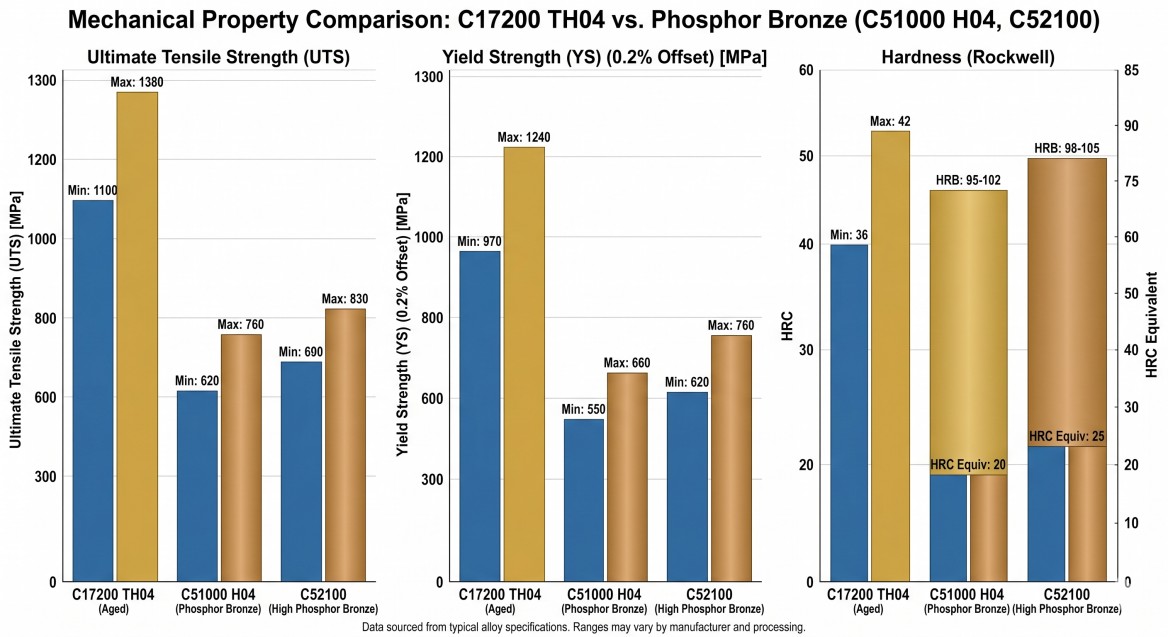
C17200 in peak-aged TH04 temper reaches 1240–1520 MPa UTS (roughly 180–220 ksi), with yield strength up to 1210 MPa. C51000 in H04 hard temper tops out at 550–760 MPa. C52100 (8% tin) pushes slightly higher at 690–860 MPa.
Beryllium copper can deliver 1.4–2× higher tensile strength depending on the tempers being compared. The practical number you design with depends entirely on temper — a mill-hardened TD02 and a fully aged TH04 are meaningfully different materials even from the same UNS number.
Hardness, Elastic Modulus, and Spring Design Implications
Elastic modulus directly affects spring design. C17200 sits at 125–131 GPa; phosphor bronze runs 103–117 GPa. Higher modulus means more stored energy per unit of deflection, producing a stiffer spring at the same geometry.
Hardness tells a similar story: C17200 TH04 reaches Rockwell C38–44, while C51000 H04 lands at Rockwell B70–85. That gap has a measurable effect on bushing wear resistance.
Phosphor bronze is not simply “weaker” — it represents a lower-strength, higher-ductility tradeoff. C51000 in the annealed condition achieves elongations of 40–60%, compared to just 2–15% for BeCu at peak strength. When your application needs tight formed geometries and moderate mechanical loads, that ductility becomes the relevant property.
Fatigue Life and Cyclic Loading Performance
Endurance Limits and S-N Curve Data
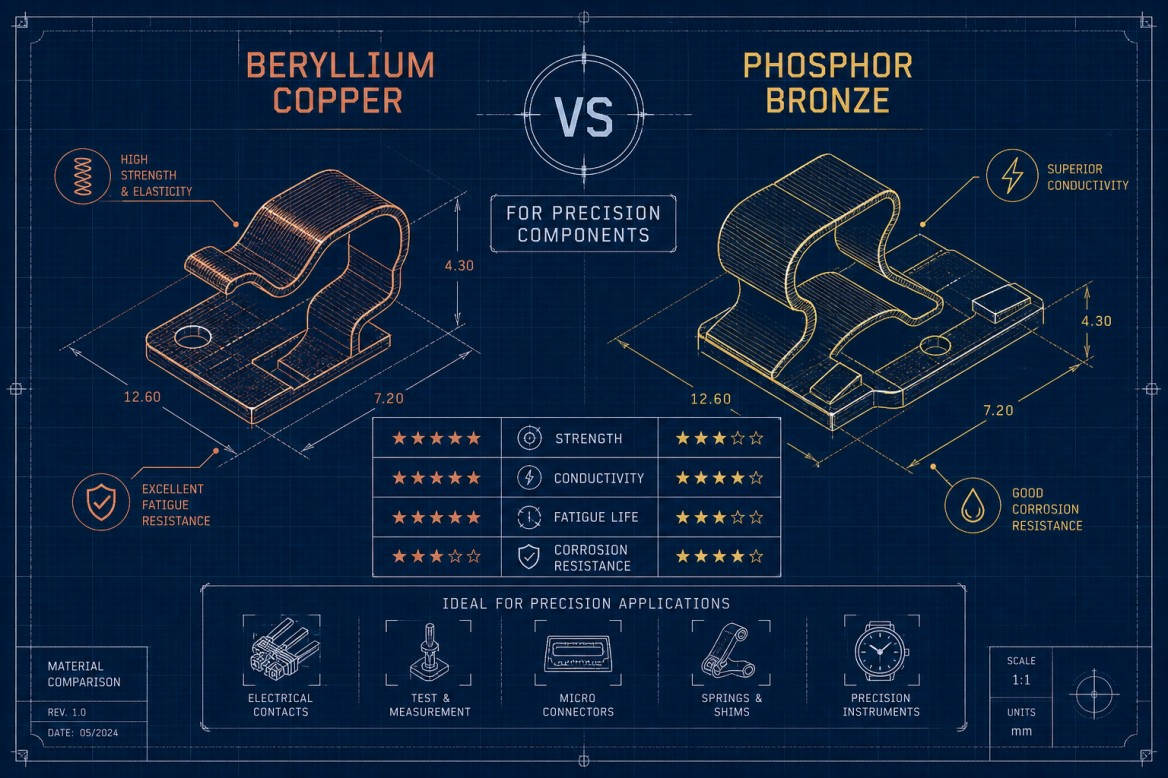
The most decisive number in this comparison is fatigue life. In rotating bending fatigue tests, BeCu Alloy 25 has demonstrated substantially longer fatigue life than phosphor bronze under equivalent cyclic stress conditions — often several times greater at comparable stress amplitudes.
C17200 shows an endurance limit of approximately 442 MPa at 10⁷ cycles in rotating bending at room temperature, dropping to around 400 MPa at 350°C and 272 MPa at 450°C where phase transitions weaken grain boundaries. Phosphor bronze lacks a well-defined endurance limit in this range.
See the ASM International data on beryllium copper for detailed material behavior and fatigue data when comparing these alloys.
The slope of the S-N curve determines your design margin. BeCu’s curve falls more gradually, giving meaningful fatigue life at lower stresses. Phosphor bronze reaches its fatigue knee earlier, meaning design stress must be reduced substantially to reach the same cycle target on a 10-million-cycle requirement.
Stress Relaxation and Spring Set
Stress relaxation extends BeCu’s advantage beyond raw fatigue numbers. Under sustained load or thermal cycling, phosphor bronze loses spring force over time. BeCu retains its mechanical properties above 300°C — critical for relay springs, connector contacts under repeated thermal cycling, and high-frequency switches where spring set failure is a real failure mode, not just a lab result.
Electrical and Thermal Conductivity Compared
IACS Values and What Drives the Gap
C17200 in aged condition delivers 22–60% IACS depending on temper and aging cycle. C51000 phosphor bronze typically falls between 12–20% IACS, with a representative value around 15%.
The gap traces directly to alloy composition: beryllium at 1.8–2% disrupts the copper lattice less than tin at 5–10% combined with phosphorus. Thermal conductivity follows the same relationship via the Wiedemann-Franz law. Based on these IACS values, BeCu runs approximately 130–170 W/m·K, while phosphor bronze sits at roughly 40–70 W/m·K.
For a concise overview of beryllium copper conductivity and application guidance, see this material summary: AZoM beryllium copper overview.
Matching Conductivity to Component Type
For contacts and relay springs carrying meaningful current, BeCu’s conductivity advantage is directly functional. Higher conductivity means less resistive heating, which extends contact life and reduces the thermal stress that accelerates fatigue.
For bushings and wear pads, conductivity is irrelevant. The filter is simple: if current-carrying capacity or heat dissipation appears in the spec, conductivity is a decision variable. If not, remove it from the comparison and let cost lead.
Machinability, Formability, and Heat Treatment Requirements
Heat Treatment Schedules and Forming Limits
C17200 requires a two-step thermal process: solution anneal at 800–850°C, followed by age hardening at 315°C for 2–3 hours to reach peak strength. That process adds real complexity — furnace scheduling, quench timing, and overaging risk.
Phosphor bronze achieves its working properties through cold reduction alone. C51000 and C52100 require no aging cycle whatsoever.
For a practical, application-focused heat treatment reference for C17200, see this technical guide on heat treatment of C17200.
Forming limits differ by alloy and temper. C17200 is best formed in the annealed condition before aging; bending after full aging in TH04 temper risks cracking, particularly on the outside radius. Phosphor bronze in O temper handles bend radii down to 0–1T; in H04 it climbs to 4–6T for C510 and 6–8T for C521.
Machining Recommendations and Beryllium Safety
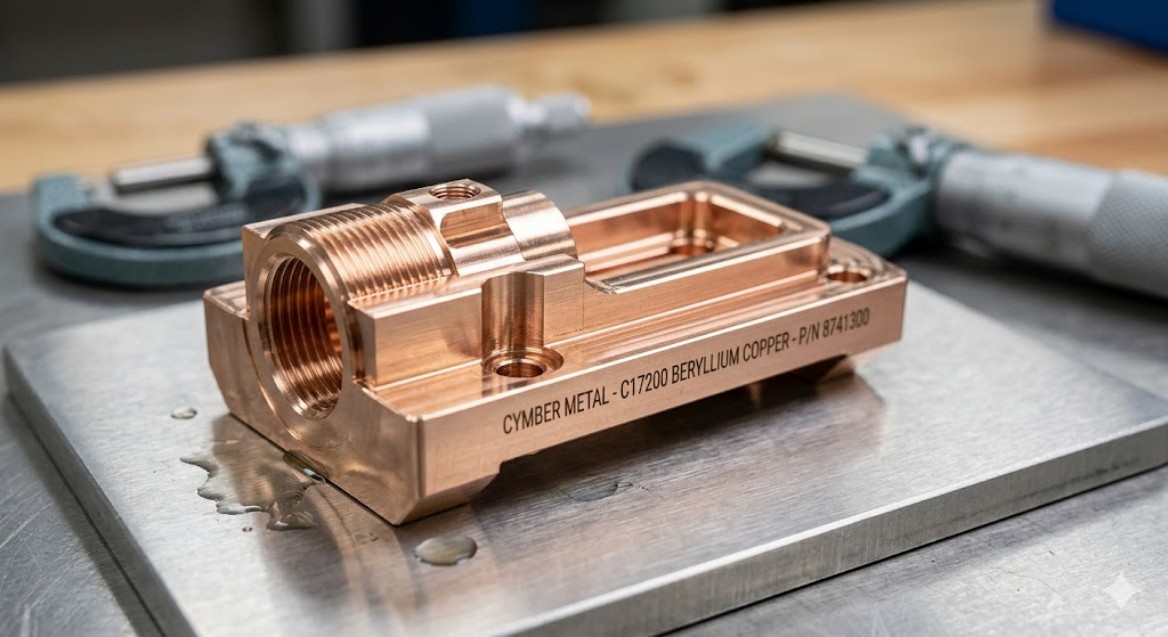
Machine C17200 with carbide tooling at 150–350 SFM with flood coolant. Wherever process flow allows, machine pre-aging: the annealed material is softer, produces cleaner chip formation, and extends tool life significantly.
The beryllium hazard requires direct treatment, not a footnote. Beryllium dust from machining BeCu is a serious inhalation risk and a recognized carcinogen at chronic exposure levels. OSHA’s current permissible exposure limit sits at 0.2 μg/m³ TWA, with an action level of 0.1 μg/m³. Local exhaust ventilation, HEPA filtration, engineering enclosures, and certified handling procedures are mandatory.
Engineers who outsource CNC machining to a supplier already operating under compliant protocols remove that safety compliance burden from their own facility. Cymber Metal’s CNC machining operations are built around these requirements.
For more on regulatory expectations and the OSHA beryllium standard, review this industry summary: OSHA’s beryllium standard guidance.
Cost, Lead Time, and Sourcing in 2026
BeCu commands a significant premium over phosphor bronze — roughly 25–40% higher — driven by beryllium raw material concentration and the regulatory cost of processing. Phosphor bronze input costs have risen meaningfully through 2025–2026, with elevated copper and tin prices expected to persist. BeCu supply is tighter and lead times stretch when automotive, aerospace, and defense demand competes for the same certified stock.
For small-to-mid production runs, procurement complexity adds hidden cost. Sourcing certified C17200 or C51000 strip and then qualifying a separate CNC machining vendor introduces coordination overhead, additional QC checkpoints, and slower engineering change cycles.
At Cymber Metal we stock both alloys in ASTM/AMS-certified grades and produce finished precision components in-house from a single facility. You can explore our full beryllium copper range here: Beryllium Copper Products and our phosphor bronze & bronze alloys options here: Phosphor Bronze.
Beryllium Copper vs Phosphor Bronze – Practical Decision Framework
Three questions drive the alloy decision:
- What cyclic stress and fatigue life does the component require?
- Does the component carry current or require thermal management?
- What is the total cost tolerance, including machining and compliance overhead?
| Application Type | Recommended Alloy | Primary Reason |
|---|---|---|
| Relay springs, high-cycle snap-action contacts | C17200 | Spring set failure at temperature is dominant failure mode |
| Precision connectors in demanding thermal environments | C17200 | Fatigue life and conductivity both critical |
| Bearing bushings and thrust washers | C51000 / C52100 | Fatigue and conductivity not limiting; cost and formability favor phosphor bronze |
| Lower-frequency spring contacts | C51000 / C52100 | Cycle count within phosphor bronze capability |
| Moderate-duty connector contacts | Either (by analysis) | Depends on cycle count and current load |
The two most common misjudgments run in opposite directions: specifying phosphor bronze for a high-cycle spring and watching it fail early, or specifying C17200 for a bushing with no conductivity or fatigue requirement and paying a 40% premium for zero performance gain.
Frequently Asked Questions
Is beryllium copper stronger than phosphor bronze? Yes, significantly. C17200 in peak-aged TH04 temper reaches 1240–1520 MPa UTS compared to 550–760 MPa for C51000 in H04 — roughly 1.4–2× higher depending on tempers compared. Phosphor bronze compensates with higher ductility (40–60% elongation vs 2–15% for BeCu at peak strength), making it better where tight forming is required.
Which alloy has better fatigue life for high-cycle spring applications? Beryllium copper. C17200 shows an endurance limit of approximately 442 MPa at 10⁷ cycles in rotating bending at room temperature. Phosphor bronze lacks a well-defined endurance limit at equivalent stress levels.
Is phosphor bronze safe to machine without special precautions? Yes. Phosphor bronze poses no significant inhalation hazard in standard machining. Beryllium copper requires strict controls (OSHA PEL 0.2 μg/m³ TWA). Outsourcing BeCu machining to a certified supplier removes this compliance burden from your facility.
When does phosphor bronze make more sense than beryllium copper? For applications without high fatigue requirements or current-carrying specifications — bushings, thrust washers, formed brackets, lower-frequency spring contacts — phosphor bronze typically delivers adequate performance at 25–40% lower material cost with no heat treatment cycle required.
Can I get both alloys machined to finished parts from a single supplier? Yes. Cymber Metal stocks C17200 and C51000/C52100 in ASTM/AMS-certified grades and produces finished precision components in-house. A single-source supplier for both material and machining reduces qualification overhead and speeds engineering change cycles.
Final Thoughts
Choosing between beryllium copper and phosphor bronze for precision components comes down to three intersecting variables: fatigue life, conductivity requirements, and total cost of ownership. BeCu leads on strength, fatigue life, and conductivity. Phosphor bronze leads on cost, formability, and process simplicity.
Get the alloy right before you cut metal. The numbers above give you the basis for that decision.
At Cymber Metal we carry both alloys in verified stock and machine them to finished parts without requiring a second vendor. Getting material selection right at this stage delivers more value than any cost optimization downstream.
Ready to review your drawing? Send it over — we’ll give you straight, practical advice on the right alloy, realistic tolerances, and a clear timeline.
Contact Us for Precision Copper Alloy Component Support
Post time: May-11-2026