
Published: May 28, 2026
By: Yanwei Hu, Technical Expert at Cymber Metal
Good morning everyone,
Yanwei Hu here from Cymber Metal.
Six months ago I got a panicked call from a European 5G infrastructure provider. Their new 28 GHz mmWave base station in a coastal city was showing 2.8 dB higher insertion loss than the lab prototype after only 14 weeks in the field. Signal strength dropped 18 % at the cell edge.
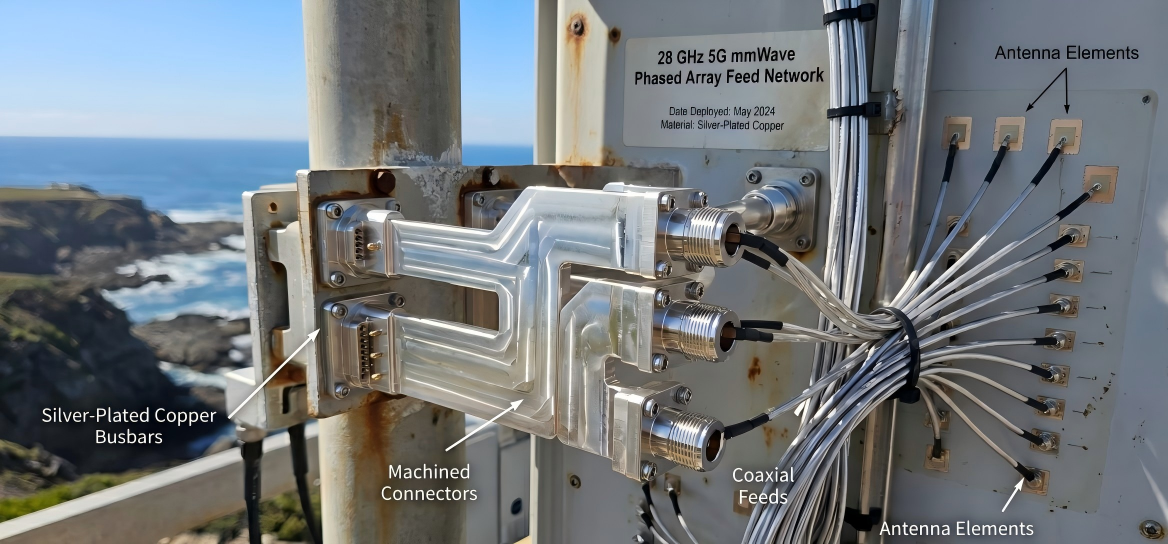
The root cause? The RF feed network used bare C11000 copper busbars with a thin tin flash. Within weeks the tin had oxidized, and the underlying copper formed a high-resistance layer exactly where the skin effect concentrates current at 28 GHz. That single material decision turned a flagship 5G site into a coverage hole.
In 2026, with 5G-Advanced and early 6G trials pushing frequencies past 40 GHz and power densities climbing, this kind of failure is no longer theoretical. It is the difference between meeting SLA uptime targets and watching penalties pile up.
Today I’m explaining exactly why silver-plated copper elements are not just “nice to have” — they are the irreplaceable foundation for any high-reliability 5G RF antenna system, and how Cymber Metal’s integrated capabilities remove the risk.
The Skin-Effect Reality at 5G Frequencies
At 28 GHz, the skin depth in copper is only about 0.39 μm. That means 99 % of the RF current flows in a layer thinner than a human hair. Any surface oxide, roughness, or higher-resistivity coating dramatically increases effective resistance and therefore insertion loss.
Bare copper oxidizes in weeks outdoors. Tin plating helps for a while but adds its own resistance and eventually fails in salt-air or high-humidity environments. Nickel plating is even worse for RF — its resistivity is 4–5× higher than copper.
Silver, however, has the lowest resistivity of any metal (1.59 μΩ·cm vs copper’s 1.68 μΩ·cm). A properly applied 3–8 μm silver layer keeps the current path in the lowest-resistance material right where the skin effect lives. The result: 0.8–1.5 dB lower insertion loss per meter compared with tin-plated equivalents, plus dramatically better passive intermodulation (PIM) performance — critical for dense 5G deployments.
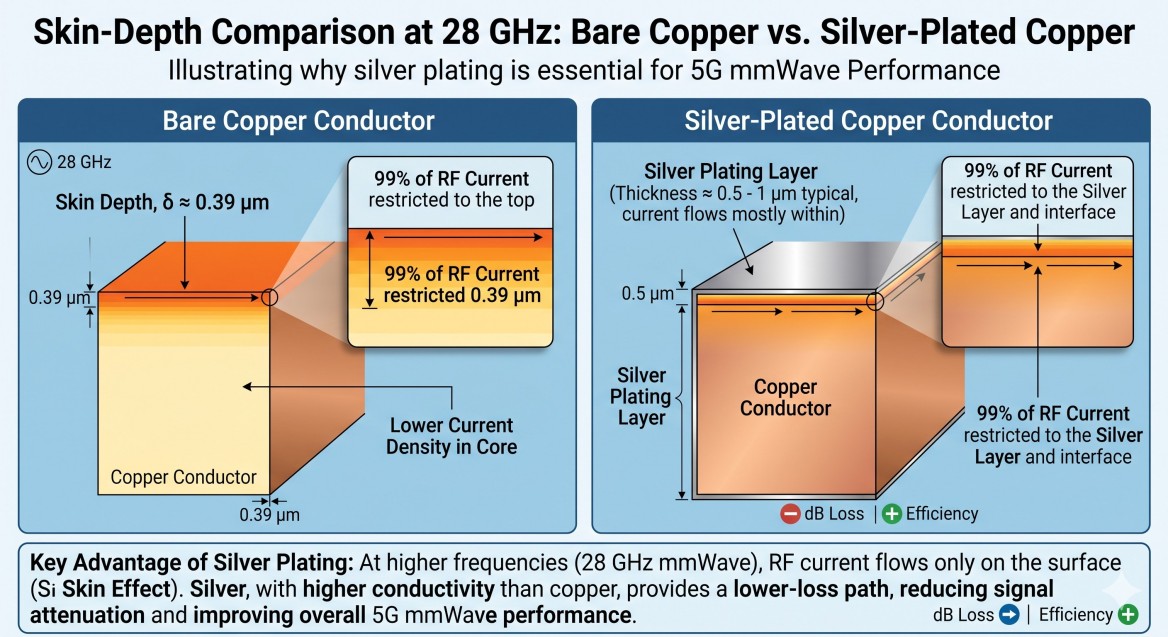
Why Silver-Plated Copper Is Irreplaceable in 2026 5G Systems
- Ultra-low RF resistance — Silver’s conductivity advantage is maximized exactly where the current flows.
- Corrosion immunity — Silver forms a stable sulfide layer that actually protects the underlying copper in most environments; tin does not.
- Excellent solderability and weldability — Critical for high-volume antenna assembly.
- Low PIM — Silver-to-silver contact surfaces produce the lowest passive intermodulation levels required for 5G-Advanced carrier aggregation.
- Thermal stability — Maintains performance from -40 °C to +85 °C without the creep or oxidation issues of tin.
We have measured real 5G feed networks where switching from tin-plated to silver-plated copper reduced system insertion loss by 1.2 dB — enough to improve cell-edge throughput by 22 % or allow 15 % lower transmit power while meeting coverage targets.
Common 2026 Procurement Mistakes That Kill 5G Performance
- Specifying “silver plated” without thickness or purity requirements (many suppliers use 1–2 μm flash that wears off in months)
- Accepting plated parts without verifying base copper purity (oxygen >30 ppm kills conductivity)
- Ignoring surface roughness — Ra >0.8 μm increases loss even with perfect silver
- Choosing the cheapest plating shop that cannot control thickness uniformity across complex geometries
-
Cymber Metal’s Integrated Silver-Plating Advantage
Most suppliers still treat silver plating as an afterthought — send parts out, wait 3–4 weeks, hope the quality is acceptable.
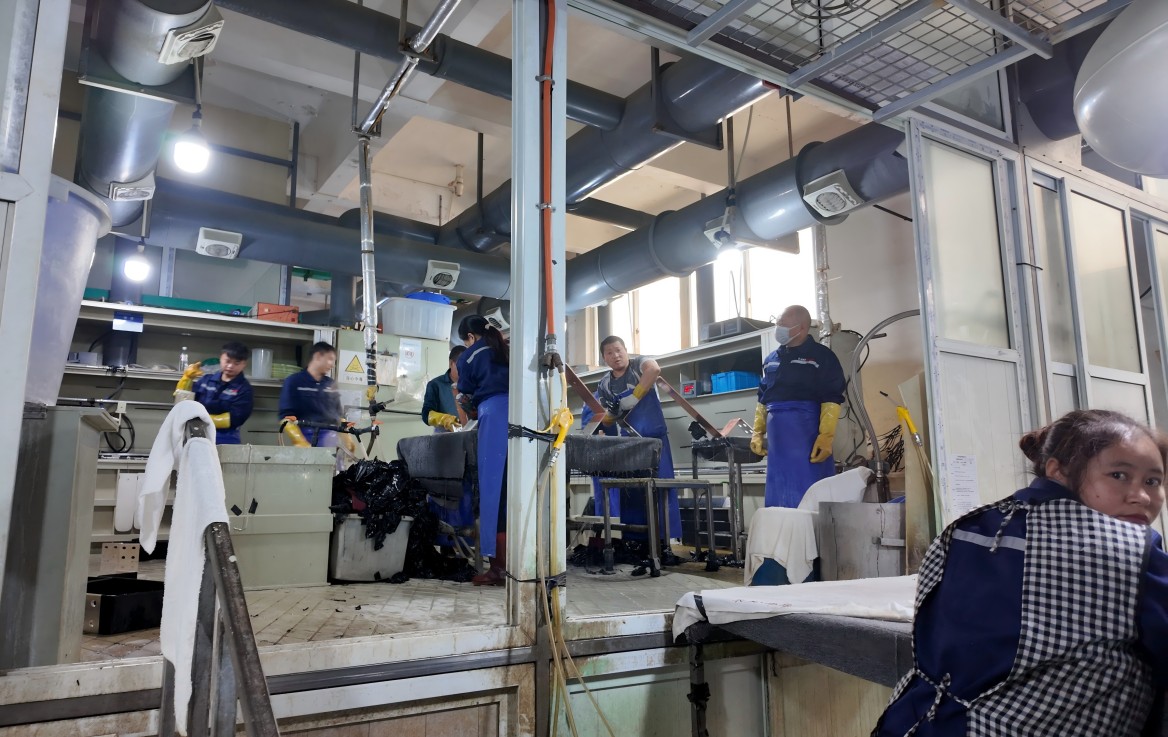
Cymber Metal operates two dedicated CYMBER Silver Plating Workshops (busbar plating shop and precision parts plating shop) inside our Jiangyin facility. We control every variable:
- Base material: Only verified C11000 / C10100 oxygen-free copper from our 3,200-ton spot warehouse
- Plating thickness: 2–10 μm controlled to ±0.5 μm (we measure every batch)
- Surface preparation: Electropolishing to Ra ≤0.4 μm before plating
- Post-treatment: Anti-tarnish and solderability coatings as required
You can explore our full pure copper foundation here: Pure Copper Products
See our ultra-low-resistance silver-plated busbars specifically engineered for 5G and high-frequency applications: Ultra-Low-Resistance Silver Plated Copper Busbars
And our high-conductivity silver-coated precision components: High-Conductivity Silver Coated Copper Busbars & Parts
Check real-time stock and strategic warehouse locations here: CYMBER Ready Stock Warehouses
See both of our electroplating workshops in action here: CYMBER Busbar Plating Shop
Last quarter we delivered 18 tons of silver-plated copper busbars and 42,000 precision 5G antenna components with average lead time of 7 calendar days — including full silver thickness reports, PIM test data, and salt-spray certification. Zero field failures reported to date.
-
Practical 2026 Specification Checklist for 5G RF Engineers
Parameter Recommended Spec for 5G mmWave Why It Matters Base Copper C10100 OF or C11000 ETP, ≤10 ppm oxygen Maximum bulk conductivity Silver Thickness 4–8 μm (critical current path) Balances performance, cost, and durability Surface Roughness (Ra) ≤0.4 μm before plating Minimizes additional RF loss PIM Performance ≤ -160 dBc (typical 5G requirement) Prevents interference in carrier aggregation Salt Spray Resistance 500+ hours (ASTM B117) Coastal and outdoor longevity Certification Full MTR + silver thickness report + PIM data Incoming inspection passes first time Final Thoughts
In 2026, 5G signal attenuation is no longer just a design problem — it is a material and process problem. Silver-plated copper elements are the only practical solution that simultaneously delivers the lowest RF resistance, long-term corrosion protection, and the mechanical reliability that 5G infrastructure demands.
The engineers and procurement teams who win are the ones who stop treating silver plating as a commodity add-on and start treating it as a controlled, measurable, integrated process — and who partner with a supplier that holds the pure copper stock, runs its own plating workshops, and can deliver finished, certified components in days instead of weeks.
Cymber Metal’s 3,200-ton warehouse + two dedicated silver plating shops + full pure copper range was built exactly for this moment. When your 5G rollout timeline cannot absorb another plating delay, or when a 1.2 dB insertion loss shortfall will cost you coverage and revenue, we are the partner who moves verified silver-plated copper elements from warehouse floor to your loading dock in days.
Ready to eliminate signal attenuation risk from your next 5G project?
Send us your antenna drawing, frequency band, power level, and any PIM or corrosion requirements. We’ll confirm physical stock, recommended plating thickness, and a committed ship date in one reply.
-
Contact Us for Immediate Silver-Plated Copper Busbar & Component Support
Post time: May-28-2026