
Published: June 18, 2026
By: Yanwei Hu, Technical Expert at Cymber Metal
For overseas buyers, sourcing custom aluminum extrusion is rarely just a unit price comparison.
A supplier may quote a very attractive price per kilogram, but the final project cost can change quickly once tooling cost, MOQ, alloy selection, machining allowance, surface finish, packaging, lead time and inspection are included.
In 2026, procurement teams are under more pressure to reduce cost without increasing supply risk. This is especially true for custom aluminum profiles used in industrial equipment, transportation systems, electrical enclosures, automation frames, heat dissipation structures, marine components and machinery parts.
At Cymber Metal, we support overseas buyers with aluminum alloy materials, custom cutting, extrusion-related stock selection and downstream machining support. This guide explains four practical checkpoints buyers should review before choosing a custom aluminum extrusion supplier for bulk order.
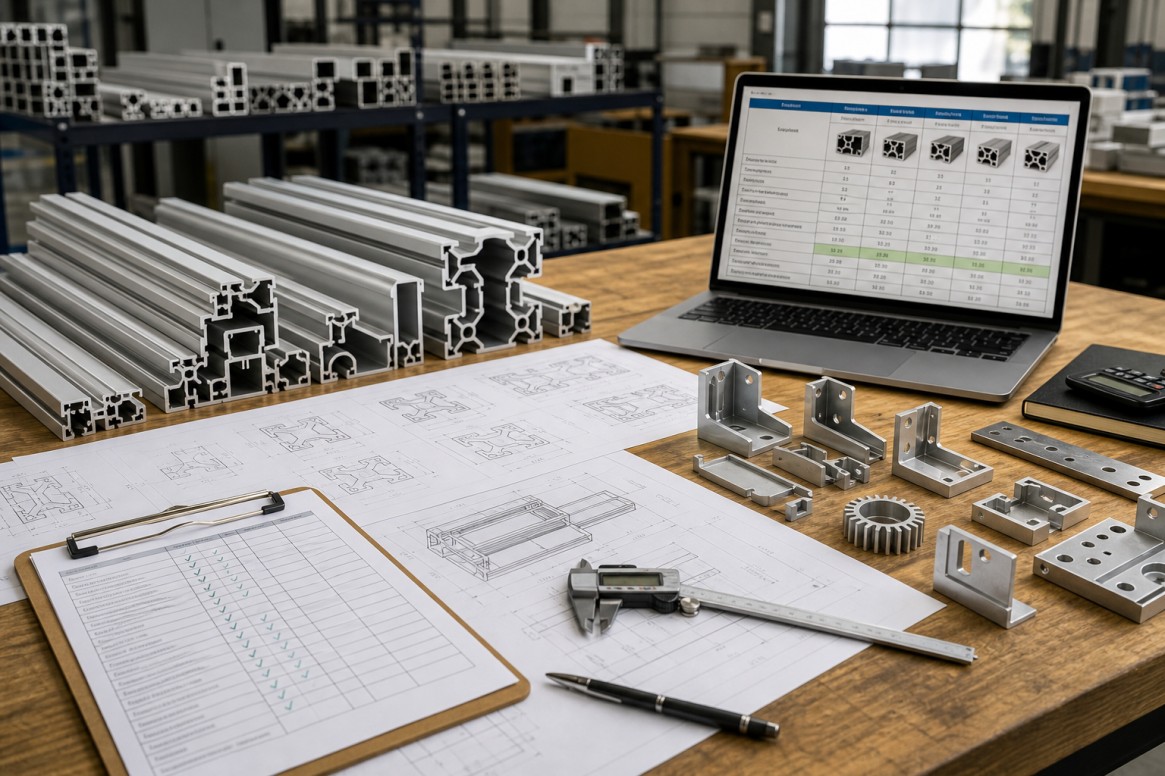
Quick Answer: What Makes a Good Custom Aluminum Extrusion Supplier?
A reliable custom aluminum extrusion supplier should be able to do more than produce a profile.
The supplier should help you:
- Review drawings before opening tooling
- Recommend the right alloy and temper
- Compare MOQ and bulk order cost
- Control extrusion tolerance and straightness
- Provide cutting, CNC machining and surface treatment support
- Pack long profiles safely for export
- Give transparent tooling and material cost
The best supplier is not always the one with the lowest first quote. It is the one that reduces total procurement risk.
1. Check Whether the Supplier Can Read Your Drawing Properly
A custom aluminum extrusion project begins with a drawing, not with a price list.
Before you compare suppliers, make sure the supplier can review:
- Cross-section geometry
- Wall thickness
- Hollow or solid structure
- Tolerance requirement
- Corner radius
- Surface finish
- Required length
- Alloy and temper
- Machining allowance
- Final application
Many problems happen when the profile is quoted before the drawing is technically reviewed. A thin wall, sharp corner or unrealistic tolerance may increase die cost, reduce production yield or cause quality issues during bulk production.
For example, a 6063-T5 decorative aluminum profile and a 6061-T6 industrial structural profile may look similar in a drawing, but they require different thinking in strength, machining, surface treatment and dimensional control.
Cymber can help buyers compare standard stock forms such as Extruded 6061 Aluminum Round Bar, Solid Extruded Aluminum Square Bar and Extruded Aluminum Rectangular Bar before recommending a new custom extrusion route.
2. Match Alloy and Temper to the Real Application
Aluminum extrusion buyers often ask for “6061” or “6063” first. That is a useful start, but it is not enough.
Different aluminum grades are used for different reasons:
| Alloy / Temper | Typical Strength | Common Use | Procurement Note |
|---|---|---|---|
| 6063-T5 / T6 | Medium | Architectural profiles, frames, decorative sections | Good extrudability and surface finish |
| 6061-T6 | Higher | Industrial structures, machinery frames, brackets | Better mechanical strength and machinability |
| 6082-T6 | Higher | Structural and transport parts | Strong option for load-bearing profiles |
| 7075-T6 / T651 | Very high | Aerospace, tooling, high-strength parts | Higher cost; not always suitable for simple extrusion |
| 5083 / 5052 | Good corrosion resistance | Marine, transport, welded structures | Better for plate/tube applications than some complex profiles |
If the end use is a machine frame, the buyer may need strength and machining stability. If the profile is a decorative rail, surface finish and anodizing behavior may matter more. If the part is for marine or transport use, corrosion resistance and fatigue behavior become important.
Cymber’s aluminum product family includes Structural 6061 Aluminum Plate, Structural 6061 Aluminum Tube and Large Diameter 6061 Aluminum Tube for buyers who need standard stock, cutting or machining alternatives before custom extrusion.
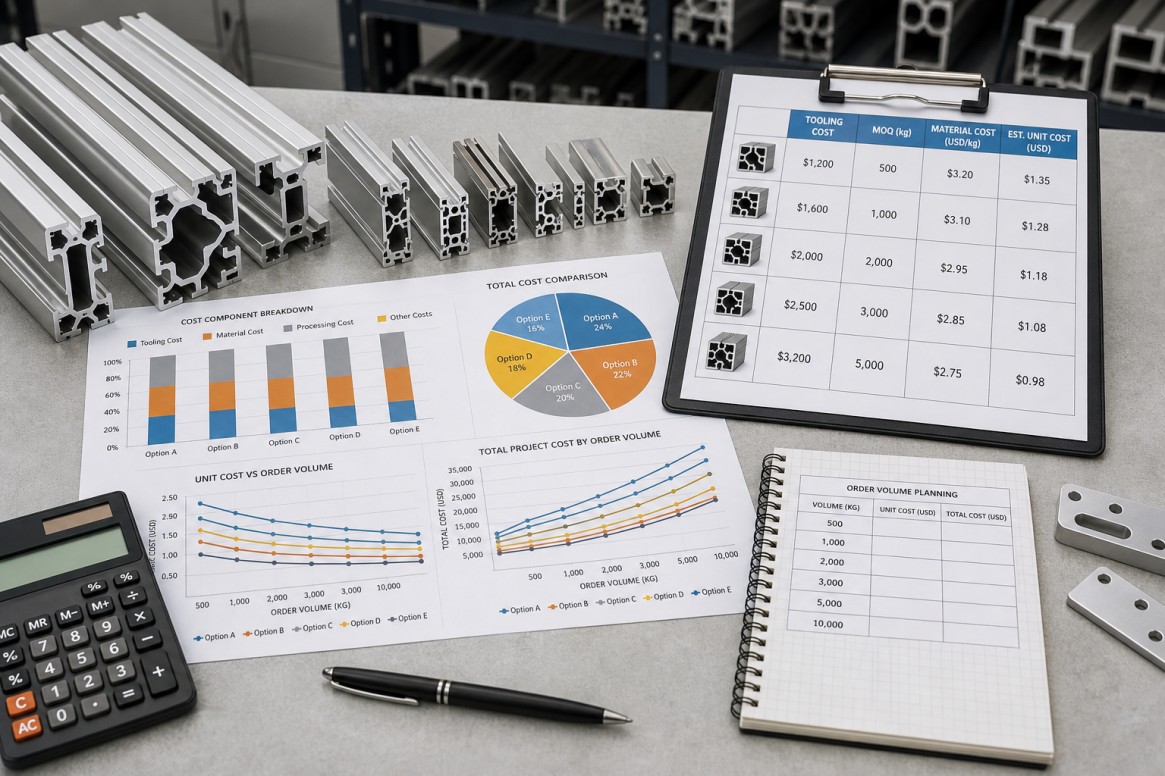
3. Understand Tooling Cost, MOQ and Bulk Order Economics
A custom aluminum extrusion profile usually requires a dedicated die. Tooling cost is not necessarily a problem, but it must be evaluated together with order volume.
The real question is not: “How much is the tooling cost?”
The better question is: “How much does tooling add to each usable meter or finished part?”
A simple formula:
Effective Unit Cost = (Tooling Cost + Material Cost + Processing Cost + Packing + Freight) / Usable Quantity
If the order volume is small, tooling cost can make the first batch expensive. If the project has stable annual demand, the tooling cost becomes much less important after it is spread across bulk quantity.
When Custom Aluminum Extrusion Makes Sense
Custom extrusion is usually a good choice when:
- The profile will be purchased repeatedly
- The shape reduces CNC machining time
- Material waste from solid bar machining would be high
- The cross-section is stable and well designed
- MOQ can be absorbed by the buyer’s project demand
When Standard Stock May Be Better First
For prototype or low-volume projects, buyers may reduce upfront risk by starting from standard stock.
For example:
- Round parts may start from aluminum round bar
- Square structures may start from aluminum square bar
- Hollow parts may start from aluminum tube
- Large structural parts may start from aluminum plate
This is why a supplier with multiple stock forms can give a more practical recommendation than a supplier who only wants to sell one production route.
4. Confirm Downstream Machining, Inspection and Export Support
A custom aluminum extrusion project does not end when the profile exits the press.
Many industrial buyers still require:
- Cut-to-length service
- CNC milling
- Drilling and tapping
- Slotting
- End-face machining
- Deburring
- Anodizing or surface finishing
- Dimensional inspection
- Export packing
- Material certificates
If a buyer sources extrusion from one supplier and machining from another, the total lead time and communication cost may increase.
Cymber’s CNC Machining Workshop supports downstream processing for custom metal parts, helping buyers move from material supply to usable components. For larger aluminum blanks or structural parts, Cymber can also support products such as Precision Forged Heavy Wall Aluminum Pipes, Aerospace-Grade Forged Thick Aluminum Sheets and Custom Cut Heavy Duty Aluminum Alloy Plates.
For bulk projects, warehouse and stock availability also matter. Cymber’s large-scale copper and aluminum warehouse helps support material matching, cutting preparation and export scheduling.
Supplier Evaluation Checklist for Custom Aluminum Extrusion
Before placing a bulk order, ask these questions:
| Checkpoint | Why It Matters |
|---|---|
| Can the supplier review the drawing before quoting? | Reduces tooling mistakes and unrealistic tolerance risk |
| Can they recommend alloy and temper? | Prevents over-specification or wrong material selection |
| Can they separate tooling cost and material cost? | Helps procurement calculate true unit cost |
| Can they support trial order and bulk order? | Reduces first-order risk |
| Can they provide cutting and CNC machining? | Reduces secondary supplier coordination |
| Can they handle export packing for long profiles? | Prevents profile bending and shipment damage |
| Can they provide certificates and inspection support? | Helps overseas buyers with quality documentation |
Why Cymber Metal Is Suitable for Custom Aluminum Extrusion Buyers
Cymber Metal is not only a material listing supplier. We support buyers through the full early-stage procurement process:
- Aluminum alloy selection
- Drawing review
- Stock form comparison
- Tooling and MOQ evaluation
- Cutting and machining support
- Bulk order preparation
- Export packing and documentation
- Factory-direct communication
For overseas procurement teams, this flexibility is important. Sometimes the best answer is custom extrusion. Sometimes the better first step is aluminum bar, tube or plate machining. Cymber helps buyers compare these routes before they spend tooling money.
What to Send for a 24-Hour Quote
To receive a fast and accurate quotation, send us:
- 2D or 3D drawing
- Alloy and temper requirement
- Profile length
- Tolerance requirement
- Surface finish
- Trial quantity
- Estimated annual quantity
- Final application
- Destination country or port, if freight estimate is needed
Once we receive your drawing, Cymber Metal can review the project and provide a transparent quotation including tooling cost, material cost, MOQ suggestion and recommended production route.
Final Takeaway
Choosing a custom aluminum extrusion supplier in 2026 is not just about finding the lowest unit price.
A good supplier should help you reduce tooling risk, choose the right alloy, calculate MOQ properly and confirm whether extrusion, stock machining or another route is more economical for your project.
If you are planning a bulk order for custom aluminum extrusion profiles, send your drawing to Cymber Metal. We can review the design and provide a transparent quotation within 24 hours.
Learn more about Cymber aluminum alloy materials: https://www.cymbermetal.com/aluminum-alloy/
FAQ
How do I choose a custom aluminum extrusion supplier?
Choose a supplier that can review drawings, recommend alloy and temper, separate tooling cost from material cost, support MOQ planning, and provide cutting or CNC machining after extrusion.
What affects aluminum extrusion tooling cost?
Tooling cost is affected by profile size, hollow or solid structure, wall thickness, tolerance, corner radius, die complexity and trial extrusion difficulty.
Is custom aluminum extrusion always cheaper than CNC machining from stock?
No. For small quantities or prototypes, machining from aluminum bar, tube or plate may be more economical. For repeated bulk orders, custom extrusion can reduce material waste and machining time.
What information is needed for a custom aluminum extrusion quote?
A supplier usually needs a 2D or 3D drawing, alloy and temper, length, tolerance, surface finish, trial quantity, annual demand and application.
Can Cymber provide both aluminum material and machining?
Yes. Cymber can support aluminum material supply, stock cutting, CNC machining, custom components and export packing for overseas buyers.
Ready to evaluate your custom aluminum extrusion supplier for 2026 bulk orders?
Send us your drawing and project details. We will provide a transparent comparison of tooling cost, MOQ, alloy recommendation and production route within 24 hours.
Download 2026 Custom Aluminum Extrusion Supplier Evaluation Guide (PDF)
Contact Us for Custom Aluminum Extrusion Quotation
Post time: Jun-18-2026