
I’ve turned and fitted more tin bronze parts than I can remember, and it always holds up impressively in slow, heavy, dirty jobs where other materials would seize or wear out quick. Classic tin bronzes like C90300 or C90500, with their 8-11% tin, give you that forgiving conformability, embeddability for grit, and natural low-friction surface that keeps things moving without constant oiling. It’s not the strongest or most corrosion-proof alloy out there, and it machines a bit slower than brass, but for high-load, low-speed bearings and gears, tin bronze has a track record that’s hard to argue with.
Let’s go over the parts we make most often, the industries that keep ordering them, how tin bronze stacks up against brass, aluminum bronze, and phosphor bronze, and the quiet but critical role it plays in keeping big operations running.
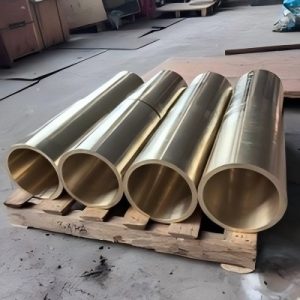
Tin bronze components in action – bushings, bearings, and wear parts built for punishing slow-speed service.
Common Parts We Machine from Tin Bronze
Tin bronze casts or extrudes well into shapes that take sliding wear:
- Bushings & Plain Bearings → Straight or flanged sleeves for pins and pivots – conform to shafts and embed dirt without scoring.
- Gears & Worm Wheels → Toothed or helical components for low-speed power transmission – quiet running and shock absorption.
- Wear Plates & Thrust Washers → Flat strips or rings for sliding surfaces – spread massive loads in crushers or presses.
- Nuts & Screw Components → Leaded versions for adjusters or feeds – self-lubricating threads that don’t gall.
- Valve Seats & Pump Liners → Rings or cylinders for fluid control – handle mild corrosives with low friction.
We turn out plenty of these, like our tin bronze bushings, gears, and wear parts – often with grooving or graphite plugs for extra lubrication.
Industries That Keep Coming Back
Tin bronze is a mainstay in gritty, high-load environments:
- Mining & aggregates (crusher eccentrics, conveyor bearings)
- Oil & gas (mud pump liners, drilling gear)
- Marine (stern tube bearings, rudder stock bushings)
- Steel & cement mills (rolling mill guides, kiln trunnions)
- Heavy construction (excavator joints, crane sheaves)
Anywhere slow speeds meet big pressures and occasional dirt.
How Tin Bronze Compares to Brass, Aluminum Bronze, and Phosphor Bronze
Brass (C36000 or similar) machines faster and cheaper, with good corrosion resistance for lighter duty – but it’s softer, wears quicker under heavy loads, and can’t take the same shock without deforming. Aluminum bronze (C95400/C95500) brings higher strength and superb seawater resistance, but it’s less forgiving with dirt (doesn’t embed particles as well) and can gall more easily in marginal lubrication. Phosphor bronze (C51000/C52100) excels at springiness and fatigue for light, high-cycle parts, but lacks the load capacity and conformability for true heavy sliding bearings.
Tin bronze’s sweet spot: superior embeddability for contaminated lube, low friction without additives, and good shock absorption – all at reasonable cost. Drawback is lower strength than aluminum bronze and slower machining than brass.
For classic high-load, low-speed service with imperfect lubrication, tin bronze often outlasts the alternatives with less maintenance.
The Bigger Role in Global Operations
Tin bronze parts don’t grab headlines, but they enable some essential heavy lifting:
- Keep extraction and processing equipment running reliably – supporting supply of metals, minerals, and energy the world needs
- Minimize unplanned stops in remote or high-output sites – saving huge on downtime and logistics
- Allow simpler lubrication systems – cutting fluid use and environmental impact in big plants
- Provide proven, recyclable components for core infrastructure
They’re the unsung heroes that let massive machines operate efficiently day after day.
If you’ve got a bearing or gear eating itself too fast, take a look at our tin bronze heavy machinery parts or send your drawing – we’ve upgraded plenty of setups that were wearing out softer materials.
Tin bronze might feel old-school, but it still solves problems nothing newer matches perfectly.
Post time: Jan-21-2026