
Publication Date: July 10, 2026
Author: Hu Yanwei, Cymber Metal Technical Expert
Quick Answer
The MOQ and price of custom brass extrusion profiles depend on more than the total order weight. Suppliers normally evaluate the brass grade, cross-sectional area, profile complexity, billet size, extrusion yield, die structure, tolerance, straightness, length, surface finish and secondary machining requirements. Tooling cost is usually charged separately for a new profile, while the bulk unit price is calculated from material cost, metal utilization, extrusion difficulty, processing, inspection and packing. Buyers can reduce sourcing risk by submitting a complete 2D drawing, 3D model, alloy requirement, annual demand and acceptable tolerance before requesting a quotation.
Why Custom Brass Extrusion Pricing Is Often Misunderstood
A standard brass bar or tube can usually be quoted from an existing size table. A custom extrusion is different because the supplier must first determine whether the profile can be extruded consistently and whether a new die is required.
Two profiles with the same weight per meter may have very different production costs. A simple solid rectangular section may be straightforward, while a thin-wall hollow profile with deep grooves, uneven wall thickness or tight corner radii may require a more complex die, more trials and a lower production yield.
Buyers evaluating custom brass special-shape extrusions should therefore compare the full manufacturing route, not only the quoted price per kilogram.
What Are Custom Brass Extrusion Profiles?
Custom brass extrusion profiles are produced by forcing a heated brass billet through a specially designed die. The die creates a continuous profile with the required cross-section, which can then be straightened, cut, drawn, machined, polished or surface-treated.
Common profile forms include:
- Solid flat, square, rectangular and shaped sections
- Hollow brass profiles
- Channels, tracks and guide sections
- Architectural trim and decorative profiles
- Electrical and mechanical contact profiles
- Profiles with grooves, ribs, slots or mounting features
- Near-net-shape blanks for CNC-machined parts
Compared with machining a complex shape entirely from a large brass bar, extrusion can reduce material removal and machining time when the order volume is sufficient.
CYMBER Metal supplies extruded brass profiles and brass alloy products for industrial, architectural, electrical and custom-machined applications.
What Determines the MOQ for Custom Brass Extrusion Profiles?
There is no universal MOQ for every custom brass extrusion. The supplier normally calculates the minimum economical batch from several production factors.
1. Billet and Extrusion Press Requirements
The profile size and cross-sectional area determine the billet diameter and suitable extrusion press. A production run must use enough billet material to cover press setup, billet ends, trial material, crop loss and stable extrusion length.
A very small order may be technically possible but economically inefficient because the setup loss is distributed across too few finished kilograms.
2. Brass Grade Availability
Common grades may be easier to schedule than uncommon or project-specific alloys. If a supplier already has a suitable brass billet in stock, the initial quantity may be more flexible.
If the requested grade requires a dedicated melt or special billet, the practical MOQ can increase significantly.
3. Profile Weight Per Meter
A heavy profile reaches a production MOQ with fewer meters. A lightweight, thin-wall profile may require a much longer extrusion length to reach the same total weight.
That is why buyers should provide both the required quantity in pieces and the expected annual usage.
4. Die Trial and Process Stability
A new die normally requires trial extrusion. The supplier may need to adjust die dimensions, metal flow or process parameters before producing acceptable profiles.
Complex shapes may consume more trial material, increasing the economical first-order quantity.
5. Secondary Processing
Cutting, drilling, milling, polishing, plating and individual packing can create separate batch requirements. The extrusion MOQ and the finished-parts MOQ are not always the same.
| MOQ factor | Why it affects the order | Information buyers should provide |
|---|---|---|
| Brass grade | Determines billet availability | Grade or approved alternatives |
| Cross-section | Determines press and die requirements | Dimensioned 2D drawing |
| Weight per meter | Affects total production length | Calculated or estimated weight |
| Profile complexity | Affects trial loss and extrusion yield | 3D model and critical features |
| Order length | Affects cutting and straightening | Piece length and tolerance |
| Secondary operations | Creates additional setup requirements | Complete process list |
| Annual demand | Helps amortize tooling and setup | Forecast by month or year |
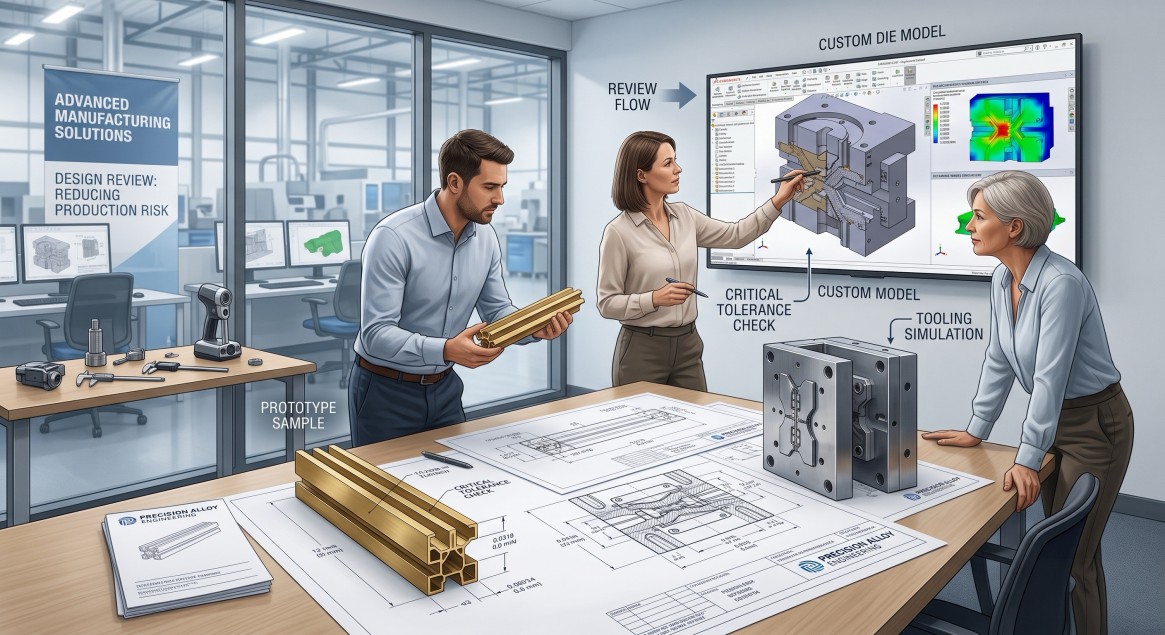
How Is Brass Extrusion Tooling Cost Calculated?
Tooling cost is the charge for designing, manufacturing and preparing the extrusion die. It should not be confused with the material cost of the bulk order.
Simple Solid Profiles
Solid profiles with balanced wall distribution and generous corner radii usually require simpler tooling. Die production and trial adjustment are generally more predictable.
Examples include simple bars, flats, channels and uncomplicated decorative sections.
Hollow and Semi-Hollow Profiles
Hollow profiles require more complex metal-flow control. Tool design must create the internal cavity while maintaining wall thickness and dimensional stability.
The tooling cost and trial risk are therefore normally higher than for a comparable solid profile.
Complex Asymmetrical Profiles
Profiles with deep slots, thin tongues, uneven mass distribution or several critical dimensions can experience twisting, bending or uneven metal flow.
These profiles may require more engineering work, die correction and trial extrusion.
Die Cost Is Not the Entire Development Cost
Before approving a new die, buyers should ask whether the quotation includes:
- Die design and manufacturing
- Initial trial extrusion
- Die correction
- First-article samples
- Sample cutting or machining
- Inspection report
- Tool maintenance
- Tool ownership
- Storage period
- Replacement conditions
A low tooling quotation may not include all these items. The buyer should compare the complete development scope.
| Tooling element | Typical purpose | Buyer question |
|---|---|---|
| Die design | Controls profile geometry and metal flow | Is design review included? |
| Die manufacturing | Produces the physical extrusion tool | Is this a new dedicated die? |
| Trial extrusion | Verifies profile feasibility | How much trial material is included? |
| Die correction | Adjusts dimensions and metal flow | Are correction rounds included? |
| First-article sample | Confirms the approved profile | How many samples will be supplied? |
| Tool maintenance | Maintains production consistency | Who pays for normal maintenance? |
| Tool ownership | Defines future production rights | Does the buyer own the tooling? |
| Tool storage | Keeps the die for repeat orders | How long will it be retained? |
Can Tooling Cost Be Reduced?
Tooling cost should be controlled through better design and clearer requirements, not by selecting the cheapest die without reviewing production risk.
Simplify the Profile Where Function Allows
Reducing unnecessary grooves, extremely thin walls, deep cavities or sharp internal corners can make the die easier to manufacture and stabilize.
A small design change may improve extrusion yield and save more money during bulk production than it saves on the initial tooling charge.
Separate Extrusion Features from Machined Features
Not every feature needs to be formed in the extrusion die. A slot, hole, thread or local precision surface may be more economical to produce later by CNC machining.
CYMBER Metal’s CNC precision machining workshop can support cutting, drilling, milling and custom finishing when an extruded blank requires additional processing.
Review Tolerances Before Opening the Die
If every dimension is marked with a tight tolerance, tooling and process-control costs can rise unnecessarily. Buyers should identify which dimensions affect assembly, sealing, contact or appearance and allow commercial tolerances elsewhere.
Use Annual Demand to Evaluate Tooling Amortization
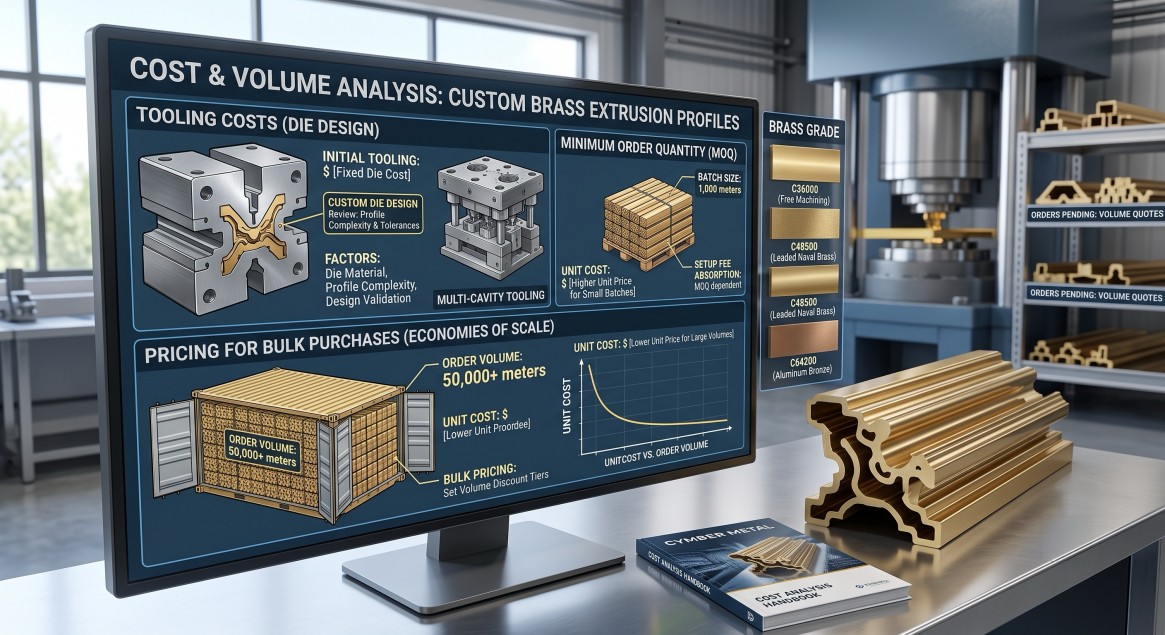
A die that seems expensive for a small trial order may be economical across repeated production. Buyers should compare tooling cost per part over the expected program volume.
The basic calculation is:
Tooling cost per part = Total tooling cost / Expected production quantityFor example, the same die charge has a very different impact across 500 pieces and 50,000 pieces. The exact tooling amount still depends on the actual drawing and production route.
How Is Bulk Order Pricing Calculated?
The final price of custom brass extrusion profiles is usually built from several cost layers.
Bulk price =
brass material cost
+ extrusion conversion cost
+ yield loss
+ straightening and cutting
+ secondary processing
+ inspection
+ packing
+ tooling allocation, if applicable
Brass Material Cost
Brass grade and metal market conditions affect the raw material portion of the quotation. Copper and zinc content, billet source and alloy availability can all influence cost.
The quotation should state whether the material price is fixed for a validity period or subject to recalculation when the order is confirmed.
Profile Weight
The supplier may calculate pricing by theoretical weight, actual finished weight or input billet weight. Buyers should ask which method is being used.
For long-term orders, an approved weight-per-meter value helps both parties compare quantities and control material cost.
Extrusion Yield
Not all billet material becomes acceptable finished profile. Billet ends, trial material, crop loss, straightening allowance and rejected sections affect metal utilization.
Complex or tight-tolerance profiles may have lower yields and higher conversion costs.
Cutting and Length Tolerance
Random mill lengths are normally easier to produce than many short, precisely cut pieces. Fixed-length cutting creates labor, equipment time, kerf loss and inspection requirements.
Surface Finish
Mill finish, brushing, polishing, deburring, coating and protective film have different costs. Decorative profiles may require tighter visual standards than internal industrial components.
Secondary Machining
Drilling, milling, tapping, countersinking and CNC finishing can turn an extrusion into a ready-to-assemble component. Buyers should clarify whether the quotation is for raw profiles or completed parts.
| Pricing factor | Lower-cost condition | Higher-cost condition |
|---|---|---|
| Profile design | Simple, balanced solid section | Hollow, thin-wall or asymmetrical section |
| Brass grade | Commonly available alloy | Special or dedicated alloy |
| Tolerance | Commercial extrusion tolerance | Multiple critical tight tolerances |
| Length | Standard or random length | Short fixed lengths with tight tolerance |
| Surface | Mill finish | Polished or appearance-controlled finish |
| Processing | Raw extrusion only | CNC machining and multiple operations |
| Inspection | Standard dimensional checks | Full report or third-party inspection |
| Packing | Standard bundles | Individual protection or export cases |
Why Price per Kilogram Can Be Misleading
A low price per kilogram may exclude tooling, machining, inspection, packing or yield loss. It may also refer to a different tolerance or surface requirement.
When comparing suppliers, buyers should normalize the quotations by checking:
- Whether the same brass grade is quoted
- Whether tooling is included or separate
- Whether the same dimensions and tolerances are accepted
- Whether the price is for mill lengths or cut pieces
- Whether secondary machining is included
- Whether inspection reports are included
- Whether packing meets the export requirement
- Whether metal-price adjustment terms are stated
The correct comparison is total landed and usable-part cost, not only the extrusion price per kilogram.
Sample Orders vs Bulk Orders
A first-article order is mainly used to verify the die and profile. It should not be expected to have the same unit price as a stable repeat order.
| Order stage | Main objective | Typical cost characteristics |
|---|---|---|
| Drawing review | Confirm manufacturability | Engineering assessment |
| Tooling order | Produce the dedicated die | One-time development cost |
| Trial extrusion | Verify metal flow and dimensions | High setup cost per kilogram |
| First-article samples | Obtain buyer approval | Inspection and possible corrections |
| Pilot batch | Verify assembly and production | Moderate volume, higher unit cost |
| Bulk production | Achieve stable repeat output | Better setup and material utilization |
| Repeat order | Reuse approved die and process | No new tooling unless changes occur |
Buyers should not skip first-article approval for a complex profile simply to reduce lead time. A controlled sample stage can prevent a much larger loss during bulk production.
What Should Be Included in a Brass Extrusion RFQ?
A complete RFQ allows the supplier to review feasibility and provide a quotation with fewer assumptions.
Required Technical Information
- Fully dimensioned 2D drawing
- 3D model where available
- Brass grade
- Profile type: solid, hollow or semi-hollow
- Critical dimensions and tolerances
- Straightness and twist requirements
- Cut length and length tolerance
- Surface finish
- Secondary machining
- Inspection and documentation requirements
- Packing method
Required Commercial Information
- Trial quantity
- First bulk-order quantity
- Annual forecast
- Delivery location
- Required delivery date
- Tool ownership expectations
- Quotation currency
- Price-validity requirement
A buyer can send the following request:
Please quote the new extrusion tooling separately from the profile production.

The quotation should identify the brass grade, profile weight per meter, extrusion MOQ, trial quantity, bulk price, die lead time, sample lead time, mass-production lead time, included die corrections, inspection documents and export packing.
Questions to Ask Before Paying for a New Die
Before opening a new extrusion die, buyers should ask:
- Has the supplier reviewed the drawing for extrusion feasibility?
- Are the tolerances achievable in extrusion, or is machining required?
- Is the quoted die solid, hollow or multi-part tooling?
- How many die corrections are included?
- Who owns the die after payment?
- Can the die be used only for this buyer’s orders?
- How long will it be stored?
- What happens if the first sample does not meet the approved drawing?
- Is a new die required if the drawing changes?
- Will a dimensional report accompany the sample?
These points should be agreed in writing before tooling production begins.
Inspection Before Bulk Shipment
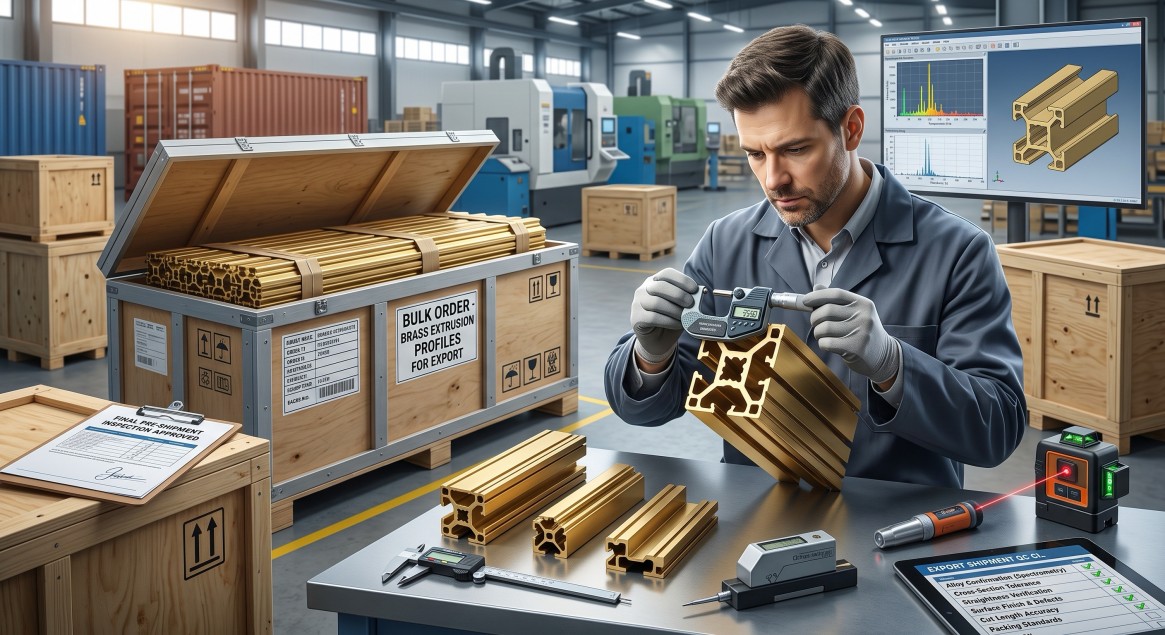
Custom profiles should be checked against the approved drawing and first-article sample.
Important inspection items include:
| Inspection item | What to verify |
|---|---|
| Alloy confirmation | Grade, chemistry and certificate |
| Cross-section | Critical dimensions and wall thickness |
| Weight per meter | Material consistency and pricing basis |
| Straightness | Suitability for assembly and machining |
| Twist | Alignment along the profile length |
| Cut length | Piece length and end squareness |
| Surface | Scratches, dents, die lines and oxidation |
| Machined features | Hole position, thread and milled dimensions |
| Packing | Protection from impact, moisture and deformation |
| Traceability | Batch, heat and order identification |
For orders requiring further machining, inspection should distinguish between extrusion tolerances and final machined tolerances.
Why Buyers Work With CYMBER Metal
CYMBER Metal supplies brass, copper, bronze, CuCrZr, aluminum alloy and custom-machined metal products for international industrial buyers.
For custom brass extrusion projects, support can include:
- Brass grade and profile-form review
- Extrusion manufacturability discussion
- New tooling and first-article coordination
- Custom cutting
- CNC secondary machining
- Dimensional inspection
- Export packing
- Repeat bulk-order support
Buyers can also review CYMBER Metal’s brass product range and fine machining capabilities when an extruded profile must be supplied as a finished component.
Conclusion
MOQ, tooling cost and bulk order pricing for custom brass extrusion profiles cannot be judged from profile weight alone. Grade availability, cross-sectional design, die complexity, production yield, tolerance, length, surface finish, machining and inspection all affect the quotation.
The most effective way to control cost is to involve the supplier before the drawing is frozen. A manufacturability review can identify which features should be extruded, which should be machined and which tolerances can be adjusted without affecting function.
Before placing an order, request separate values for tooling, trial samples and bulk production. Confirm tool ownership, die corrections, inspection scope and packing in writing. Buyers with a new profile drawing can submit the specifications through the CYMBER Metal contact page for technical review and quotation.
FAQ
What is the typical MOQ for custom brass extrusion profiles?
There is no single standard MOQ. It depends on brass grade, profile weight, press setup, billet availability, die trials, production yield and secondary processing. Suppliers should calculate the MOQ after reviewing the drawing and expected annual demand.
Is tooling cost included in the brass profile price?
Tooling is commonly quoted separately for a new custom profile. Buyers should confirm whether die design, trial extrusion, corrections, samples, maintenance and storage are included.
Can the tooling cost be refunded after a large order?
This depends on the commercial agreement. Some suppliers may amortize or credit tooling under an agreed production volume, while others keep it as a separate development charge. The condition should be written into the quotation or purchase contract.
Who owns the brass extrusion die?
Ownership depends on the tooling agreement. Paying a tooling charge does not automatically clarify storage, exclusivity or transfer rights. Buyers should confirm ownership and permitted use before payment.
Why is the sample price higher than the bulk price?
Trial extrusion has setup, die-testing, material-loss, cutting and inspection costs distributed across a small quantity. Stable bulk production normally uses material and machine time more efficiently.
Can a custom brass extrusion be supplied as a finished part?
Yes. Profiles can be cut, drilled, milled, tapped, polished or otherwise processed after extrusion. Buyers should specify final dimensions, tolerances, surface requirements and inspection needs in the RFQ.
What files should buyers provide for quotation?
A dimensioned 2D drawing is essential. A 3D model, brass grade, trial quantity, annual demand, critical tolerances, surface finish, machining requirements and packing instructions will improve quotation accuracy.
Post time: Jul-10-2026