
I’ve machined gears from all sorts of materials over the years, and bronze alloys always have a place when you need quiet running, corrosion resistance, or good conformability under load. They’re not the go-to for every gear – steel dominates for high power and durability – but in precision, low-speed, or harsh environments, brasses and bronzes like yellow brass, aluminum bronze, tin bronze, and phosphor bronze keep things turning smoothly without the noise or wear issues you’d get from harder metals. With global machinery pushing for longer life and less maintenance, these alloys fill important niches that keep specialized equipment reliable.
Here’s my shop-floor perspective on the gear parts we produce, the industries that spec them, how these bronzes compare to common alternatives, and the real value they bring to global operations.
Bronze gear components – worm wheels, spur gears, and custom machined parts for smooth, reliable transmission.
Common Gear Forms from Bronze Alloys
Bronzes machine well into precise tooth profiles:
- Worm Wheels & Helical Gears → Often tin or phosphor bronze for mating with steel worms – excellent conformability and low friction.
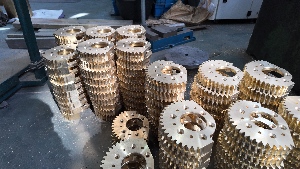
- Spur & Bevel Gears → Brass or aluminum bronze for moderate loads – quiet operation and good shock absorption.
- Pinion Gears & Small Transmissions → Phosphor or yellow brass – springy with decent wear for light duty.
- Custom Tooth Profiles → Any of the four for specialized ratios – easy to hob or shape with fine finishes.
We run these regularly, like our brass gears, aluminum bronze gears, tin bronze worm wheels, and phosphor bronze pinions – finished with precision CNC hobbing for accurate meshing.
Industries That Specify Bronze Gears
These alloys fit where steel would be overkill or problematic:
- Food & pharmaceutical processing (non-contaminating, corrosion-resistant)
- Marine & pump systems (seawater-compatible drives)
- Instrumentation & robotics (quiet, precise low-speed transmission)
- Textile & printing machinery (smooth, low-vibration running)
- Conveyor & material handling (moderate loads with dirt tolerance)
Places needing reliable meshing without constant lubrication or noise.
How These Bronzes Compare to Alternatives
Steel gears (carbon or alloy) rule high-power apps with top strength and wear life – but they’re noisy, heavier, and can rust or spark in sensitive environments. Plastic/nylon gears are lightweight and quiet with zero corrosion – but melt under heat, wear fast under load, and lack strength for anything serious. Cast iron offers good damping and embeddability – but it’s brittle, heavy, and corrodes easily.
Yellow brass machines fastest with good corrosion for light gears – but softer, wears quicker than bronzes under load. Aluminum bronze brings high strength and cavitation resistance – great for tough conditions but pricier and harder on tools. Tin bronze excels at heavy, slow sliding with embeddability – forgiving in dirty lube but lower strength overall. Phosphor bronze adds springiness for light, high-cycle pinions – fatigue-resistant but not for brute force.
Bronze gears’ edge: quiet operation, self-lubricating tendencies, and corrosion tolerance – ideal for precision or harsh settings. Trade-offs are higher cost and lower load capacity vs steel.
For low-to-moderate power where noise, corrosion, or conformability matters, bronzes often outlast expectations with less fuss.
The Broader Role in Global Machinery
Bronze gears support key precision functions:
- Enable hygienic, reliable drives in food/pharma processing – backing global supply chains
- Provide durable transmission in marine/pump systems – supporting energy and trade
- Keep instrumentation and robotics accurate – advancing automation and tech
- Reduce noise/vibration in everyday machinery – improving worker environments worldwide
They’re niche but vital for specialized, long-life performance in demanding sectors.
If you’ve got a gear setup that’s noisy or wearing prematurely, check our bronze gear components or send your specs – we’ve quieted down plenty of transmissions that steel just couldn’t handle gracefully.
Bronze gears aren’t for every application, but in the right spot, they run smooth and true for years.
Post time: Jan-22-2026