
I’ve spent more hours than I care to admit machining brass parts for big equipment, and it always feels like the material that just cooperates – cuts clean, finishes nice, and doesn’t fight you on the toolpath. Common brasses like C36000 free-cutting or C38500 architectural give you decent strength, good corrosion resistance in mild environments, and that unbeatable machinability that keeps cycle times short. It’s not the toughest for extreme wear or seawater, but for fittings, valves, and hardware in heavy machinery where you need quick production and reliable performance without exotic costs, brass gets specified a lot.
Here’s my shop-floor view on the parts we run most, the industries that order them steadily, how brass compares to phosphor, aluminum, and tin bronze, and the practical role it plays in keeping global manufacturing humming.
Brass machined components for heavy equipment – fittings, valves, bushings, and hardware that machine fast and perform reliably.
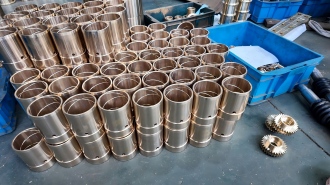
Parts We Machine Most from Brass
Brass extrudes or draws into shapes that fly off the machines:
- Fittings & Connectors → Elbows, tees, reducers – threaded or compression for fluid/power lines.
- Valves & Bodies → Gate, ball, or check valve components – easy threading and sealing surfaces.
- Bushings & Sleeves → Plain or shouldered for lighter pivots – good fit with steel shafts.
- Nuts & Fasteners → Hex or lock nuts, bolts – high-volume turning with clean threads.
- Gears & Small Transmission Parts → Spur or worm gears for moderate loads – quiet and smooth.
We run these daily, like our brass fittings, valves, and bushings – often straight to CNC for custom features.
Industries That Order Steady Volumes
Brass fits well in cost-conscious, high-production heavy setups:
- Construction & earthmoving (hydraulic fittings, control hardware)
- Agricultural machinery (tractor valves, implement connectors)
- Automotive & truck (brake lines, fuel fittings)
- General manufacturing (conveyor hardware, pump components)
- Mining support equipment (lighter-duty pneumatics, controls)
Places where parts need to be made fast, in volume, and hold up to moderate abuse.
How Brass Compares to Phosphor, Aluminum, and Tin Bronze
Phosphor bronze brings killer springiness and fatigue life for contacts or light flex – but it’s pricier, slower to machine, and overkill for static fittings. Aluminum bronze dominates extreme corrosion and high-strength wear – but tools hate it, costs jump, and it’s less forgiving on threads. Tin bronze rules heavy, slow sliding with embeddability and low friction – but chips gummy, wears tools faster, and lacks brass’s speed on multi-spindle lines.
Brass’s clear wins: fastest machining (chip control is dreamy), lowest tool wear/cost, good corrosion in dry/mild wet, and attractive finish if visible. Downsides are softer wear life under heavy sliding and weaker in aggressive corrosives compared to aluminum or tin bronze.
For threaded fittings, valves, or hardware needing quick production and decent service without extreme demands, brass often comes out most economical.
The Practical Role in Global Manufacturing
Brass parts keep things affordable and fast:
- Enable high-volume production of reliable hardware – supporting efficient assembly in factories worldwide
- Lower barriers for smaller shops or developing markets – machinable without fancy tooling
- Contribute to recyclable, durable components in everyday heavy equipment – aiding sustainability in construction/agriculture
- Fill the gap for cost-effective alternatives to pricier alloys – keeping projects on budget
They’re the everyday enablers that let heavy industry scale without breaking the bank.
If you’ve got a fitting or valve run that’s eating tools or time, take a look at our brass heavy machinery components or send over your print – we’ve switched plenty to brass for smoother runs.
Brass might not be the hero alloy for extremes, but for practical, high-output work, it’s hard to beat.
Post time: Jan-21-2026